First Seen
2023-05-10T21:03:43+00:00
simple-description (qwen3.5_2b-q8_0)
The "Dark Papes" meme features a person reading "PAPES" in a mirror while the text "PAPES!" appears on screen. This category is defined by a dark, often green color palette, which fits the image of discarded electronic waste found in the photo. The visible text includes labels on the circuit boards and a sticker in the bottom left corner that reads "Good...".
simple-description (llama3.2-vision_11b)
The meme appears to be a screenshot of a computer screen displaying a "Blue Screen of Death" (BSoD) error message, with a caption "Papes - Dark" written in a bold, pixelated font. The image is a humorous take on the classic Windows error message, implying that even the operating system's own code is "dark" and unstable. The meme is likely referencing the frustration of dealing with a malfunctioning computer, and the "Papes - Dark" caption is a tongue-in-cheek reference to the idea that even the most basic computer code can be "dark" and unstable.
detailed-analysis (gemma3-27b-vision)
Okay, let's analyze the image provided through the lenses of various critical theories. This is a compelling image ripe for such analysis!
1. Visual Description
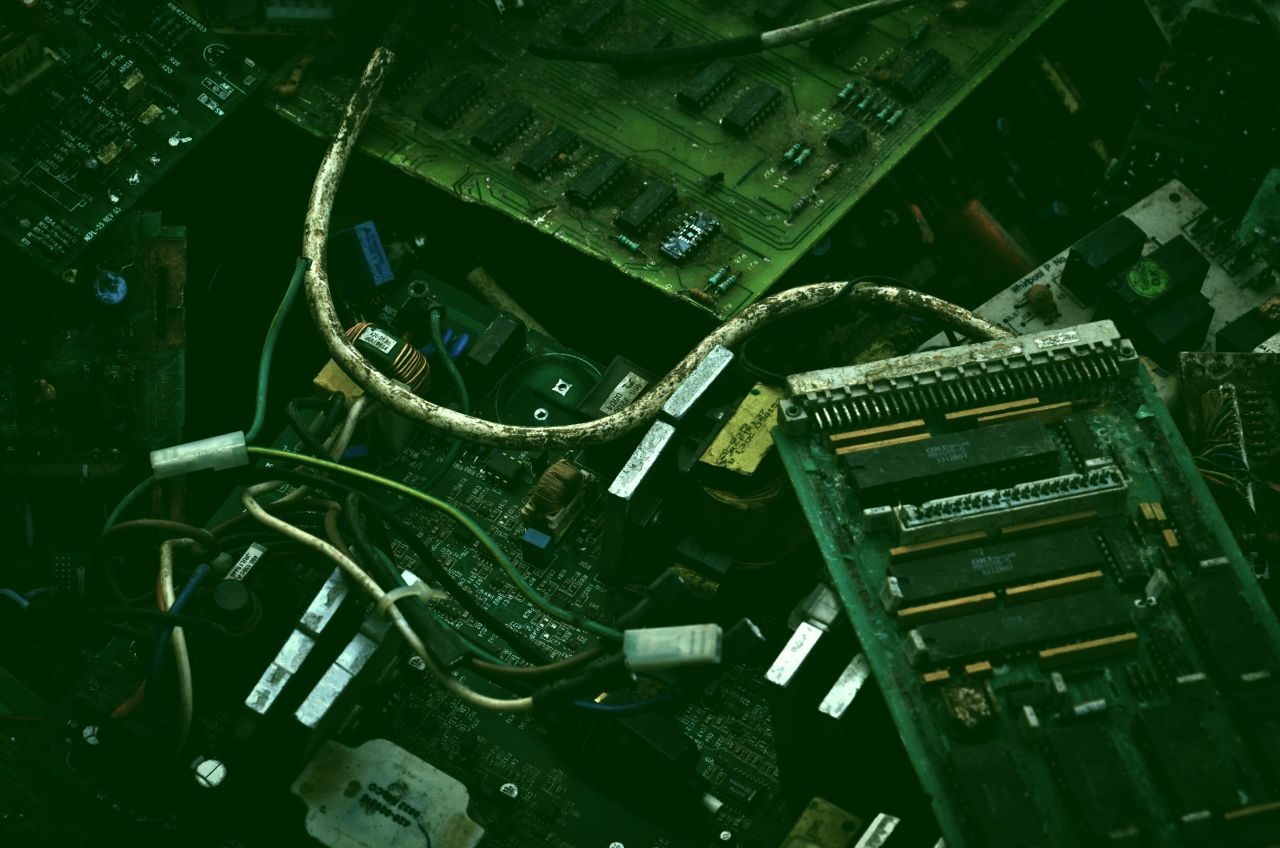
The image presents a top-down, close-up view of electronic waste (e-waste). It's a chaotic and dense composition primarily consisting of circuit boards, wires, and various electronic components. The color palette is overwhelmingly dark, dominated by greens and blacks, which contributes to a sense of decay, obsolescence, and perhaps even toxicity.
- Texture: The textures are complex: shiny metal, corroded plastic, the intricate patterns of the circuit boards, and tangled wires.
- Composition: The arrangement is not organized; it’s a jumbled pile suggesting disuse, disposal, and the aftermath of rapid technological advancement. The arrangement appears organic, like a nest or a snake.
- Lighting: The lighting is somewhat flat and diffused, creating harsh contrasts. This emphasizes the surface detail of the components, making them appear more visceral and less 'clean'.
2. Foucauldian Genealogical Discourse Analysis
This image provides fertile ground for a Foucault-inspired analysis. We can trace a genealogy of technological power/knowledge relations.
- Discourse of Progress: The sheer volume of discarded components speaks to a dominant discourse of technological “progress” – a relentless drive for newer, faster, and more advanced technologies. This image is the dark side of that discourse: the hidden cost of that progress.
- Power/Knowledge: The obsolescence inherent in e-waste is not simply about failing technology. It's a manifestation of power structures. The corporations that design and manufacture these devices exert control through planned obsolescence, encouraging constant upgrades and creating a cycle of waste. The very categorization of what is considered 'new' versus 'old' is a power move.
- Archaeology of the Technology: A genealogical approach would ask how the knowledge that created these components was constructed. How did this circuit board come to be understood as a solution? What social and historical conditions allowed for its creation and subsequent discarding?
- Disciplinary Practices: The design of technology often implicitly (or explicitly) disciplines its users, compelling certain behaviors and forms of interaction. Discarded technology is a remnant of that disciplinary power.
3. Critical Theory
This image aligns closely with themes within Critical Theory, particularly those related to commodification and the culture industry.
- Commodification: The electronics are ultimately commodities – objects created for exchange and profit. Their discard highlights the inherent instability of commodification. They are valuable only while useful (or perceived as useful), and are quickly rendered worthless by the next iteration.
- Alienation: The image could be seen as symbolic of alienation – a key concept in Marxist thought. Humans become alienated from the products of their labor, as these objects are created for a market, not for human need or fulfillment. The discarded state further emphasizes this separation.
- Mass Culture: The ease with which we discard electronics speaks to a consumer culture driven by novelty and planned obsolescence. The image stands as a symptom of a broader system of manipulation and control via consumerism.
4. Marxist Conflict Theory
The image directly embodies elements of class conflict and the exploitation inherent in capitalist production.
- Labor Exploitation: The creation of these components relies on a global system of labor, often in conditions of exploitation. The image represents the externalized costs of production – the environmental and human toll that is hidden from the consumer.
- Capital Accumulation: The cycle of upgrading electronics is driven by the need for capital accumulation. Corporations benefit from constant consumption, while the environmental and social costs are often borne by marginalized communities.
- Class Inequality: The e-waste often ends up in developing countries, where it is processed by workers with limited safety protections and exposing them to harmful toxins. This demonstrates a clear global class disparity in bearing the burden of technological progress.
5. Postmodernism
The image fits well into a postmodern interpretation, particularly around themes of simulacra, hyperreality, and fragmentation.
- Simulacra & Hyperreality: The discarded components are remnants of a technologically driven “reality” that has become increasingly simulated. We are surrounded by artificial experiences and objects, and the line between the real and the artificial has blurred.
- Fragmentation: The chaotic arrangement of the components reflects a broader postmodern condition of fragmentation – the breakdown of traditional structures and narratives.
- Deconstruction of Progress: Postmodern thought challenges the idea of linear progress. The image is a visible dismantling of the notion that technology always leads to improvement.
6. Queer Feminist Intersectional Analysis
While seemingly unrelated, this image can be explored through a Queer Feminist Intersectional lens.
- Environmental Justice: The disproportionate impact of e-waste on marginalized communities (often women and people of color) highlights the intersection of environmental degradation and social inequality.
- Toxic Feminism: The toxins contained in e-waste disproportionately impact women's reproductive health. The image speaks to a "toxic feminism," where technological progress contributes to the harm of women's bodies.
- Disposability & Value: The image of discarded objects mirrors the disposability of bodies – the ways in which certain bodies are deemed less valuable and are therefore more vulnerable to exploitation and harm.
- Reframing Waste: The image can be a point of reclamation, questioning what is considered ‘waste’ and who bears the burden of it. Feminist artists often repurpose discarded materials, challenging notions of value and redefining aesthetics.
In conclusion, this image is a complex and multilayered representation of contemporary society. It encapsulates themes of power, exploitation, environmental degradation, and the challenges of a technologically driven world. It's a powerful visual prompt for engaging with critical theory and understanding the hidden costs of “progress.”
simple-description (llama3.2-vision)
The meme is a photo of a computer motherboard with wires and components severely damaged by water, likely due to a flood or other water-related disaster. The image is captioned "When you're trying to save your gaming PC but it's just too salty".
tesseract-ocr
“ ey S 3 x fa Pe ep tf ao TS 7 Ne oe es ae iy ay . s S ’ og Mo é 2 ry i 7 ee ee A ee é 8 4 CS Pn Sh eo “ & : 4 aa od re od RG a Lilia ele Ye, wo: rd <<} ; 4 rN Y 4 eS a’ as Sikes ee : - fe} ‘ AAAS 5 m Yin o| LAG Be Ww SS ened Riis cicin ——— we 4 Es oi ae << aS ia < of 4 \ ee fos oS = “ea ae - { . : a r a _ ut ww ~ \ : 4 +~<—o a , r ——— # ‘ Saag he ; ~ ca ee \ Se > 4 > 5 os oe > 2 von C2 & ff ‘4 7