First Seen
2015-12-18T09:30:09+00:00
simple-description (llama3.2-vision_11b)
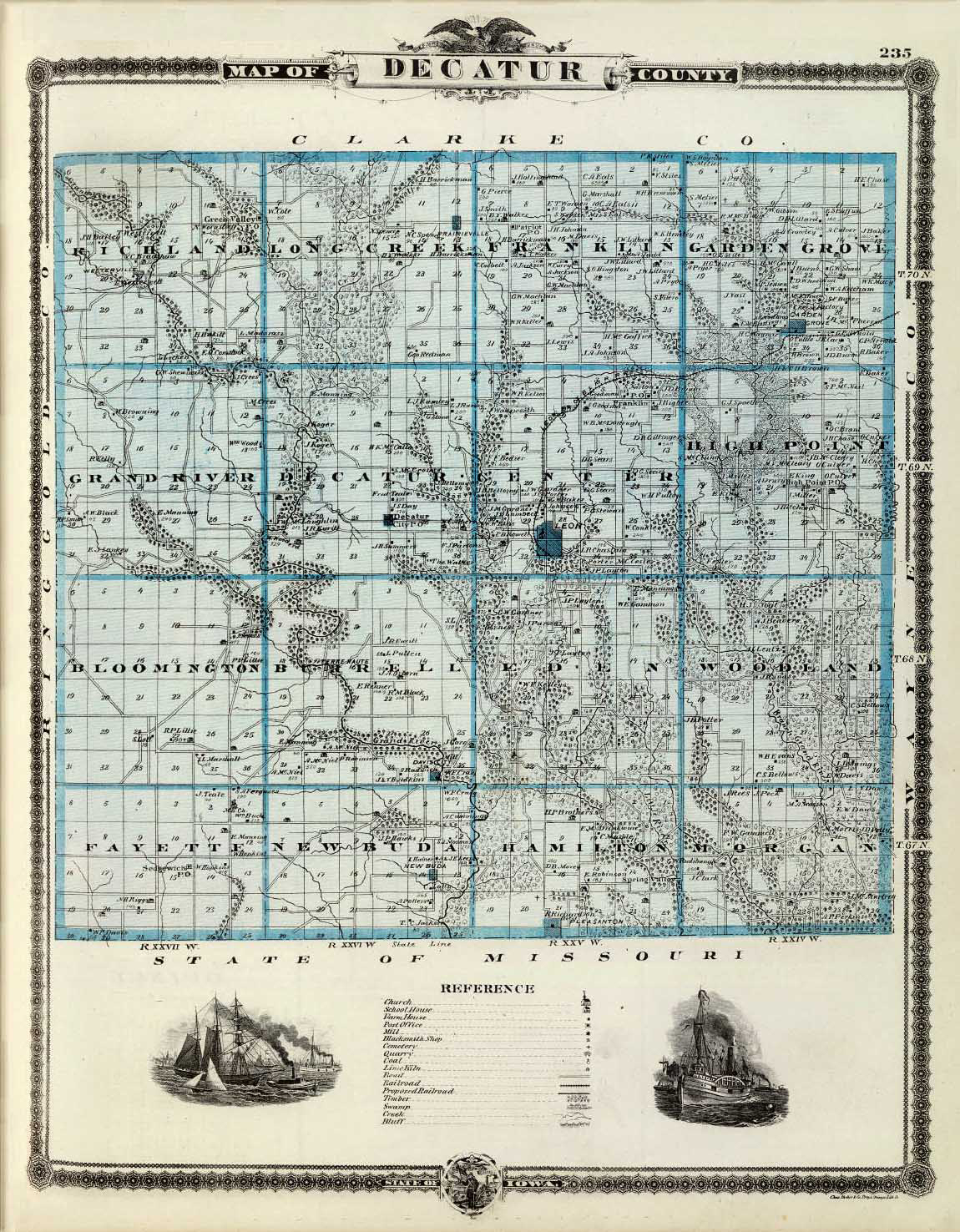
The meme is an old map of the United States, specifically Illinois, with the county of Decatur highlighted. The map is labeled "Decatur County" in the top left corner, and the surrounding counties are listed in the bottom left corner. The text "Decatur County" is also written in bold letters across the top of the map.
detailed-analysis (gemma3-27b-vision)
Okay, here's an analysis of the provided map of Decatur County, Missouri, structured by the requested theoretical lenses. I'll skip sections where the map doesn't lend itself readily to those perspectives, and explain why if I do.
1. Visual Description
The image is a lithographic map of Decatur County, Missouri, appearing to be from the late 19th or early 20th century based on its style and paper texture. It is encased within an ornate, decorative border featuring floral and geometric designs. The map itself is rendered in shades of beige and blue. A grid system divides the county into square sections, likely representing land divisions for surveying and ownership.
- Key Features:
- Towns & Villages: Named settlements (e.g., Bloomfield, New Market, Winston) are marked.
- Rivers & Waterways: The Grand River is prominent, and smaller creeks and streams are indicated.
- Railroads: Railroad lines crisscross the county, demonstrating the importance of transportation for commerce.
- Roads & Trails: Roads are represented as lines, indicating accessibility and connectivity.
- Topography: Subtle shading suggests variations in elevation.
- County Boundaries: Clear lines delineate the boundaries of Decatur County and surrounding counties.
- Reference/Legend: A detailed reference key in the bottom corner lists symbols and abbreviations used on the map (towns, railroads, churches, post offices, etc.).
- Aesthetic: The map is illustrative and functional, with an emphasis on clarity and accuracy. The decorative border adds a touch of artistic embellishment. The colors are muted and sepia-toned, typical of maps of this period.
2. Foucauldian Genealogical Discourse Analysis
This map is a discourse about Decatur County. It doesn't simply reflect the county's reality; it constructs it through the act of representation. A genealogical analysis would investigate how this map’s categories and classifications (towns, rivers, railroads, property lines) came to be considered "truthful" or "natural" categories.
- Power/Knowledge: The map embodies power/knowledge. Those who created it—surveyors, cartographers, county officials—held the power to define the county's territory, organize its space, and categorize its features. This is not neutral; it reinforces a particular order. The emphasis on property lines, for example, reinforces the ideology of private land ownership.
- Discontinuity & Rupture: Looking at this map alongside earlier or later maps of the same region would reveal the discontinuities—the shifts in how the county was understood and represented over time. This map isn’t a timeless record; it’s a snapshot of a particular moment, constructed from particular assumptions.
- Archaeology of Knowledge: We can trace the "archaeology" of knowledge embedded in the map. What systems of surveying, classification, and measurement were in place? What assumptions about land use and settlement are evident? The very act of "naming" places (towns, rivers) establishes a history and a sense of ownership.
- Discursive Formation: The map is part of a larger "discursive formation" related to land management, settlement patterns, and economic development. It’s a text that participates in broader power relations.
3. Marxist Conflict Theory
This map is deeply implicated in the dynamics of class and economic control.
- Means of Production & Land Ownership: The most striking feature for a Marxist reading is the grid system of property lines. This visually demonstrates the division of land—the primary means of production in the 19th and early 20th centuries—into private ownership. The map actively legitimizes this division.
- Spatial Control & Exploitation: The railroad lines are critical. They facilitated the transportation of agricultural goods and resources out of the county and manufactured goods in, contributing to capitalist accumulation. The map reveals the spatial organization of this extraction and distribution.
- Class Relations: The location of towns and the presence of infrastructure (railroads, roads) likely reflect the distribution of wealth and power. Larger towns might have been centers of commercial activity, where landowners and merchants held sway. Smaller, more isolated settlements might have housed agricultural laborers or tenant farmers.
- Conflict Potential: While the map doesn’t explicitly show conflict, it implies it. The division of land and the control of resources inevitably create inequalities and potential for class struggle.
4. Postmodernism
A Postmodern reading focuses on the instability of the map’s claims to "truth" and its role in constructing a particular narrative.
- Simulacra & Hyperreality: The map is a representation of Decatur County, not the county itself. It’s a simulacrum—a copy without an original. Through repeated reproduction and dissemination, the map could come to precede and even shape our understanding of the actual place. This could lead to a situation of hyperreality, where the map is more real than the territory it represents.
- Deconstruction of Boundaries: While the map appears to define clear boundaries, these are artificial constructs. The boundaries of the county, the sections of land, even the towns themselves are products of human convention. A Postmodern reading would question the inherent "naturalness" of these categories.
- Multiple Perspectives: The map presents a single, authoritative perspective. But other maps could be created, emphasizing different features (e.g., Native American land use, ecological zones, social networks). A Postmodern approach highlights the possibility of multiple valid representations of the same territory.
- Fragmentation & Loss of Grand Narratives: The map could be seen as a fragment of a larger historical narrative about westward expansion and settlement. Postmodernism would question the validity of these "grand narratives," emphasizing the contingency and local specificity of historical events.
Sections Skipped and Why:
- Critical Theory: While elements of Critical Theory overlap with Marxism and Postmodernism, a dedicated analysis wouldn’t significantly add to the insights already gained.
- Queer Feminist Intersectional Analysis: The map, on its own, doesn’t provide enough information to conduct a meaningful Queer Feminist Intersectional analysis. We would need additional historical data about the social, cultural, and political lives of people in Decatur County (gender, sexuality, race, class) to explore how these identities intersected and shaped experiences of space and power.
I hope this detailed analysis is helpful! Let me know if you'd like me to expand on any particular section or explore additional theoretical lenses.
simple-description (llama3.2-vision)
The meme is an image of a map of the United States, with the state of Illinois highlighted in red. The text "IL" is written in the top left corner of the image, indicating that the meme is referencing the state of Illinois. The meme is likely poking fun at the idea that Illinois is the best state in the country, with the red highlight implying that it's the only state that matters.
tesseract-ocr
eee — Rie DEC ATUR Gig 8 CGBSS nse) : Cc x A mK BK Cc o.. a ? Re Pps Pees ui a Elid see del i " @ Poa tee Peete w st GC memhiCv: seress a) pee ees WS “Sie [hy oF eee 4! BS ee | | sea ee ee PO en Lele at le BENS Pee ]iS\het agen Clee Bee] ED oat. Pioneers | Peg eee a etl ae a PER ieee ge a | Pa hee Gael ee TS oo a ee a ee ea i I : en oe ee hc : a te ree i @) | paca srstolgetaedat: SOT es ag Pie ee de eis | «NI ee ce “e = t ‘ Eg = =p ‘oe att Be | Sco Ae ° Bi = ate - Le Ss ane BS Ae 4 mil je | se et || at rear a Ae Ir Pe : ie Bil b's x be” ce TIN bd FESTA a ok (ieee ei ae ei) <a F [ peril LDS i Sn acer oP ar te : poe 5) x Ed Po 4 ae: | * By we oe ess es S ' ‘ be ee REFERENCE : 4 £ : | 2s. = =>’