First Seen
2015-12-18T09:30:09+00:00
simple-description (llama3.2-vision_11b)
This meme is a playful take on a historical map of the world, specifically a 16th-century map of the world created by Abraham Ortelius. The meme features a map with a humorous caption, "I'm not a map, I'm a globe", which is a play on words referencing the classic phrase "I'm not a [insert profession/occupation], I'm a [insert profession/occupation]". The meme is poking fun at the idea that a map is not just a map, but a globe, and the phrase is a clever play on words.
The text in the image is not present in the meme, but the caption "I'm not a map, I'm a globe" is the humorous part of the meme.
detailed-analysis (gemma3-27b-vision)
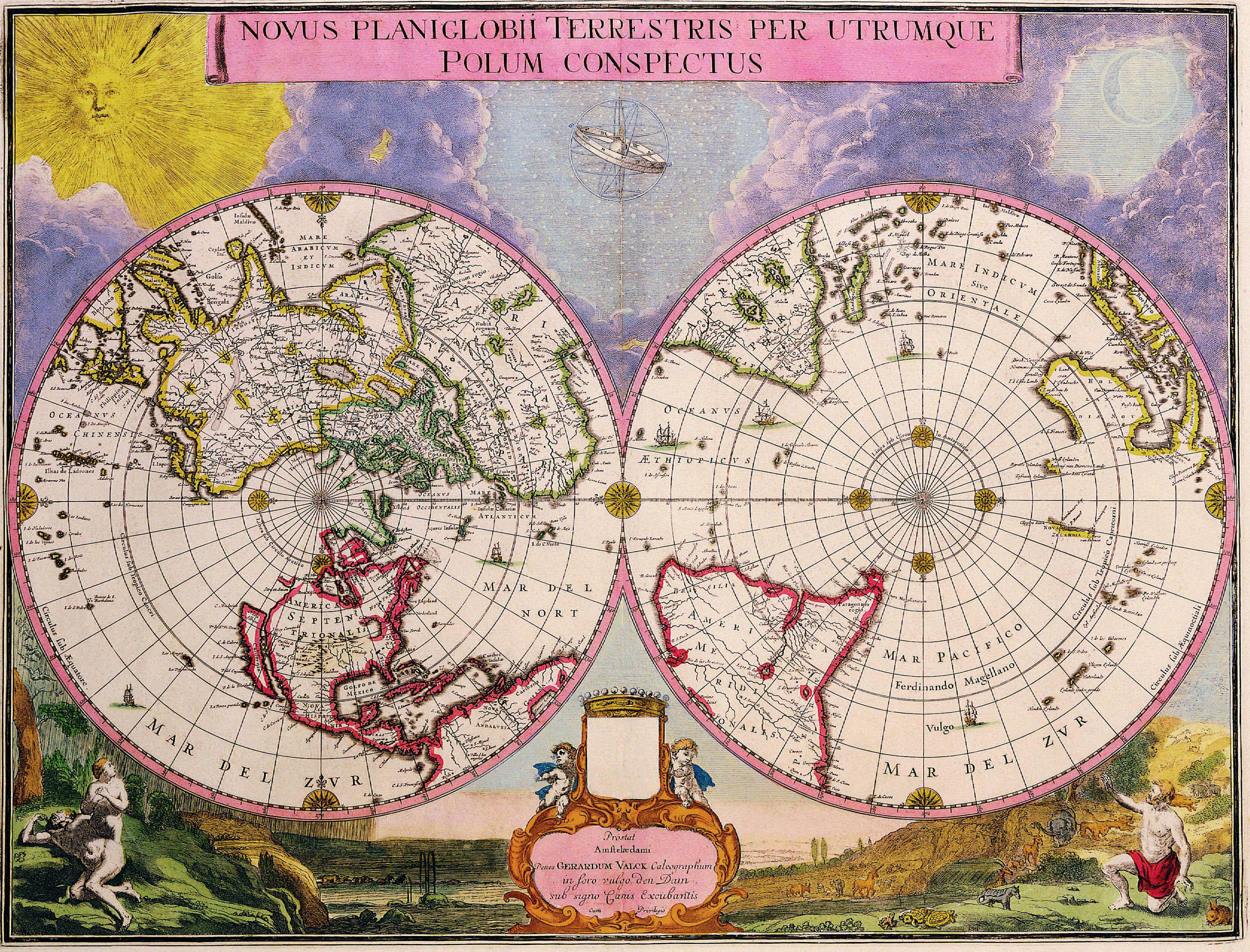
Okay, let's break down this 17th-century world map, titled "Novus Planiglobii Terrestris utrumque Polum conspéctus," (New Planisphere of the Terrestrial Globe Viewing Both Poles) through several lenses as you requested. I'll include sections only where the map offers relevant material for those frameworks.
1. Visual Description
This map is a hand-colored copperplate engraving, displaying a double hemispherical projection of the world. Two circular map projections – one Northern, one Southern – are placed side by side. The map is quite detailed for its time, depicting continents, islands, major rivers, mountain ranges (rendered in stylized form), and city names.
- Projection: The projection is not a modern equal-area or conformal projection; it's more of a compromise, intended to show the entire globe within a circular format. This inevitably leads to distortions of landmasses, particularly at the poles and toward the edges.
- Cartography: The Americas are shown, but the details of the interior are less developed compared to Europe, Asia, and parts of Africa. Australia is partially mapped but incomplete. The presence of a large Terra Australis Incognita (unknown southern land) suggests the ongoing quest for a complete mapping of the globe. The ocean is decorated with elaborate sea monsters and wind representations, typical of maps from the period.
- Ornamentation: The map is heavily ornamented with allegorical figures: on the left, a European woman with a horn of plenty, and on the right, a Native American man with a bow and arrow, symbolizing the abundance of the Earth. A central cartouche features a coat of arms and the mapmaker's dedication. The borders are filled with vignettes.
- Color: Colors are used to differentiate landmasses, bodies of water, and to highlight political boundaries. Colors are flat, without any gradients, and tend towards earthy tones.
- Typography: The map utilizes elaborate, calligraphic typography. Names are prominently displayed, with different styles and sizes denoting the importance of the location.
2. Foucauldian Genealogical Discourse Analysis
This map isn't simply a neutral representation of geography; it's a document steeped in the power/knowledge relations of its time. Through a Foucauldian lens, we can analyze how it constitutes the world rather than merely reflects it.
- Discursive Formations: The map participates in the formation of the "Western gaze" upon the world. It's constructed through specific discourses—cartography, exploration, colonialism, religion—that define what is considered "knowable" and "legitimate" knowledge.
- Power/Knowledge: The act of mapping itself is an act of power. By naming, delineating, and categorizing the world, the map makers exert control over it—both conceptually and potentially materially. The emphasis on European exploration and naming practices is evident. The focus is on the world known to Europe, and shaped by European interests.
- Archaeology of Knowledge: Looking back at the history of cartography, we can trace how the conventions of mapmaking evolved. This map reflects a specific moment in that history—the rise of scientific exploration alongside colonial expansion. The mapmaker's style, conventions, and choices about what to include and exclude are shaped by these historical forces.
- Discipline and Surveillance: While not a panopticon in the literal sense, the map contributes to a system of surveillance and control. By creating a visual inventory of the world, it enables European powers to understand, exploit, and govern distant lands.
3. Critical Theory
From a critical theoretical perspective (drawing on thinkers like Adorno, Horkheimer, and Benjamin), this map embodies the Enlightenment's instrumental reason, and its dialectic with the non-rational.
- Instrumental Reason: The map is a product of the Enlightenment's attempt to rationally understand and control the world. Its precision and detail reflect a faith in empirical observation and scientific categorization. This is the logic of dominance and control.
- The Culture Industry: While not a mass-produced item in the modern sense, the map’s creation, distribution, and use contributed to a "culture industry" – a system that creates and disseminates ideologies. The map presents a particular worldview that is circulated among the elite and reinforces their power.
- Enlightenment as Myth: The map appears to offer objective knowledge, but it's fundamentally constructed. This illusion of objectivity is a core aspect of the Enlightenment’s mythic status. It masks the underlying power relations and biases that shape its representation of the world.
- The Dialectic of Enlightenment: The map showcases a moment where reason’s potential for liberation is intertwined with its capacity for domination. The quest for knowledge and understanding goes hand in hand with colonialism and exploitation.
4. Marxist Conflict Theory
Through a Marxist lens, the map is a powerful visualization of the emerging capitalist world system and the inherent conflicts within it.
- Mode of Production: The map reflects the shift from feudalism to early capitalism. European powers are depicted as actively exploring and claiming territory, driven by the desire for resources, trade routes, and economic dominance. The map is a tool for visualizing and legitimizing this expansion.
- Class Struggle: The map implies a clear division between the colonizers and the colonized. The depiction of non-European lands often emphasizes their resources and potential for exploitation. The map silences the perspectives and experiences of the colonized, presenting a Eurocentric view of the world.
- Imperialism: The map is a visual manifestation of European imperialism. It demonstrates the control exerted by European powers over vast territories, and their willingness to use force and coercion to maintain that control. The map presents a distorted view of the world, obscuring the violence and exploitation that accompanied colonial expansion.
- Material Conditions: The creation of the map itself was dependent on material conditions—the availability of paper, ink, copper plates, skilled artisans, and patronage from wealthy elites. These material conditions shaped the map’s form and content.
5. Queer Feminist Intersectional Analysis
While this map does not directly address sexuality or gender, we can unpack how it contributes to colonial/patriarchal structures which shape gender and sexuality.
- Silencing of Indigenous Women: The map, even with its allegorical figures, focuses primarily on the perspectives of European men. Indigenous women’s knowledge, agency, and perspectives are erased or marginalized. The map contributes to the ongoing oppression of Indigenous women.
- Gendered Spaces: The map reflects and reinforces gendered divisions of labor and power. The depiction of certain regions as “wild” or “untamed” often aligns with patriarchal notions of femininity and the need for European “civilizing” influence.
- Colonial Violence and Gender: Colonial violence, including sexual violence, is not explicitly depicted on the map, but it's an inherent part of the historical context. The map obscures this violence and contributes to the normalization of colonial domination.
- Intersectional Oppression: By focusing on the world through a European lens, the map erases the diverse experiences of people across the globe, reinforcing the power dynamics of race, class, gender, and colonialism.
I hope this breakdown offers a comprehensive view of the map through various theoretical lenses. Let me know if you'd like me to elaborate on any particular aspect or theoretical framework.
simple-description (llama3.2-vision)
This meme is an image of a map of the world from the 18th century, specifically the "Nova et Accurata Descriptio" (New and Accurate Description) of the world by Johannes Blaeu in 1644. The text at the top of the image reads "Nova et Accurata Descriptio" and the bottom text says "Nova et Accurata Descriptio" in Latin. The image is likely being used to humorously highlight the inaccuracies and outdated nature of the map.
tesseract-ocr
OU DWELLER = —— = 2 —— —S—=> = WSs Ny thi ie Le a . 5 ira) ae = = a ———E | Wor Ue { NOVUS PLANICLOBIL TERRESTRIS PER UTRUMQUE Se gi ee TF Te = EE = a Vee eS rrrrr— ee - ee Pig \ Oe oo ee oe ee e—=e Were Ne we SS, ee So Ses ee oe =. ee LS . ee ae ===, + “Cg pe se en en BOOS SE) A IIE. TO - = ~s Fes «Ope a SS eee Bee Adem TOS Se ge le Aa MO SK Oe KS ee Be lang M0ty ty oe FN eff % : Pria\ re wat I eM K A ETS 2 2 sau NA ee Pe eee fe | [SLOP PRS ARS LA. REE NN ek le = — Ee TR | bs ee (aie Wee Ny oe Ae BaP RK 5 | | [RSS AS Ss ee Re es ae ae KT< SEN | IB Fe yy ADS Ky ae a ue S355 eR \ | fp ig oe S 4 ji| Sl se ee SS Fe: \ 4 yr ex, pe “ ee Sy S\ (é gS ey \ Ft Soa SS | : | BS So) es S AS See aS te NS eS See pe i sun f f ~/ ae > <S mB re Se VV a LR oe iS C2 ee ae Lf giles Cs \ SB ea Dok NR cca AEN fate) a ag arial EST OK gee | | aS ECS eel 2 SW eS M4. Se ape sie ge | NU ea a Wy Se, | SS SO pn mente] ef $8 egg mrtg oe ! “ Pest) | he ee ee eS Sr @ te ey dt \ PRR pli fe me te | i (eae Semen INS ape " | ; : Paez. Fe ah ee ae SIS ae Ee Ok eevee AL) |) ae OT a, N AX \, Be Cae. ie : Beas Hy \ po \ ae eae a eet =f [ a \ < 4 pas ee f Ve ® NY See a Y = éf I SHANG SF lg eo us se ey, Ww K SAR | Oe. - wy | aN 4 eS ly ’ ES ant P a oS i ¥ 2 | Gln fo 5 See oe To, Uo 3% 2 1280 5 ass oe 29 ~~ Ferdinando Be ae oe a fy ae ai TS de en Le a . hao iv ete. ee: a ZY eel Lic Kp aI | hoes ee I ee ef er Gata Pe YS Za PRESS Ron ed a ee a ee I 9} Ye a 7) er oa Ce ee ere ee a = ey es ae i aa fa. > ew 2 = ee Chan fp Nise!