First Seen
2015-12-18T09:30:09+00:00
simple-description (llama3.2-vision_11b)
This meme is a humorous image of a 17th-century map of the world, specifically the "Carte du Monde" by Guillaume Delaunay, which is a rare and valuable example of a 17th-century map. The image shows the world as it was understood at the time, with various regions and countries labeled. The meme is likely a joke or a reference to the absurdity of how the world was perceived in the 17th century, with many countries and regions not even existing or being known to Europeans at the time.
detailed-analysis (gemma3-27b-vision)
Okay, here's an analysis of the image, broken down into sections addressing the prompts. I'll indicate where a section doesn't apply strongly.
Visual Description
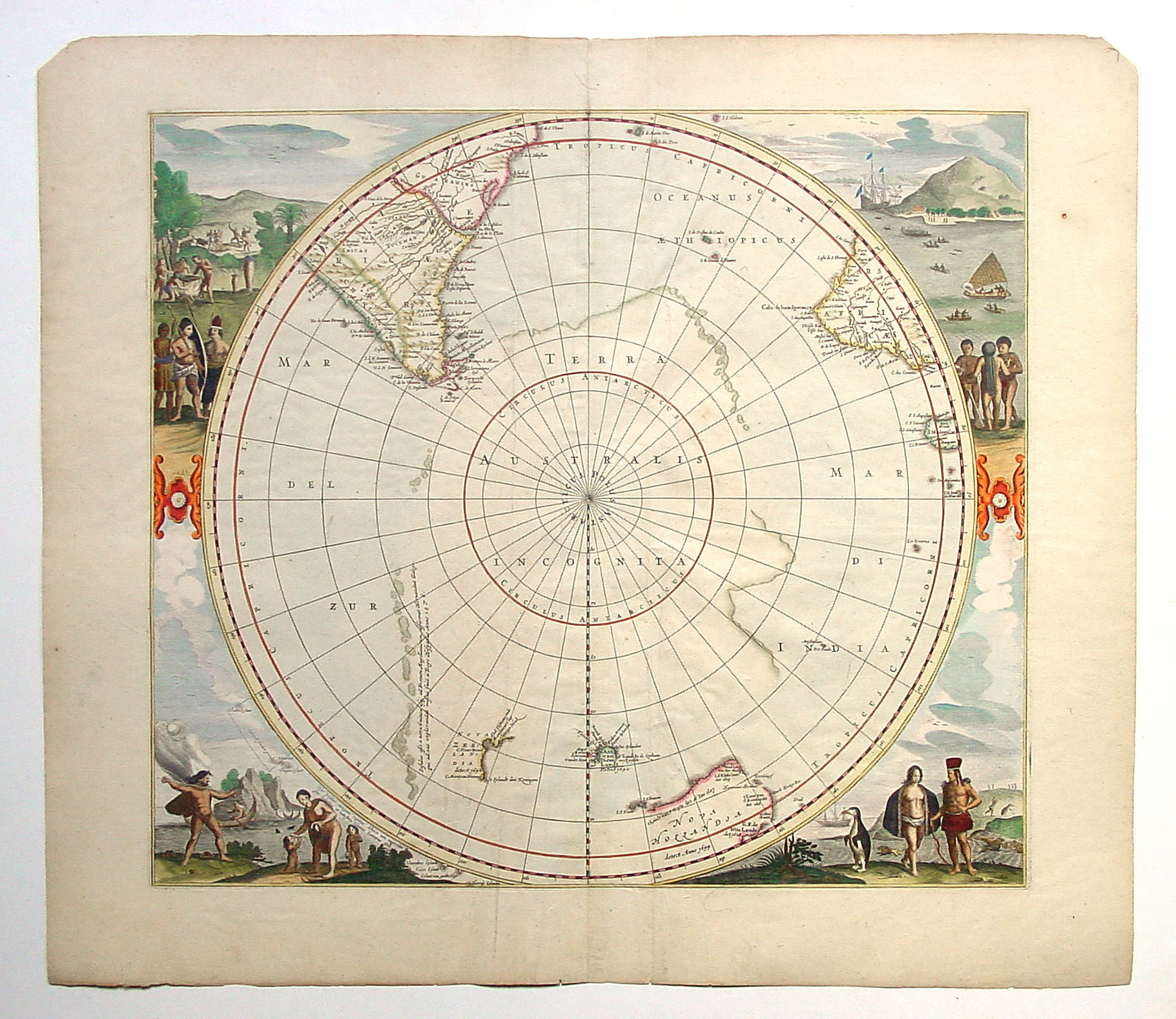
The image presents a hand-colored copperplate map, likely from the 18th or early 19th century, depicting a world map projected onto a circular or polar projection. The most prominent feature is the central, white, circular space representing the North Pole. Radiating from this center are concentric circles and lines of longitude and latitude, defining continents and oceans in a relatively rudimentary, stylized manner. Continents are labeled, though the labeling style is antiquated.
Around the periphery of the circular map are four vignettes or scenes. Each depicts a group of people in indigenous attire, associated with a different cardinal direction, and seems to represent different regions of the world. These vignettes are visually detailed and brightly colored, contrasting with the more austere map itself. They incorporate elements of the landscapes associated with those regions (trees, huts).
The map is set on a lightly beige, aged paper. Overall, the aesthetic is antique and illustrative, suggestive of an era of early cartography and global exploration. The rendering style isn’t strictly accurate by modern standards; rather, it’s more concerned with representing the idea of the world and its perceived order.
Foucauldian Genealogical Discourse Analysis
This map is a potent artifact for a Foucauldian analysis. It reveals how knowledge about the world was constructed and legitimized during a particular historical period. The map isn't merely a representation of geography; it is an exercise of power.
- Discursive Formation: The map participates in the discourse of exploration, colonization, and the establishment of European dominance. The centering of the North Pole, and the projection of the world radiating outwards, implicitly positions Europe as the central, organizing force, and a point of origin for understanding the globe.
- Archaeology of Knowledge: The map’s style (projection, labeling conventions, depiction of landmasses) reflects the episteme of its time – the underlying assumptions and rules that govern what can be known and said. It's a product of a world where scientific inquiry was intertwined with colonial ambitions.
- Power/Knowledge: The map isn’t a neutral record; it creates the world it purports to represent. By defining borders, naming places, and categorizing regions, it exercises power by establishing a particular order and framework for understanding the globe. The vignettes around the border aren’t just "illustrations" – they are performative acts of categorization and othering of non-European populations.
- Genealogy: We can trace the genealogy of this map back through earlier cartographic traditions, through the practices of exploration, and through the ideologies of colonialism. It demonstrates how "truth" about the world is not objective but historically contingent and linked to specific power relations.
Critical Theory
From a Critical Theory perspective, this map can be viewed as an artifact of ideological domination. The map is not simply a factual representation of the world, but a product of a specific historical and social context, infused with the biases and power dynamics of that context.
- Hegemony: The map reinforces a European hegemonic worldview. The centering of the map on the North Pole (and by extension, Europe) subtly implies European centrality and superiority. The detailed depiction of Europe compared to other regions also signals a prioritization of European knowledge and perspectives.
- Representation & Othering: The vignettes around the border are crucial here. While seemingly illustrative, they present a simplified, stereotyped view of non-European peoples. They function as "the Other" against which European identity is defined. The depiction of indigenous peoples, even if seemingly benign, is inherently framed through a European lens.
- Commodification of Knowledge: The map itself is a form of commodified knowledge, produced and disseminated to serve certain interests (e.g., exploration, trade, colonial administration). The very act of mapping the world can be seen as a form of claiming and controlling territory.
- Ideological Function: This map contributes to the ideological justification of colonialism. By presenting a world ordered and defined by European categories, it legitimates the European right to explore, control, and exploit other regions.
Marxist Conflict Theory
From a Marxist perspective, the map embodies the conflicts inherent in the development of capitalism and colonialism.
- Control of Means of Representation: The map itself represents the control of the means of representation, specifically cartographic knowledge, by the European ruling class. This allows them to shape perceptions of the world and legitimize their economic and political interests.
- Imperialism & Resource Extraction: The detailed mapping of the world is directly linked to the expansion of European imperialism and the exploitation of resources. The map functions as a tool for identifying and claiming territories rich in resources.
- Class Relations & Exploration: The expeditions that produced the data for this map were driven by capitalist motives (trade, profit) and often involved the exploitation of labor (both European and indigenous).
- Geographical Inequality: The map’s focus on regions of economic interest to Europe (e.g., the Americas, Asia) reflects the uneven development of capitalism and the creation of a global division of labor.
- Conflict & Domination: The map implicitly reveals the conflicts that accompanied European expansion, including wars, enslavement, and the displacement of indigenous populations.
Postmodernism
From a postmodern perspective, the map challenges the notion of a single, objective truth about the world.
- Deconstruction of Grand Narratives: The map participates in the "grand narrative" of European progress and mastery over the world. A postmodern analysis would seek to deconstruct this narrative by highlighting its biases, exclusions, and power dynamics.
- Relativity of Knowledge: The map's representation of the world is not neutral or universal; it is contingent on a specific historical, cultural, and political context. Postmodernism emphasizes the relativity of knowledge and the impossibility of achieving a truly objective representation of reality.
- Simulation & Hyperreality: The map is a simulation of the world, a representation that stands in for the real thing. A postmodern analysis would question the relationship between the map and the territory it represents, arguing that the map can become more real than the reality it purports to depict.
- Fragmentation & Multiplicity: The map's circular projection, while visually cohesive, also fragments the world into discrete regions. A postmodern analysis would highlight this fragmentation and emphasize the multiplicity of perspectives and experiences that are excluded from the map's representation.
Queer Feminist Intersectional Analysis
(This is less directly applicable than the other categories, but still possible).
- Spatial Politics of Colonization: The map's very construction is linked to the spatial politics of colonization. It's a form of mapping power onto the land, defining territories and boundaries in a way that often marginalized or erased indigenous relationships to the land. This is particularly impactful on queer and gender non-conforming populations whose land-based kinship systems are erased by these imposed boundaries.
- Erasure of Indigenous Gender & Sexuality: The vignettes around the map present a highly generalized and likely patriarchal view of non-European cultures. They are unlikely to represent the diversity of gender and sexual identities that existed in those cultures, or how those identities were shaped by their specific relationships to the land and their communities.
- Intersection of Colonialism & Gendered Violence: Colonialism frequently involved gendered violence, including the sexual exploitation of indigenous women. The map, as a tool of colonial power, is indirectly implicated in this violence.
- Mapping of Power & Control: The map's depiction of the world reinforces hierarchical power relations based on gender, race, and colonialism. This contributes to the systemic oppression of marginalized groups. The center/periphery dynamic of the map visually reinforces this dynamic in a spatial context.
I hope this detailed analysis is helpful. Let me know if you'd like me to elaborate on any specific section or aspect!
simple-description (llama3.2-vision)
This meme is a humorous image of a historical world map, specifically the 1720s-era map by Guillaume Delage, with the addition of a few modern-day stereotypes and cultural references. The image features a map of the world with various regions labeled with humorous and often inaccurate descriptions, such as "Where the Natives Eat Each Other" and "Where the Natives Don't Eat Each Other". The text "Where the Natives Eat Each Other" is written in a small box on the map's left side.
tesseract-ocr
f te = EE FE RTT NP Tp | SSS , : = Za a | So Li oO See eee | \ Sie ae 4 . Ces “beg aX Efren eS > . x — ae . | Re / See aa pa OX \ <== [ Wf | ee Ye Ne eT NEE a \ y La Paes, Ste fC GN A i Mi V/ A eS i f | % 7> ae \\C Sees | Bole, / aes fee NE lk SEE i SNe / XN / [a é {| 7 ee ae i WG aos Se pe n| »/ 96 y A 7 SSA V6 60. : = ED oo) ee \ Oe CaN NFR a pn St Ser ; | £ CNN a AN e SN \ = a ‘ | = PON IIT XXX Bae \ ne Dees ee i y 4 5 : TKS, a | al NUE ae | Pp eps HS yee ag ik = “Tel i er A 1 Cf/p fe Sass | y L_.| Pie 28 E Z > | cD 7 |} i ls \, Ss Lat DI a pe = eX g . ee] als = VS S/ ; 7 ihe ©@ ——_ oe \ Wid i : y = / ; 4 Bes ee ~\ at ee mgt TH ae aw e! Wa la pe ] i 3 E es = > yes i a4 \ NY Pd Br f= \ <4 ee * Nae , ag at | (= aN t SNS ) ; Bs pnb | yee 55 er Ns o Sa | | lee CES SS bas. | . | ss — P) | BC N Se s Vous Xs Ss Ai A il 4 * al <a = a ee AF oes es Z | ens PS ae | TESST ee ee E ene ee ao : |