First Seen
2015-12-18T09:30:09+00:00
simple-description (llama3.2-vision_11b)
This meme is a satirical image of a historical world map, specifically the 1570 map by Gerardus Mercator, but with the continents rearranged to resemble a cartoonish, exaggerated face. The image is captioned "The World is a Flat Pancake" and is likely referencing the popular internet meme of a pancake with a face, but with the continents rearranged to resemble a cartoonish, exaggerated face.
detailed-analysis (gemma3-27b-vision)
Okay, let's break down this fascinating 17th-century world map through several theoretical lenses.
Visual Description
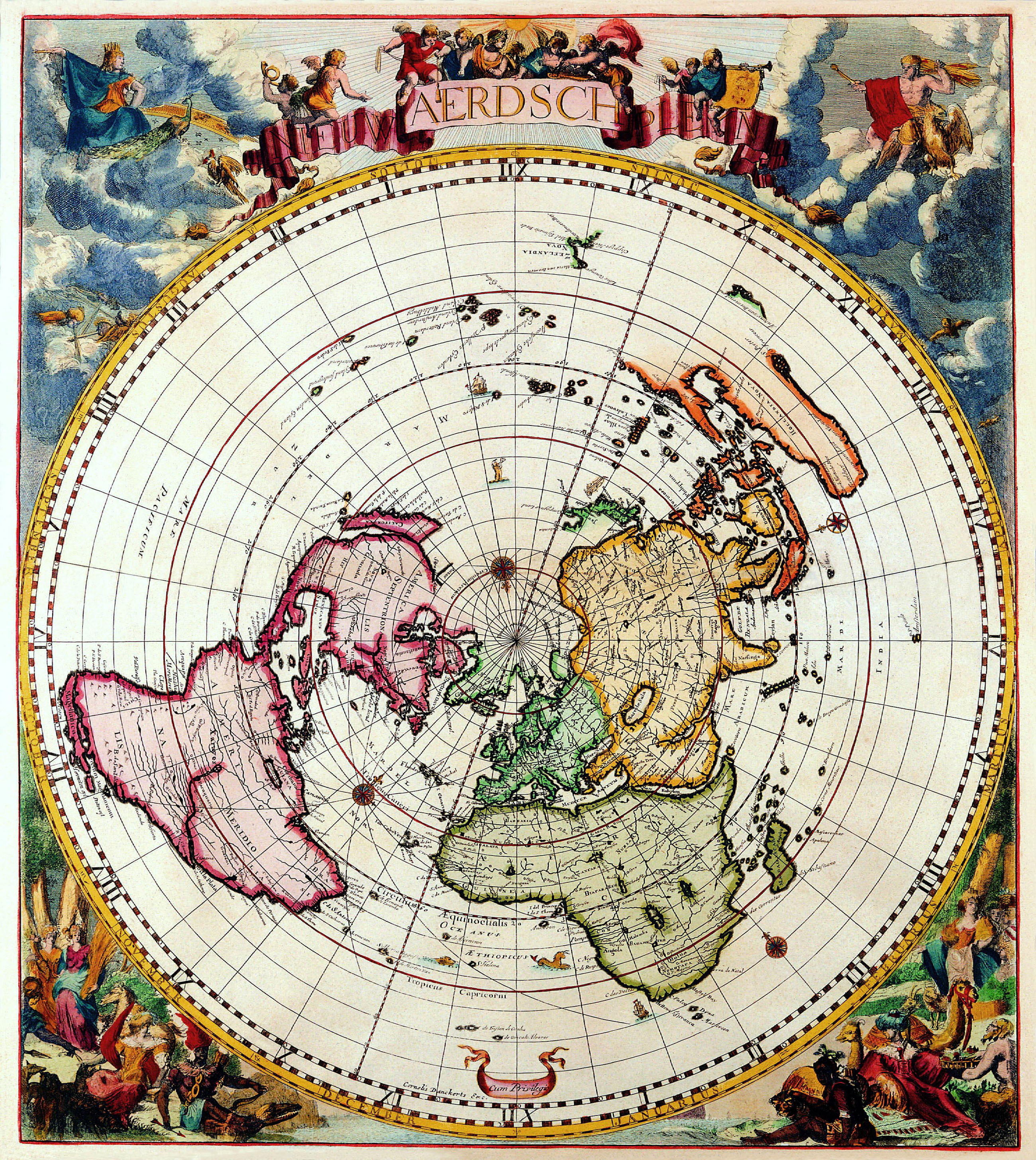
This is a visually striking world map, rendered in a style typical of the 17th century, likely a Dutch production given the "AERDSCH" inscription at the top (meaning Earth in Dutch). It employs an azimuthal equidistant projection, centered on the North Pole. This projection, while visually arresting, inherently distorts landmasses, exaggerating areas further from the center.
- Color & Detail: The map utilizes a palette of greens, browns, pinks, and blues to delineate landmasses, bodies of water, and relief. The level of detail is remarkably high for the period, including representations of mountains, forests, and settlements.
- Decoration: The map is heavily decorated with allegorical figures, vignettes, and symbolic images. The upper section shows figures, perhaps representing the winds or seasons, and what looks like a depiction of the creation or a heavenly host. The border around the map also contains numerous figures and scenes, showing various inhabitants and animals. This isn't merely a geographical representation; it’s an artistic statement filled with cultural assumptions.
- Geographical Accuracy: The map, while detailed, contains many inaccuracies by modern standards. The shape and size of continents are distorted. Notably, the Americas are incompletely charted, and Australia is not fully understood. The coastline is roughly mapped, but interior features are more conjectural. The placement and depiction of regions like the “Terra Australis Incognita” (Unknown Southern Land) is based on speculation and myth.
- Typography: The lettering is ornate and in a distinctive style. The map likely employed copperplate engraving.
Foucauldian Genealogical Discourse Analysis
Applying a Foucauldian approach, this map isn't just a depiction of the world; it's a discourse – a system of thought, language, and practice that constructs our understanding of the world.
- Power/Knowledge: The map represents a specific power structure. The mapmaker (and the patrons who commissioned it) possessed the power to define what the world is. By representing certain areas and omitting others, they exercised control over knowledge. The very act of mapping is an exercise of power – to name, to classify, to order, to dominate.
- Episteme: This map reflects the episteme of the 17th century – the underlying set of rules and assumptions that govern knowledge. The emphasis on Europe as the center, the incomplete charting of non-European lands, and the inclusion of mythological creatures demonstrate the epistemic frameworks of the era. The concept of "Terra Incognita" doesn't just denote unknown lands; it signifies the European perception of these lands as "other" and open to interpretation and control.
- Genealogy of Cartography: A genealogical analysis would trace the historical development of cartography, exposing the shifts in power and knowledge that shaped mapping practices. This map isn't a neutral representation of reality, but a product of a specific historical trajectory. The move from Ptolemaic worldviews, through the Renaissance and the Age of Exploration, to this map reveals a changing understanding of the world driven by political, economic, and religious forces.
Critical Theory
From a critical theory perspective, this map is not a neutral depiction of the world but actively participates in the construction of a Eurocentric worldview.
- Hegemony: The map reinforces European hegemony by centering Europe and portraying other regions as peripheral. The focus on European exploration and colonization subtly legitimizes these practices. The map’s visual hierarchy places Europe at the top, symbolically asserting its dominance.
- Representation and Othering: The map’s depiction of non-European lands often relies on stereotypes and exoticization. The inclusion of “mythical” creatures or incompletely charted territories contributes to the “othering” of these regions, reinforcing a sense of European superiority.
- Ideology: The map reflects the dominant ideologies of the 17th century, including colonialism, mercantilism, and religious justification for expansion. The map's aesthetic and symbolic choices function as ideological statements, subtly promoting a specific worldview.
Marxist Conflict Theory
Examining this map through a Marxist lens highlights its connection to economic and political conflicts.
- Imperialism & Colonialism: The map is directly linked to the Age of Exploration and the rise of European empires. The cartography served as a tool for navigating, claiming, and exploiting new territories. The map enabled the planning and execution of colonial projects.
- Resource Control: The map depicts regions rich in resources that were coveted by European powers. The depiction of these regions reflects a desire to control trade routes and access to valuable commodities.
- Class & Power Dynamics: The production of the map itself was driven by the interests of ruling elites – merchants, monarchs, and landowners. The map served to legitimize their power and facilitate their economic expansion. The map could be seen as a tool to establish and maintain a system of unequal exchange.
Postmodernism
A postmodern approach would deconstruct the notion of a single, objective "truth" represented by the map.
- Subjectivity of Representation: Postmodernism would challenge the idea that the map accurately reflects reality. The map is merely one interpretation of the world, shaped by the perspective and biases of the mapmaker.
- Fragmentation & Simulacra: The map can be seen as a simulacrum – a copy without an original. The map doesn't represent a pre-existing reality, but rather creates a representation that becomes detached from its referent. The fragmented and incomplete nature of certain regions reflects the instability and ambiguity of knowledge.
- Deconstruction of Grand Narratives: Postmodernism would challenge the grand narrative of European progress and discovery implied by the map. The map is not a neutral account of historical events but rather a construction that serves specific ideological purposes.
Queer Feminist Intersectional Analysis
This lens is harder to directly apply as the map doesn't explicitly depict gender or sexuality. However, we can examine how the map’s broader ideological implications intersect with gender, sexuality, and colonial power.
- Colonial Violence & Gendered/Sexual Exploitation: Colonial projects (facilitated by maps like this) often involved the exploitation and subjugation of indigenous populations, including women and gender-nonconforming individuals. The map indirectly enables these forms of violence.
- Cartography as a Masculine Domain: The field of cartography historically has been dominated by men. This map can be seen as a reflection of patriarchal power structures and the silencing of alternative perspectives.
- Othering & the Construction of "Normality": The map’s “othering” of non-European regions reinforces a sense of European “normality” that has historically been used to justify oppression and discrimination. This map’s assertion of a European center can contribute to the construction of harmful binaries.
Let me know if you'd like me to delve deeper into any of these analyses, or explore a different theoretical lens.
simple-description (llama3.2-vision)
This meme is an image of a vintage-style world map with a humorous caption. The image appears to be a stereotypical "map" of the world with a giant "C" in the middle, supposedly representing the "center" of the world. The text "C is for Canada, always" is written above the "C" in a playful, cursive font.
tesseract-ocr
re = _——_ aa a se. el I Se oe . SB 14 re hc > 0 Ot ~ CL tee, ‘a a De S os be ape ashe. ‘ Z ). 3 Ss y) a * ‘ =o 3 ~ RS 1 a me VO de PALIN — MD EB ei\e O_o Sec ie ey PS IR Reins hy n\n a MTT 1 - . @ is 4 Or | | Nan — -_ SF Feo! e | ee ae . ae i: | | Ww | HH” = me IS : RS A 1 a Fa ae | ao . & an et a iN — ee es ape = Z s oa Rie she eS 7 oy ~~ RSS ee ; oS ger a « ser es vraxvase§ | See] Ry NSS Ne a ase = eee er ye oa oun SD f Sy OS = € i er eae Ss - ee 4 f git \; foe i ; \ SD WS : bee i) yy y S ‘S pt ‘ — ties = K é " ‘ 3 < oy \ ee ; | eae ay wy ‘ye by / aoe A et aD 8 5 a. x \ <a, \ yo OS ERR as / Y fie ites tere, aN Le) of / Sige fear <a,» RX ee e XA ny | SS pets. fad Oe NB A iy mans ae eh \ 1 BRL | TAN Sauer Mae eg, \\ | AE HE Lf RL RE aa + a) eae | |W es i ; : ‘ ee, uo PESYZZ AC A Pe é AN es 1 if : | ets ea SP at aS Se se] IS i A ile | t \ 3 Ne 4 a ens ee Oe m, Lp 5s ea, k K Ct pre tte It LS RSET ESR AS ats De BY tee yl get | yo Lie ay OS ee ep hI ti a (| La DTS Ve ea | ho | eh e BA? WG MART AREA gl |g or Uf hy] ty Na VA SS WR ONES OR RU) > / } ie LEY WI se ara: Ee. OL eed /2 a) Y ae oat 6. hs x Y Noy a SL eee : Z Se as A A ff | BN ER SCORES RR ee, 7 i , oS Oe Ve CORN Pat ee Si ax Ae 8 . Si te Net wwe pe RS [ee eae ee PSK Ae oe Loe & a A Ro < Ea rey She : ae FoR fee “Se Val ake? | ee ; fe 7 Uti eee ae MAS AY oy \ re KE ee ee Si y bye oa 2 Ss oe cae WSs ® e> wa. < p. ae as ef ee SEA IS A “we a ¥, i 4 AP ERIS Ria Fa ER iin “Sy | iy Re < PM LIS > S| ro PEN Vc y/o AN fee sede — *\ JE GLO 8) we Sg es, io a el NSS se ule i : "ee YZ as". oy: Ex Ke ao & she 2 SF S ag id S Ny a BY Pe Ps, : ) Tee aS RY — ee is ee ——. Se eo | il Pee es. Co |e a 2 We Rg ee Bb (Yi eee Sore ta ee | ne Bic — es a ba ee |