First Seen
2015-12-18T09:30:09+00:00
simple-description (llama3.2-vision_11b)
This meme is a humorous representation of a 17th-century map of the world, featuring a large globe with various illustrations of mythological creatures and gods. The meme is likely a joke about the accuracy of ancient maps, with the text "Papes" (a typo for "Papes" is likely "Papes" is a typo for "Maps") and "Old Maps Of The World" being a play on words. The image is likely a joke about the inaccuracy of ancient maps, with the text "Papes" being a typo for "Maps".
detailed-analysis (gemma3-27b-vision)
Okay, let's analyze this 17th-century map, "Orbis Terrarum Nova et Accuratissima Tabula," through the requested lenses. It's a rich image, capable of yielding insights from various theoretical perspectives.
Visual Description
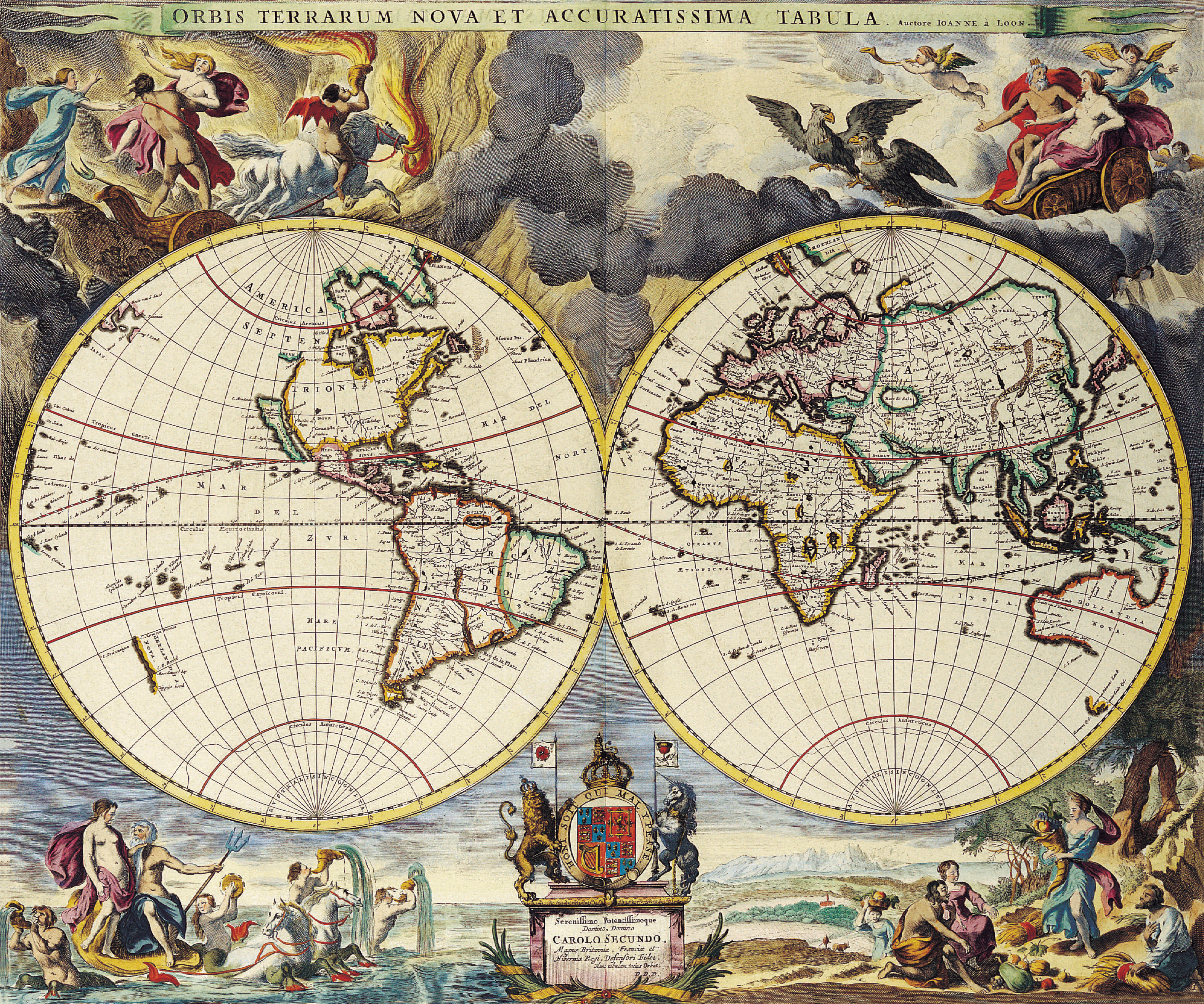
This is a beautifully rendered world map, produced in a style typical of the 17th century. It’s presented as two circular hemispheres, side-by-side, depicting the Eastern and Western worlds. The map is visually dominated by detailed cartography – coastlines, rivers, mountain ranges, and place names are intricately illustrated. The cartographic style is characteristic of the era, showing a mix of accurate (for the time) coastal outlines with less accurate internal geographical representations. Latitude and longitude lines are prominently displayed, forming a grid across the maps.
The map is framed by allegorical figures, specifically personifications of the four continents (America, Europe, Asia, and Africa) in classical dress, and a highly embellished cartouche bearing the coats of arms of Carolus Secundus (Charles II of England). These figures are not realistic portrayals of the inhabitants of those continents, but rather represent idealized (and likely colonial) conceptions. Above the hemispheres, cherubs or angels hold ribbons bearing the map's title. The overall aesthetic is baroque—ornate, detailed, and intended to impress. The use of color is limited, primarily browns, greens, and blues, typical of the printing methods of the time.
Foucauldian Genealogical Discourse Analysis
This map, as a product of its time, can be analyzed through a Foucauldian lens to reveal the discursive formations that shaped European understandings of the world and justified colonial power.
- Power/Knowledge: The map is not a neutral representation of geography, but a manifestation of power/knowledge. The very act of mapping, of defining and naming territories, is an assertion of power. The map defines the world in terms of European categories and perspectives, effectively “constructing” the world as Europe understands it. This construction legitimizes European exploration and colonization.
- Discourse of Discovery/Colonization: The map's emphasis on routes of exploration and the names given to places are critical. It’s a narrative of “discovery,” but this "discovery" is framed from a European perspective, conveniently ignoring existing indigenous knowledge and claims. It represents the world as if it was empty until Europeans arrived.
- Genealogy of Geographical Categories: The way the continents are represented, the attributes given to the personified continents (and the absence of nuanced representation of diversity within continents), reveals a genealogy of specific European categorizations. These are not natural or inherent categories, but historically constructed ones, reflecting specific power dynamics and ways of understanding the world.
- Surveillance and Control: Mapping is inherently a form of surveillance. It creates a visual inventory of resources, territories, and potential targets for exploitation or control. The map is not just about knowledge, but about making the world knowable and therefore controllable.
Critical Theory (Frankfurt School)
From a Critical Theory perspective, the map embodies the “Enlightenment” project's problematic relationship to rationality and domination.
- Instrumental Reason: The map showcases the application of “instrumental reason” – the focus on technical skill and efficiency in representing the world. While technically impressive, this focus comes at the expense of ethical considerations. The map facilitates the rationalization of colonialism—reducing complex cultures and geographies to quantifiable data for exploitation.
- Domination of Nature: The act of mapping can be seen as a manifestation of the desire to control and dominate nature. By creating a visual representation of the world, the map transforms it into an object for analysis and manipulation.
- Reification: The map "reifies" geography – turning dynamic, lived spaces into static, abstract representations. It masks the social, political, and ecological complexities of different regions.
- Ideology: The map functions ideologically by normalizing the European worldview and obscuring the impact of colonialism on the mapped territories. It subtly reinforces the idea that Europe is the center of the world, and that other regions are defined in relation to it.
Marxist Conflict Theory
From a Marxist perspective, this map exemplifies the material and ideological forces driving European expansion and the development of capitalism.
- Imperialism and Resource Control: The map is a direct product of and facilitator for European imperialism. The depiction of trade routes, resource locations (even if vague), and the labeling of territories all indicate a concern with extracting wealth and establishing economic dominance.
- Capital Accumulation: The mapping of the world was crucial for the expansion of global trade networks and the accumulation of capital. Knowing the geography of the world allowed European powers to identify potential markets, resources, and trading partners.
- Class Conflict: While the map doesn’t explicitly depict class conflict, it implicitly reflects the power dynamics of the time. The map's creators and patrons were members of the European ruling classes who benefited from colonial expansion. The map served to legitimize their power and control.
- Ideological Justification: The map's depiction of the world as open for European exploration and exploitation served as an ideological justification for colonialism, masking the violence and exploitation that accompanied it.
Postmodernism
A postmodern reading would deconstruct the map's claim to objective truth and highlight its constructed nature.
- Rejection of Grand Narratives: The map participates in the “grand narrative” of European progress and discovery. Postmodernism would challenge this narrative, arguing that it is just one possible interpretation of the world, and that other perspectives are equally valid.
- Deconstruction of Representation: Postmodernism would focus on the ways in which the map represents the world, rather than the world itself. It would highlight the choices made by the map's creators – the selection of features to include, the style of representation, the names given to places – and show how these choices shape our understanding of the world.
- Emphasis on Subjectivity: The map is not a neutral or objective representation of the world, but a subjective interpretation shaped by the cultural and historical context of its creation.
- Fragmentation & Simulacra: The map's details can be seen as fragments of information, assembled to create a simulacrum—a representation that lacks a real original. The map's depiction of distant lands may be based more on rumor and imagination than on accurate observation.
Queer Feminist Intersectional Analysis
This is perhaps the most challenging lens to apply directly, as the map doesn't explicitly address these themes. However, we can infer how the map reinforces patriarchal, colonial, and heteronormative power structures.
- Erasure of Indigenous Women's Knowledge: Colonial mapping fundamentally erased Indigenous cartographic knowledge, disproportionately impacting Indigenous women who often held the responsibility of spatial knowledge and transmission within their communities.
- Gendered Representation of Continents: The personification of continents as idealized European women reinforces patriarchal expectations and silences Indigenous female bodies. These figures function as symbolic vessels for European colonial fantasies, obscuring the lived realities of women in those regions.
- Reinforcement of Colonial Violence: Mapping contributed to the systematic dispossession and violence inflicted upon Indigenous and marginalized communities, disproportionately impacting women who are often the primary caretakers and keepers of cultural knowledge.
- Intersectionality of Oppression: The map implicitly reinforces a system of intersecting oppressions – colonialism, patriarchy, and heteronormativity – that marginalized and silenced Indigenous women, women of color, and LGBTQ+ individuals in the mapped territories.
- Silence & Absence: The map is notable for what it doesn't show – the lived experiences of women, LGBTQ+ individuals, and marginalized communities – further contributing to their erasure and invisibility.
This is a complex analysis, and many other perspectives could be applied. I have aimed to offer a detailed and nuanced exploration of this map through the requested theoretical lenses. Let me know if you’d like me to elaborate on any specific aspect!
simple-description (llama3.2-vision)
This meme is an image of a vintage world map with a large, red X marked through the middle of the United States. The text "I'm not arguing, I'm just explaining why I'm right" appears above the X. The image is likely being used to humorously express a sense of confidence or certainty in one's opinions.
tesseract-ocr
a =e NOVAYET: ACCURATISSIMA TABULA.......... i —— “SSS SSS Sos SSSSSq—ooCS a Se ee NN Rea) Gee = a z | ae Sy 22 eae ee fe 7 -— ,. - - -— we << ae <3 o : mee 7 SSSA ats Bo ve a Ree NAT HAN Oe Z| : PE Se = aed A Qa = Fee 2 ae Os EL A \) : = es : wo la oe so 72) oe. Ars. Si o2 20. > ee Gs > te = = eS GE Az ee FX = iB ag Se fk ge ee Ee ge oo ae a - -_ . a Oe AGS wa >. SOs eae © PKK Z|. S— i 3. 2 5 SPT oe SO tei L me 2 7 Fe Son = “ w Oo i oo OY , a] ] LA > 2 A eek bind Iraleas| PE Sack VW LY f Pp ge ig as BO: S\N o | as een S\ We UU OEE ERS C9 ON S97 7 By PA ee eS et N | Vf * MPS: Sat Pe p = vy i f hg Nt. a ee fe ee EE a Te \ Ge aN | ee N eS Sop) Lao Nr, Vf iS 3 off es ONL ei pct cl Aw Be GaN : 3 7. p ay See [| a ~\ LN ft ~& PRE EY Coy Pikes = JER a - a A rean\ ee \ Sk A) Aa eS ee Ge eS oe Seg t. ho ee ees Ly Re CN age Ss xs Vhs | Se is {be Sa WE ae a ae q NP | VN oy) es s a) beinkees A FE, Ce \ E.* faa RE Fy - esi Wing eee ss ced ay - iy ! Ki carey : c ae ee ies eh \ fee Bt. ors ah ees Vee, nang BL Jey eo Bs ae =e eo LE Le en Se DA a | a : | Pe = ao : a 2 i pe xo oe aed e ky 1 — “6 eS irr ; Nie we a Gi ses Be ee BF ae \ = a ye LP 2 Ls lag Maho A: In | is? Peele adie ere a y ee + ctl am oo ae Cf ee ae et bt Sy *] 4 [ ie Le | oe Nc ee tice’ ps #3 i Sees eT i ST i Wee —_ age a ae i BS oe er oe st om gt Ee Are din Peers cate ela a a ie 2 4 ai pe | A ae meee ie av 2B zl | | Dl §£ |x | u ates se ee oe eo oe f Bey bite: ote ie Keo Nee to a i a ‘ 1: Fan ee e - See | : i i Slee oS ee ed 3 Fey, ee oe’ pe | ; : ‘| = ne .~ ee ne i i -\ re Fad ee ee. ce ep norm sa aa es 1 ee - wy 2 ieee en rg ee < ; ie PRS 2: : EE 1 ay 1} ES de iy te Z| Ww ep Loe as rats ae gee ae a pe al ate acme acon NG > a ei 3, | | ee | 2h eh Ea SS Lf ny Mt bee rant Le, ee | oe Pincers Lats | , - 4 uy : LE = iy bes Pe et et oe aesar ek 6 a Pees | a ss e | ve | se ine, oh stein Sores, = top ae ye lene ss 4 ae | A \ ah of Oz) 4 ee feet me ue Fateh Pes ie av Po lex | — ee pie | ey ceed f eer a: 7 Rr By s Ervibric+s) sal ee te E Pt ae < A h \ ay S eet epee | | L fe PES ef i ee i A ee oe Py = aioe | =F [So a jal te = a= \\ * pga 0 ol 1 Sm 2 ee a a pe | Orr fete || | ? rs = - ee] Te fs e ee ie ge - yl ae oaNe \ sae MARE Thang oy a 9 ) Poe PS / Yea oe S ee a TS * < > =] = d | | ak fe peal Pe SY i a. \ 4 . La se P< he Fan mee nl # =} | a 1 ee : 5 yet, % “ice oF or Bs = ‘ 2. . plete ase I Ler | pa oY JX \ opaa ee ead Se met HS fi 54 \ AN peg Se eer Pt 4 NX VES g ez ae Ie — > i [see et Ne aS a ate, ff pe \ ly pe pte P st fil ie yy fy f ee =< Le ae FS ae f pre \ Hee gs : ae P 2 =X ey Se, / = — YY c ey) Le = . ay. Se f ft = \ \ * fe 7 2 = =A, | | fa a J eE=ZEZZAA, “N N \ 4 1S ana Fe a f (NN See _ _ == A ok EPI fe — = §“‘s_ \ A rt / Joa SS ee=™EeS L? a Pilg, GS (8 \* KO TITS <f a4 pu & A a hk t SNS KOK S : az Wee A ja is | (fe fe So “ee - 3 Sey = X& \Z (fo a= ae SS S/ f- Q Fs) ve ———— 05 Re BO fo a a a SS af Ahhh \ ——— a 7 \ Is >" <ee S| ee — NS i oN ZS A ee FA), . e |. _—— ae SS . ea oe 470 Ss : ——— Sa ws IM fee = ee £2 Sh == re = ee Sa ee Bo > Lite LO | ep ; Se a ae — & wx 22s = = Sea SS Ee a; 3 ; Sana Neate we = ESS Ye a ‘ SE ae a SS os == a NS SSS | ee — \ g5ee = ee ce , a er) Ee — x = oe 4 i 7 == ; a - badd ii \ 2 “We ee at 4 es as | : ie ge ae AS as a ee 4 : f ‘ ——— ) wal = , AME A » 2 ‘ Reis B ti Bea alice i ; z see NeRpeee a ‘ A py Wank === “ga a 4 ifn ———*%, J 1 Be & S Py / 2DIs ee 1S oe ae oe ee C' <ay jm: f, ee fy iG a , Zi i i a " o- =) a ie ign = _ f 5) aa ~~ os typo SO SE We Nf JTS GF aN 5 BA es SS Oe awe A WO \ | a cy f 2 ee\ > =. > > a as ie oF Hh oe asses 23 eee om ee ee A = 3 Ve A i ‘, se aN. (| av ® ee ode i iS Se Li == _ (EF - Domino, Donsizo fp eee ON Wes) A ee Ce bs SN MEAP =) ; OY ae __ # | caroro Sxcuxvo,| 4 _¥f ie NN | oh ees EY eg |g 4 = = ae GE Je (eel I ae eater aise a ag Yo ee oH — Sg ta as a PO a Pa wae yy 2S SS stig fon i = SAN)” <s a SS ee SSS Ss NS Wek } 2,2,2. he ——————— = ee es - eee TS 2 ‘ 5 eee = 23 = = SS et — = ms es ai" iz 7 aS = = eee : —— Me ae x a a .