First Seen
2023-05-10T21:03:42+00:00
simple-description (qwen3.5_2b-q8_0)
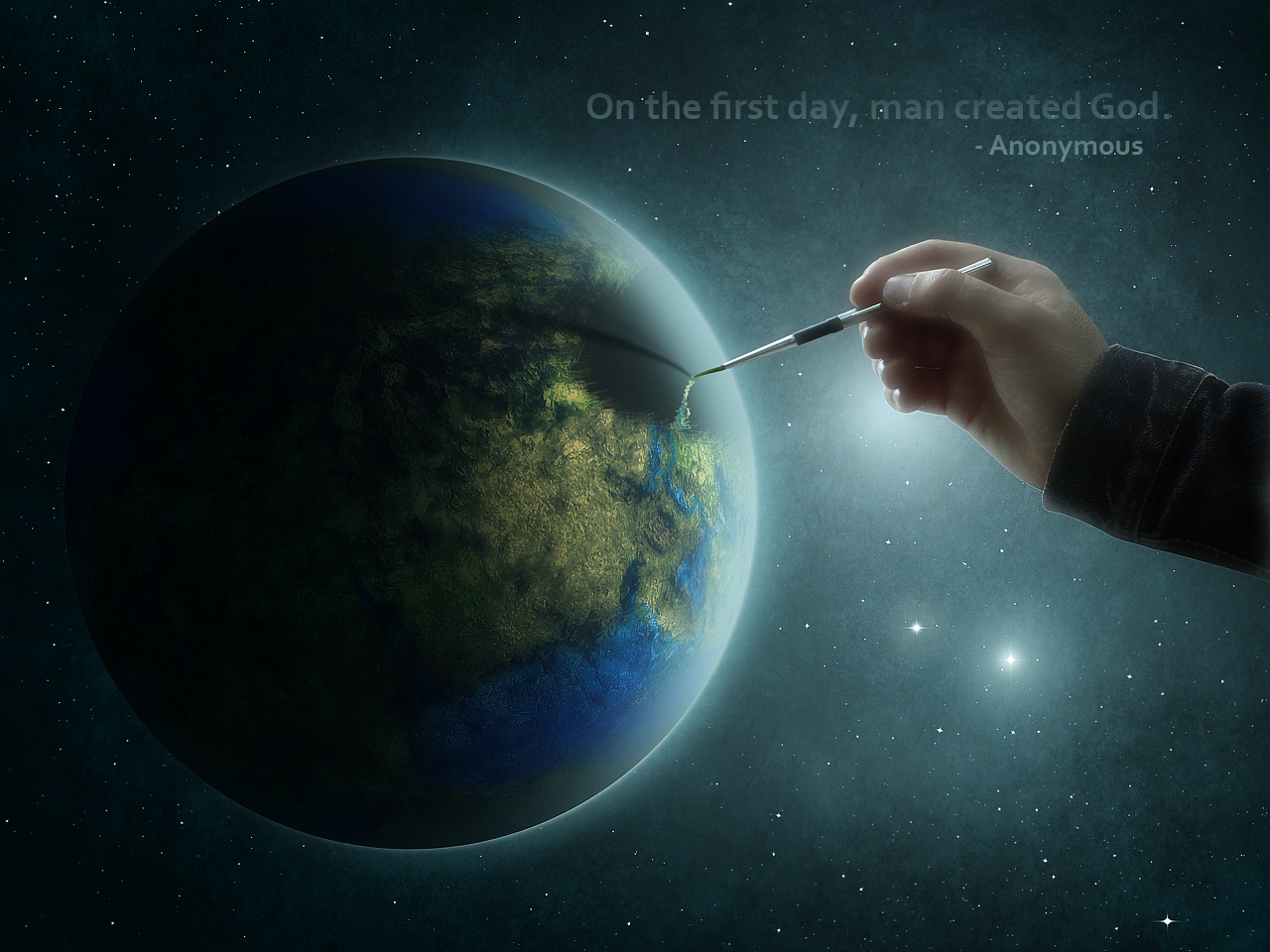
This image depicts a hand using a brush to paint a human figure on the surface of the planet Earth, a visual reference to internet memes and the video game God of War. The text overlay accompanies the action by quoting a famous biblical story: "On the first day, man created God." - Anonymous.
simple-description (llama3.2-vision_11b)
The meme is an image of a hand holding a paintbrush, with the paintbrush creating a perfect circle on a globe. The text "God created the universe in 6 days" is written above the globe, and the phrase "I created the universe in 6 minutes" is written below it. The image is a humorous take on the biblical story of creation, implying that a person with a paintbrush can create a perfect circle on a globe in a much shorter time than the biblical God.
detailed-analysis (gemma3-27b-vision)
Okay, let's break down this image using the lenses you've requested.
Visual Description
The image depicts a dramatic, digitally manipulated scene set in space. A large, partially-rendered Earth, predominantly blue and green, is in the foreground. It appears to be being painted by a human hand wielding a paintbrush. The paint itself seems to be a golden, viscous liquid, dripping from the brush. Behind the Earth is another, smaller planet or celestial body, somewhat obscured by the Earth and the general atmospheric glow. The background is a field of stars and nebulous light. Above this image is the phrase, "On the first day, man created God." The image has a fantastical and provocative quality. The use of digital manipulation is apparent, lending a dreamlike, unreal quality to the scene.
Foucauldian Genealogical Discourse Analysis
This image powerfully invites a Foucauldian reading. The phrase "On the first day, man created God" immediately challenges the traditional discourse surrounding creation myths. It flips the power dynamic, suggesting that "God" isn't a prime mover but an effect of human action.
- Discourse & Power: Foucault would be interested in how the dominant discourse around God has been constructed over time and how it functions to establish and maintain power structures. This image subverts that discourse, demonstrating how concepts like "God" are not transcendental, but rather, products of human "creation" (both literally in the image, and figuratively in the development of religion).
- Genealogy of the Concept of God: A genealogical approach would trace the historical development of the idea of "God," focusing on the power relations and material conditions that have shaped it. The image suggests that the concept isn’t pre-existent, natural, or divine, but is literally made by humanity.
- Truth & Knowledge: Foucault believed that "truth" is not an objective reality, but is produced within specific discourses. The image challenges the "truth" of traditional religious narratives by presenting an alternate origin story, highlighting the constructed nature of religious beliefs. It suggests that "truth" about God is not revealed, but rather, created by the "man" in the image.
- Subject Formation: The image subtly challenges the notion of a universally accepted, naturalized "subject" within the religious discourse. If God is created by “man,” it begs the question of how "man" is defined and constituted within this context.
Critical Theory
This image lends itself strongly to a Critical Theory analysis, particularly drawing on the Frankfurt School's concerns with ideology and the critique of domination.
- Ideology: The image can be interpreted as a critique of religious ideology. It challenges the notion that religious beliefs are based on objective truth or divine revelation, instead suggesting they are constructed by human beings to serve certain interests.
- Enlightenment and Instrumental Reason: The act of "painting" God, and the somewhat cold, sterile aesthetic, might be seen as a comment on the Enlightenment's attempt to "rationalize" the divine. It suggests that when reason is employed instrumentally (i.e., to manipulate and control), it can lead to a desacralization of the world.
- Domination: The act of "creating" God implies a power dynamic—the creator has power over the creation. This image may be interpreted as questioning the power structures inherent in religion, and how they can be used to justify domination and control.
- Alienation: The visual portrayal of a partially-formed, painted Earth could be seen as symbolizing the alienation of humanity from the natural world, and from its own creative potential.
Marxist Conflict Theory
From a Marxist perspective, this image can be read as a commentary on the social construction of religion and its role in perpetuating class relations.
- Religion as an Opium of the People: The image subtly suggests that religion is not a source of genuine liberation, but rather a creation of humanity, potentially used to pacify and control the masses.
- Material Conditions and Ideology: A Marxist reading would focus on the material conditions that give rise to religious beliefs. The image implies that the concept of God is not divinely inspired, but is a product of human labor and creativity, shaped by the prevailing social and economic conditions.
- Power Dynamics: The image highlights the power of the "creator" over the "creation." From a Marxist perspective, this could be seen as a metaphor for the power of the ruling class to shape ideology and maintain its dominance.
- False Consciousness: The painted, somewhat artificial quality of God could be interpreted as a symbol of false consciousness—the distortion of reality that prevents the working class from recognizing its true interests.
Postmodernism
This image is highly compatible with a postmodern interpretation.
- Deconstruction of Grand Narratives: The image directly challenges the "grand narrative" of traditional creation myths. It proposes an alternate origin story that deconstructs the idea of a divine creator and emphasizes the human role in shaping religious beliefs.
- Simulacra and Simulation: The painted Earth and "painted God" can be seen as simulacra—copies without originals. It suggests that reality itself is increasingly mediated by representations, and that the distinction between reality and illusion is becoming blurred.
- Rejection of Essentialism: The image rejects the idea that God is an essential, immutable being. It presents God as a construct, a product of human imagination and creativity.
- Emphasis on Subjectivity: The image suggests that our understanding of God is not based on objective truth, but is shaped by our subjective experiences and interpretations.
Queer Feminist Intersectional Analysis
This is a complex lens, but with potentially insightful results:
- Challenging Patriarchal Creation Narratives: Traditionally, creation stories have often been used to justify patriarchal social structures. This image, by placing "man" as the creator, can be seen as a feminist critique of these narratives. It questions the idea that God is a masculine figure, and suggests that the concept of God is socially constructed, not divinely ordained.
- The "Man" as a Universalized Subject: The use of "man" as the creator (rather than a gender-neutral term) can be seen as reinforcing patriarchal power structures. A queer feminist reading would question the universalization of "man" and highlight the exclusion of other gender identities and sexualities from this narrative.
- Intersectionality: The image's critique of power structures can be extended to an intersectional analysis. The act of "creating" God can be seen as a metaphor for the creation of other social categories and hierarchies, based on race, class, and other forms of identity.
- Reclaiming Creation: A queer feminist perspective might also reclaim the act of creation as a form of resistance against oppressive social norms. By challenging traditional creation narratives, the image opens up space for alternative ways of imagining the world and our place in it.
- Deconstructing "God" as a Site of Control: The image suggests that “God” is not a fixed entity, but a malleable construct. This aligns with queer and feminist critiques of rigid social categories and power structures.
I hope this detailed analysis meets your requirements! Let me know if you'd like me to elaborate on any of these points or explore other theoretical frameworks.
simple-description (llama3.2-vision)
The meme is an image of a person's hand holding a paintbrush, with a globe in the background. The paintbrush is creating a massive tear in the globe, as if the person is painting a hole in the Earth. The text "On the first day, God created the Earth. On the second day, he created mankind. On the third day, he created paint. On the fourth day, he destroyed the paint. On the fifth day, he created the internet. On the sixth day, he created animals. On the seventh day, he rested. On the seventh day, he created Facebook."
tesseract-ocr
- ; On the first day, man created God. 2 ee - -Anonymous' ; ae eee a. : ; = -_ “s eS 7 - Ss p ec i es wr —