First Seen
2023-05-10T21:03:42+00:00
simple-description (qwen3.5_2b-q8_0)
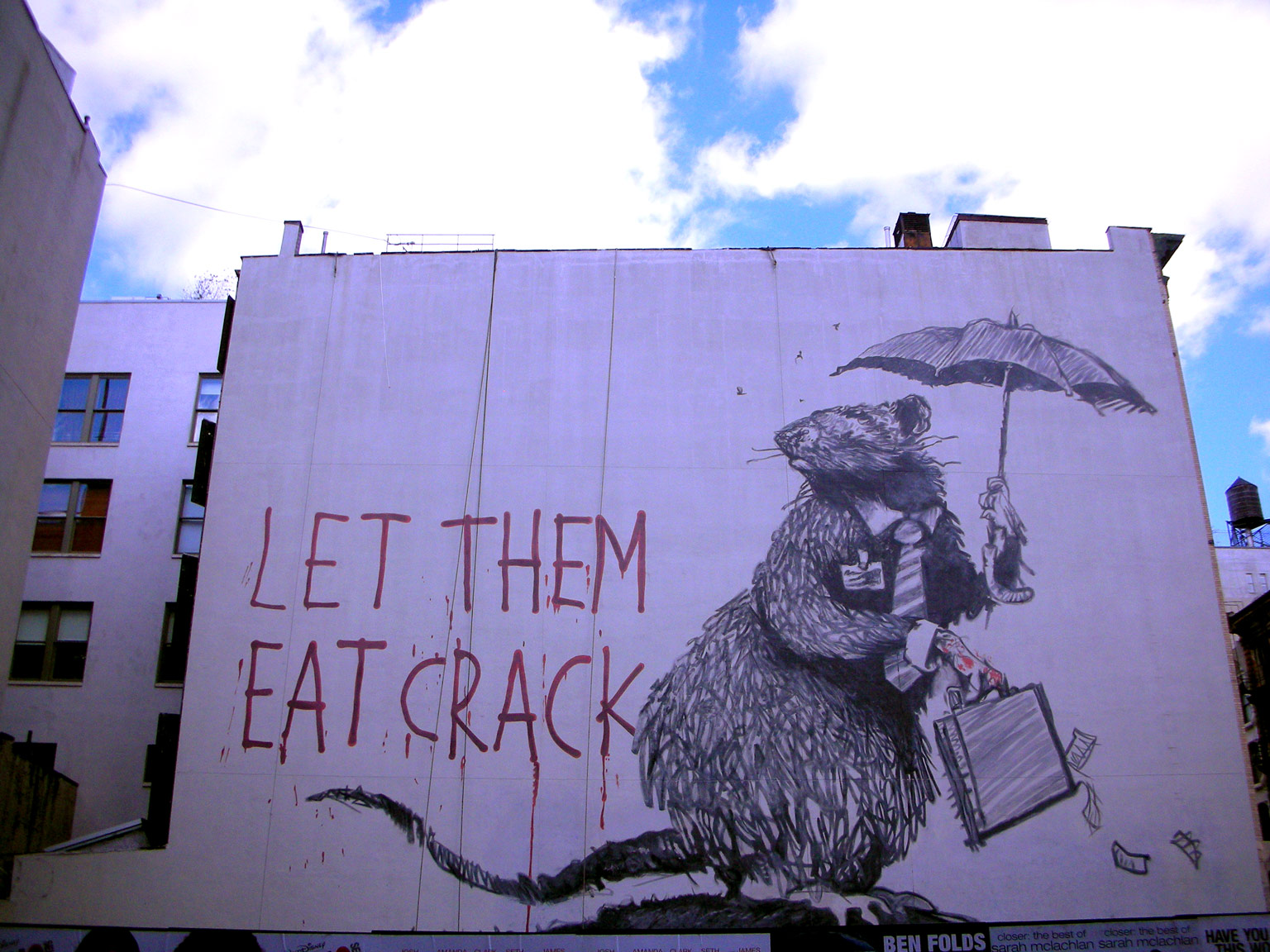
This large-scale mural features a rat dressed in a suit, holding an umbrella over its tail and carrying a briefcase. The text "LET THEM EAT CRACK" is a humorous play on the word "rack," likely referencing the colloquial term for a hard-boiled egg or simply creating a nonsensical command that plays on the visual elements. This piece of street art blends a familiar urban icon with a pun to form a funny, surreal scene.
simple-description (llama3.2-vision_11b)
The meme is an image of a cartoon rat wearing a business suit and holding a briefcase, with a caption "Papes". The image is a humorous take on the stereotype of a rat in a business setting, implying that the rat is a high-rolling executive who is also a "pape" or a user of the dark web. The image is meant to be ironic and playful, poking fun at the idea of a rat in a business context.
detailed-analysis (gemma3-27b-vision)
Okay, here's an analysis of the Banksy mural (as it appears to be) as requested, broken down into the sections you provided, only including those applicable.
Visual Description
The image is a large-scale mural painted on the side of a building. The mural depicts a rat, rendered in a graphic, sketchy black and white style, reminiscent of stencil art. The rat is dressed as a gentleman, complete with a top hat, waistcoat, and holding a small umbrella. It is also holding a placard that appears to have writing on it. Above the rat, scrawled in a rough, uneven font, is the phrase “LET THEM EAT CRACK.” The building itself is a relatively plain, light-colored brick structure, and there are partial views of adjacent buildings visible on either side. The sky above is a light blue with some clouds. The overall aesthetic is stark and gritty, characteristic of street art. The artwork makes a pointed, satirical statement, using humor and irony to critique societal inequalities.
Foucauldian Genealogical Discourse Analysis
This artwork is rich for Foucauldian analysis. The phrase "Let Them Eat Crack" directly references Marie Antoinette's infamous (though likely apocryphal) “Let them eat cake,” a statement that exemplifies the perceived disconnect between the ruling class and the suffering populace during the French Revolution. However, substituting "cake" with "crack" radically alters the historical context.
Foucault's genealogical method encourages tracing the shifts in discourse and power relations that transform a statement like this. The change from cake to crack signifies a shift from a critique of luxury to one of addiction, systemic marginalization, and the denial of basic needs. "Crack" evokes connotations of poverty, desperation, and the social problems often associated with drug use, and the way these are framed by societal power structures.
The artwork functions as a counter-discourse. It deconstructs the original historical narrative and forces us to question how the same patterns of power and social division operate in contemporary society. The rat, often seen as a symbol of the underclass or those living in the margins, becomes a powerful vehicle for this counter-narrative. The depiction of the rat in a gentleman's attire adds a layer of irony, highlighting the absurdity of a system where even the marginalized are expected to adhere to the norms of the elite. Power is not imposed through direct authority, but through discourse - and this art actively disrupts the conventional language of social and economic inequality.
Critical Theory
The mural embodies aspects of the Frankfurt School's Critical Theory. The artwork critiques the illusion of social progress, revealing the persistence of power imbalances. It challenges the dominant ideologies that justify inequality. The reference to Marie Antoinette, even with the changed wording, acts as a reminder that despite surface-level changes, the same exploitative dynamics can persist across time.
The image also invokes Adorno and Horkheimer’s concept of the “culture industry.” The seemingly ironic image of a rat in aristocratic garb becomes a critique of the commodification and aestheticization of social issues. The mural critiques the way in which systems of power are normalized and perpetuated through cultural representations. It questions how dominant culture can distract from the realities of inequality.
Marxist Conflict Theory
From a Marxist perspective, this mural is a clear representation of class conflict. The rat symbolizes the proletariat—the working class—and the aristocratic attire is a satirical commentary on the attempts of the ruling class (represented by the historical reference to Marie Antoinette) to maintain its power and privilege.
The phrase "Let Them Eat Crack" exposes the indifference of the elite to the suffering of the lower class. Crack cocaine is associated with marginalized communities and systemic oppression. The statement suggests that the ruling class not only ignores the needs of the poor but actively profits from their misery. The artwork visualizes the inherent antagonism between these social classes. The conflict isn’t physical, but economic and ideological. The image is a visual call for revolution, or at least a challenge to the status quo.
Postmodernism
The mural exhibits hallmarks of postmodernism. The appropriation of a historical phrase ("Let them eat cake") and its alteration (“Let them eat crack”) is an act of pastiche – the imitation of stylistic elements from different sources. The artwork doesn’t offer a singular “truth” but rather questions the very concept of truth.
The image embraces irony and ambiguity. The contrast between the rat’s aristocratic dress and the drug reference creates a sense of paradox and challenges the viewer to interpret the artwork's meaning. The artwork is a rejection of grand narratives—the idea that there is a single overarching story that explains the world. Instead, it presents a fragmented, subjective, and politically charged perspective. It is a self-reflexive commentary on representation and the power of images to shape our understanding of the world.
Let me know if you'd like me to elaborate on any of these sections or analyze the artwork from a different theoretical perspective.
simple-description (llama3.2-vision)
This meme features a drawing of a rat wearing a business suit and holding a briefcase, with a caption that reads "Let them eat cake... rats". The image is a play on the phrase "let them eat cake", which was originally said by Marie Antoinette, but in this case, it's a rat that's saying it, implying that even a rat can be a snob.
tesseract-ocr
" " . x ; x SRR or ca Sf ae ee 1 | ; ; | = ee Bs + eae 2 =e "