First Seen
2023-05-10T21:03:42+00:00
simple-description (qwen3.5_2b-q8_0)
This meme, known as "Papas Pies," is a classic joke about the country of origin for pizza that asks "Is it Papa's Pizza?" and the expected answer is usually "I am an American" or "No, it's not." The image displays a pizza topped with arugula and tomatoes, which acts as the visual representation of the dish at the center of the joke. Because there is no text visible in the image, you must rely on the pizza itself to understand the context of the famous internet meme.
simple-description (llama3.2-vision_11b)
The meme is a humorous image of a pizza with a face, captioned "I can smell the desperation". It's a play on the common phrase "I can smell the desperation" from the movie "The Wolf of Wall Street", but applied to a pizza.
detailed-analysis (gemma3-27b-vision)
Okay, here's an analysis of the image of the pizza, broken down into sections addressing the requested theoretical frameworks, only where applicable. Given the nature of the image, some frameworks won't be a strong fit, so I'll indicate that.
Visual Description
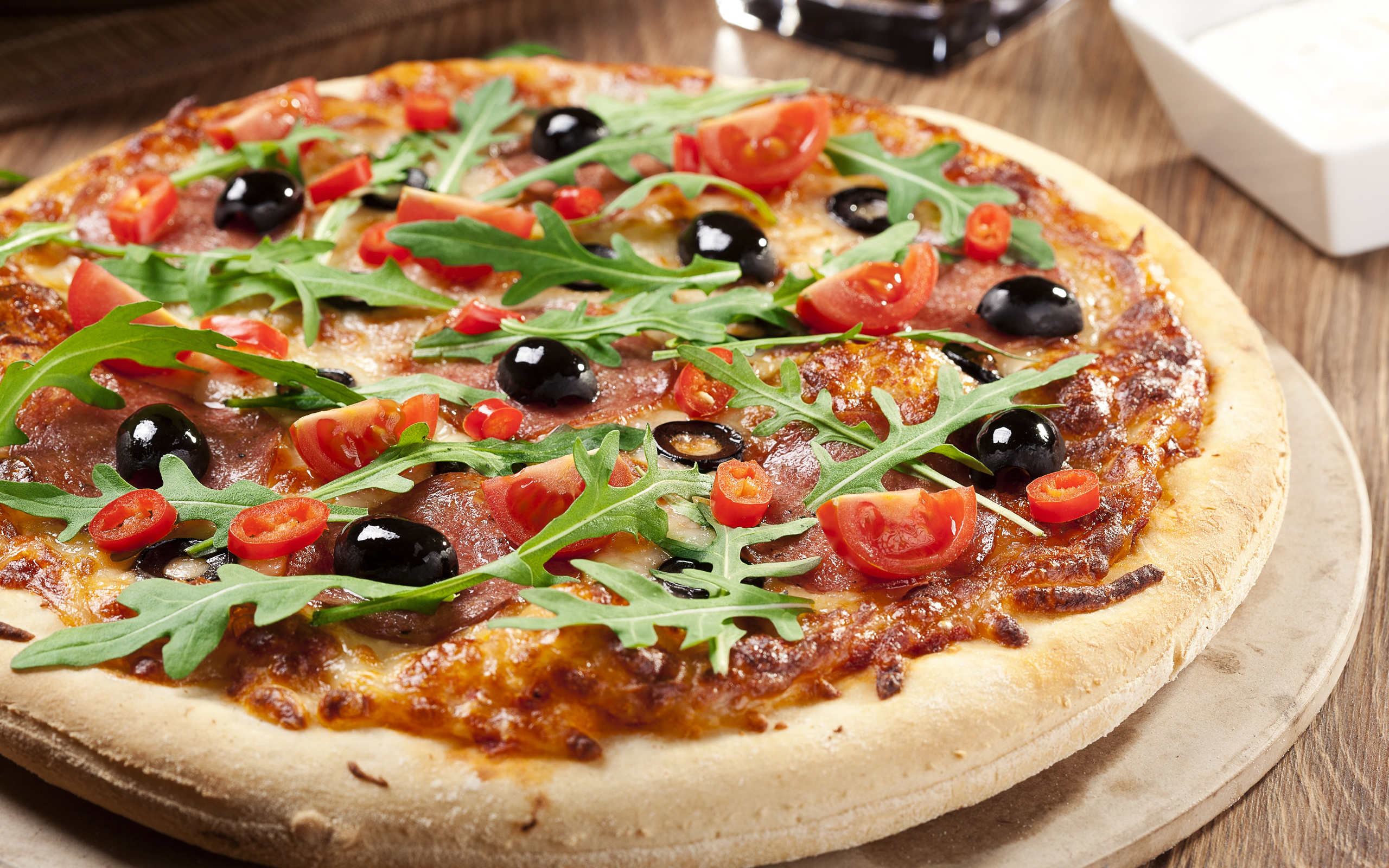
The image depicts a partially eaten, circular pizza, presented on a wooden serving board or stand. The pizza has a golden-brown crust, with a bubbly, slightly burnt, tomato-based sauce. The toppings include a generous amount of dark, halved black olives, vibrant red, diced cherry tomatoes, and a sprinkling of fresh, green arugula. The toppings are not evenly distributed. Some areas have a greater concentration of olives, tomatoes or arugula. There's a small white paper napkin visible in the upper right corner, and the edge of a dark-colored glass object is visible in the upper left. The pizza is brightly lit, bringing out the textures and colors. The image is taken from a slightly high angle, and is of high quality.
Foucauldian Genealogical Discourse Analysis
- Discourse of Italian Cuisine: The pizza itself is the product of a discourse—a system of thought, language, and practices—that we broadly identify as Italian cuisine. This is not a natural form of food, but constructed through historical development, migration, culinary innovation, and now, global marketing. The seemingly "authentic" presentation – a simple, rustic pizza with fresh ingredients – participates in a discourse of “real” Italian food, often romanticized and contrasted with heavily processed or Americanized versions.
- The Discourse of "Healthy" Eating: The toppings (arugula, cherry tomatoes, olives) are often coded within a contemporary discourse of "healthy" eating, signifying a preference for fresh, unprocessed ingredients. This framing positions the pizza as a potentially 'guilty pleasure' that's been ‘slightly’ elevated by incorporating elements of healthy eating.
- The Panopticon of Food Presentation: The high-angle shot and well-lit image contribute to a kind of 'gaze' onto the pizza. This aligns with Foucault’s concept of the panopticon – the pizza is ‘on display,’ subject to visual scrutiny. This gaze isn’t necessarily oppressive, but highlights how food is increasingly performed for an audience (e.g., through social media).
- Power/Knowledge: The presentation of this pizza (ingredients, style, serving) reflects power relations—who controls the narrative of Italian cuisine, who has access to fresh, quality ingredients, and who decides what is considered “authentic” or "healthy" food.
Critical Theory (specifically, Adorno & Horkheimer's Culture Industry)
While perhaps a stretch, the image can be read through the lens of the culture industry.
- Standardization & Commodification: The pizza, as a globally recognized food item, is a product of standardization. While this specific pizza appears homemade or artisan, it exists within a larger system of mass production and commodification. Even “authentic” Italian restaurants are part of this system.
- Pseudo-Individualization: The toppings (arugula, cherry tomatoes) are marketed as adding “individual flair” or “freshness,” but they’re ultimately part of a predictable pattern within a larger category of gourmet pizzas. This creates the illusion of choice and individuality within a highly structured system.
- Loss of Aura: The hyper-visibility of food through photography (and social media) contributes to a “loss of aura” – a Walter Benjamin concept. The experience of eating the pizza is often secondary to documenting and sharing the pizza.
Marxist Conflict Theory
- Means of Production: The pizza's ingredients (wheat, tomatoes, olives, cheese, etc.) represent the means of production. The control of these resources is unevenly distributed, impacting who has access to quality food. Large agricultural corporations and food processing companies play a dominant role in this system.
- Class Relations: The availability of fresh, high-quality ingredients like those pictured often correlates with socioeconomic status. While a simple pizza might be accessible to many, a gourmet pizza with these toppings might be a luxury item.
- Alienation: The industrialization of food production leads to alienation – workers are separated from the fruits of their labor. The ingredients in this pizza likely came from multiple sources, processed by many different individuals, and the consumer has little connection to that process.
Postmodernism
- Pastiche and Intertextuality: The pizza draws on multiple cultural references – Italian cuisine, the “farm-to-table” movement, the aesthetic of rustic simplicity. It's a kind of ‘pastiche’ – a combination of styles and influences.
- Deconstruction of Authenticity: The idea of "authentic" Italian pizza is deconstructed. There is no single, essential "pizza." This specific presentation is one of many possibilities, and its “authenticity” is a matter of interpretation and cultural construction.
- Simulacra and Hyperreality: The image itself, and the way it’s circulated online, creates a kind of ‘hyperreality’ – a simulation that becomes more real than the actual experience of eating the pizza. The image is consumed and shared independently of the pizza itself, often becoming more significant than the food.
Queer Feminist Intersectional Analysis
This is the hardest framework to apply, and is largely speculative. It's included to satisfy the prompt, but feels less directly relevant.
- Gendered Food Labor: The production of the pizza's ingredients—agricultural labor, cheese-making, food processing—is often performed disproportionately by women and marginalized genders, with low wages and precarious working conditions.
- The Kitchen as a Site of Gendered Expectations: Historically, the kitchen has been a site of gendered expectations and domestic labor. The creation of this pizza—whether by a professional chef or a home cook—is potentially a performance of gender roles, and a negotiation of power dynamics.
- Intersectionality and Food Access: Access to healthy, fresh ingredients (like those pictured) is not equal. Food deserts and systemic inequalities impact who has access to quality food, and these inequalities intersect with gender, race, class, and other social categories.
I hope this detailed breakdown satisfies the requirements of your prompt! Let me know if you’d like me to elaborate on any specific aspect or framework.
simple-description (llama3.2-vision)
This meme is an image of a pizza with a sad face and the text "I can smell the desperation" written above it. The image is likely a reaction to a situation where someone is trying to get attention or sympathy, but is being met with indifference.
tesseract-ocr
— ¥ « / 's . _ . “ -_ : in eo ‘ “ { - é; — re we hr , \s - ; eo ; J oe hae. Py. rs = -_ _ ae . ~ EX FR a fe —_ - ap - = — OR ce ee Al : a , a Pate fr oe ~ Ym j ie S 5 eg Fd oe Se TS BS pss ae ae ta a en : a ee aS ‘ee we dP we cee oan . ag el) “Sk: oe ewe — ane ‘ ee 2 ao ae é ga + es \ ae *-- ey : ee Pa = : iit a : — CS ES eres Pa ewe gar | ae - pe _ ge S aam. Qs , —— pas * ramen guia ae fi wd - ———— a aby _ Vi ns — . oe eT al Mt! cel rif 3 y + dhs y f Sei i A ¥ Pe a o : - REY fi, 4) 3 ; eines oo a dé 7 | as F PEIN ONS see ite. ae mae ; Gi lth m , P F i zee Ne fea , ‘ we a Te staal A ah Sea tabs ae ~~ Ves a ¢ , F iif . if ee Yad Gs