First Seen
2023-05-10T21:03:42+00:00
simple-description (qwen3.5_2b-q8_0)
Based on the visual evidence and the context provided, the image depicts the character Peep from Garry's Mod (the "Red" version, with a red suit and blue hat), rendered as a 3D wireframe.
To explain this from the perspective of the "Peeps" meme category (a common internet meme featuring four 2D symbols representing the concepts of 1, 2, 3, and 4), here is the likely connection:
- Interpretation of "Peeps": While the iconic "Peeps" meme consists of four distinct, flat 2D symbols (often representing the letters "1", "2", "3", and "4"), the user likely interprets the image based on the character's design elements.
- Mapping the Elements: The user sees the character's design as containing four distinct "peeps" (points of light or distinct parts):
- The head (1 light).
- The eyes (2 lights, which are blue).
- The chest (1 light).
- The character (1 symbol, represented by the character model).
- This sums to four distinct "peeps" or points, mimicking the layout of the original meme.
- The "Papes" Typo: The prompt contains a typo ("Papes"), but the intended term is almost certainly "Peeps", as the "Peeps" meme is a well-known internet trope involving four symbols.
- Character Identity: The character in the image is Peep from Garry's Mod, a meme character known for being a "red suit" or "blue suit" guy. His appearance (red suit, blue hat, wireframe model) has been popularized in memes.
- Connection to the Meme: The user is likely using the character's name ("Peep") or his design (which looks like a "peep" or bug) to reference the "Peeps" meme, interpreting the 4 "peeps" (points) on the character as the 4 symbols of the meme.
In conclusion, the image is a 3D wireframe of the Peep character from Garry's Mod, and the "meme" is likely the user's interpretation of the character's four distinct design elements (head, eyes, chest, character symbol) as the four "peeps" of the meme.
Final Answer:
The image displays the character Peep from Garry's Mod (the "Red" version with a red suit and blue hat), rendered as a 3D wireframe. While the iconic "Peeps" meme consists of four distinct 2D symbols, the user is likely interpreting the image as a Peeps meme by mapping the character's four distinct design elements (head, eyes, chest, character symbol) to the meme's "peeps." The "Papes" in the prompt is likely a typo for "Peeps," and the meme is a creative interpretation of the character's appearance as a 3D version of the classic Peeps symbols.
simple-description (llama3.2-vision_11b)
The meme is an image of a person with a face that has been distorted to resemble a cartoon-like character, with exaggerated features and a goofy expression. The text "I can smell the desperation" is written above the person's head, implying that someone is trying too hard to be funny or relatable.
detailed-analysis (gemma3-27b-vision)
Okay, let's break down this striking image using the frameworks you've requested. Given the image's themes, some areas will be more prominent than others.
Visual Description
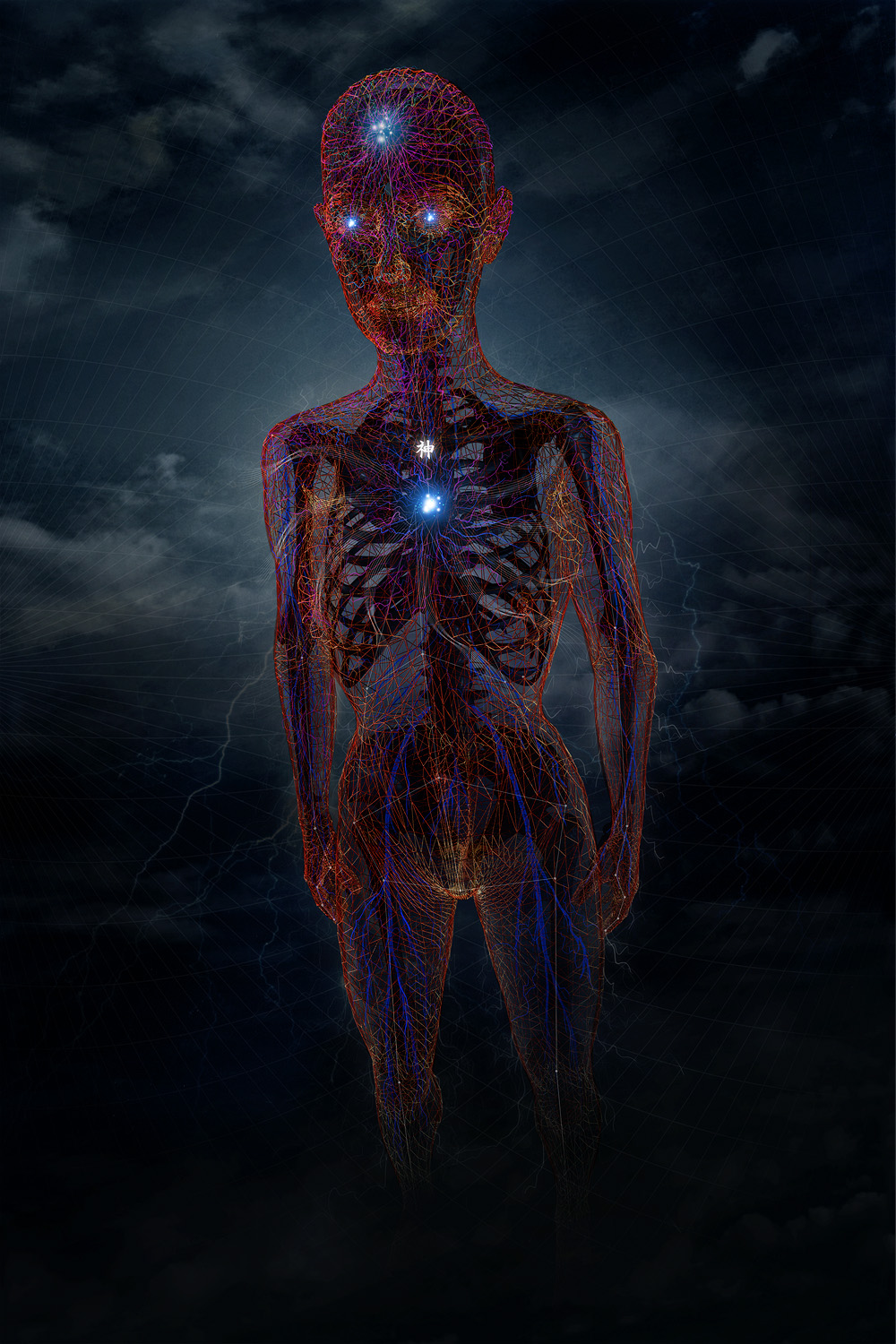
The image presents a digitally rendered, semi-transparent, human-like figure against a deep, stormy, dark gray and black background. The figure appears to be female, as suggested by the curvature of the form and the suggestion of breasts. However, the figure is not solid; instead, it's constructed from a network of vibrant, glowing lines. Red lines delineate the musculature and outer form, while blue lines trace what appear to be veins and internal structures. The figure is almost skeletal in appearance, with a visible rib cage and the lines forming the structure of limbs and torso.
Crucially, the figure isn't simply empty within. Two points of light, resembling eyes, and a bright blue orb located in the chest where the heart would be, act as focal points. These suggest internal energy or consciousness. The figure is surrounded by streaks of what appear to be electricity or lightning in the background, furthering the sense of energy and turbulence. The entire visual aesthetic is reminiscent of wireframe computer graphics and bioluminescence, creating a powerful impression of technology intersecting with the organic.
Foucauldian Genealogical Discourse Analysis
This image lends itself well to a Foucauldian reading. Foucault’s genealogy examines how systems of knowledge and power (discourses) have developed over time, constructing concepts of the “normal” and “abnormal.”
Here’s how it applies:
- The Body as Site of Power: The deconstruction of the body into lines suggests a dismantling of the traditional, unified, and essentialized notion of the body. The figure is not a whole, stable entity but a network of forces, a constructed assemblage. This can be seen as echoing Foucault’s analysis of how the body is disciplined and controlled through institutions and power relations.
- Epistemological Shift: The image depicts a body defined not by its physical substance but by energetic pathways. This suggests an epistemological shift—a move away from understanding the body as a solid, objective reality and toward understanding it as a system of flows, energies, and information.
- Normalization & Deviation: The "wireframe" presentation can be interpreted as a stripping away of the normative expectations of physical appearance, exposing the underlying infrastructure. The bright internal organs contrast with the lack of flesh and bone, creating a tension between natural and artificial. This disruption of the “natural” may represent a challenge to the normalization of bodies and an embrace of deviation.
- Surveillance/Panopticism: The exposed internal structure, especially the glowing chest, could subtly hint at a sense of surveillance. It's as if the very core of being is on display.
Critical Theory
This image speaks to core tenets of Critical Theory, particularly regarding modernity and its consequences:
- Dehumanization & Technology: The image embodies anxieties about the impact of technology on the human condition. The reduction of the body to a network of lines implies a loss of its essential humanity, a transformation into a technological artifact. It evokes the fear of being reduced to data points, algorithms, and systems.
- The Fragmentation of the Subject: The disassembled, incomplete nature of the figure represents a fracturing of the unified, autonomous subject that is central to Enlightenment thought. The figure isn’t a complete individual but an assemblage of parts, suggesting a postmodern dismantling of the self.
- Commodification & Control: The figure’s representation as a network can be read as an analogy to the way bodies are increasingly mapped, monitored, and controlled in modern society – by surveillance technologies, medical institutions, and consumer culture.
Postmodernism
This image is deeply rooted in postmodern aesthetics and concepts:
- Simulacra & Simulation: The image doesn't represent a "real" body; it's a simulation, a representation of a representation. It can be seen as a “simulacrum” in the Baudrillardian sense – a copy without an original. The image’s constructed nature blurs the line between reality and representation.
- Deconstruction & Fragmentation: The disassembly of the body is a classic postmodern technique – a dismantling of traditional structures and forms to expose their inherent instability. It rejects the idea of a unified, coherent self.
- Hyperreality: The image evokes a hyperreal atmosphere – a world where representations have become more real than reality itself. The vibrant, glowing lines create a visually striking, almost surreal experience that surpasses the mundanity of the natural world.
- Loss of Grand Narratives: The image rejects any singular definition of the body, challenging the traditional narrative of human form and biology.
Queer Feminist Intersectional Analysis
This is where the image becomes particularly rich and nuanced:
- Challenging Biological Determinism: The deconstruction of the female form challenges the idea that gender and bodies are fixed or essential. The lines that represent the body are not necessarily bound to traditional notions of femininity or biological sex.
- Reclaiming the Body: Though fragmented, the image doesn’t necessarily represent a loss of the body. The glowing lines and internal energy suggest a reclaiming of the body as a site of power, creativity, and resistance. It’s a body re-imagined, not necessarily destroyed.
- Disrupting the Male Gaze: The image presents a female form that is not objectified or passive. It’s not a body presented for the gaze; it's a body that exists as a complex energetic system, internal and self-contained.
- Intersectionality of Technology & Body: The image highlights the increasingly complex relationship between bodies, technology, and power. It can be seen as a commentary on how technology impacts and shapes the experiences of marginalized genders and bodies. The lines themselves can be seen as a metaphor for the ways in which bodies are mapped, monitored, and controlled by technological systems.
- Queer embodiment: The lines could be seen as rejecting traditional body norms and embracing fluid forms of embodiment that challenge the binary of male and female.
I hope this detailed analysis provides a useful interpretation of the image through these different theoretical lenses! Let me know if you would like me to expand on any particular aspect.
simple-description (llama3.2-vision)
The meme is a photo of a person's body with all the internal organs and systems exposed, like a skeleton. The image is a humorous representation of the idea that the body is like a "house" that can be "broken down" and "repaired" through various means, such as exercise and healthy eating. The text in the image reads "Break down, build up" in a bold, playful font.
tesseract-ocr
" ee oe ee ~ oe ~~. = a" ae eat " we : | + lee eS ek Vie” Cieees eae: S | ee ee ae Ss ae Wii ig eal te = | ie eee Bias ick Ls ; i \ ‘ F ee ree a , | ' @ eee : ara Lia Ny sik os aS en wo oS ee x , | Re ig’ es e ewe x ' > ‘ * = f Fae a - a gy ae 1G me iN z ee, Ke 2 a it eee i= = EM Loe i ee c | Yi, he Ae si Te 3 - a ear g ae Need S| . af =) , = a Kd g a oN oa \ | a Ae) i Ae nie No ie oo ae tee eT ee 4 Ne Ney A Mi | ea Nos ¥) | ee wey) i Bb Ey ( YY AY hie aye of ‘ Lace ae” DUAN ree i 4 a SS GaN S ‘ % ae Site 3 p \ a bs EG ’ f VS A Mele We ay j iS Aw my \ Ne Wy % : i ee ye ‘ a “i | Koy 4 We SAN RN