First Seen
2023-05-10T21:03:42+00:00
simple-description (qwen3.5_2b-q8_0)
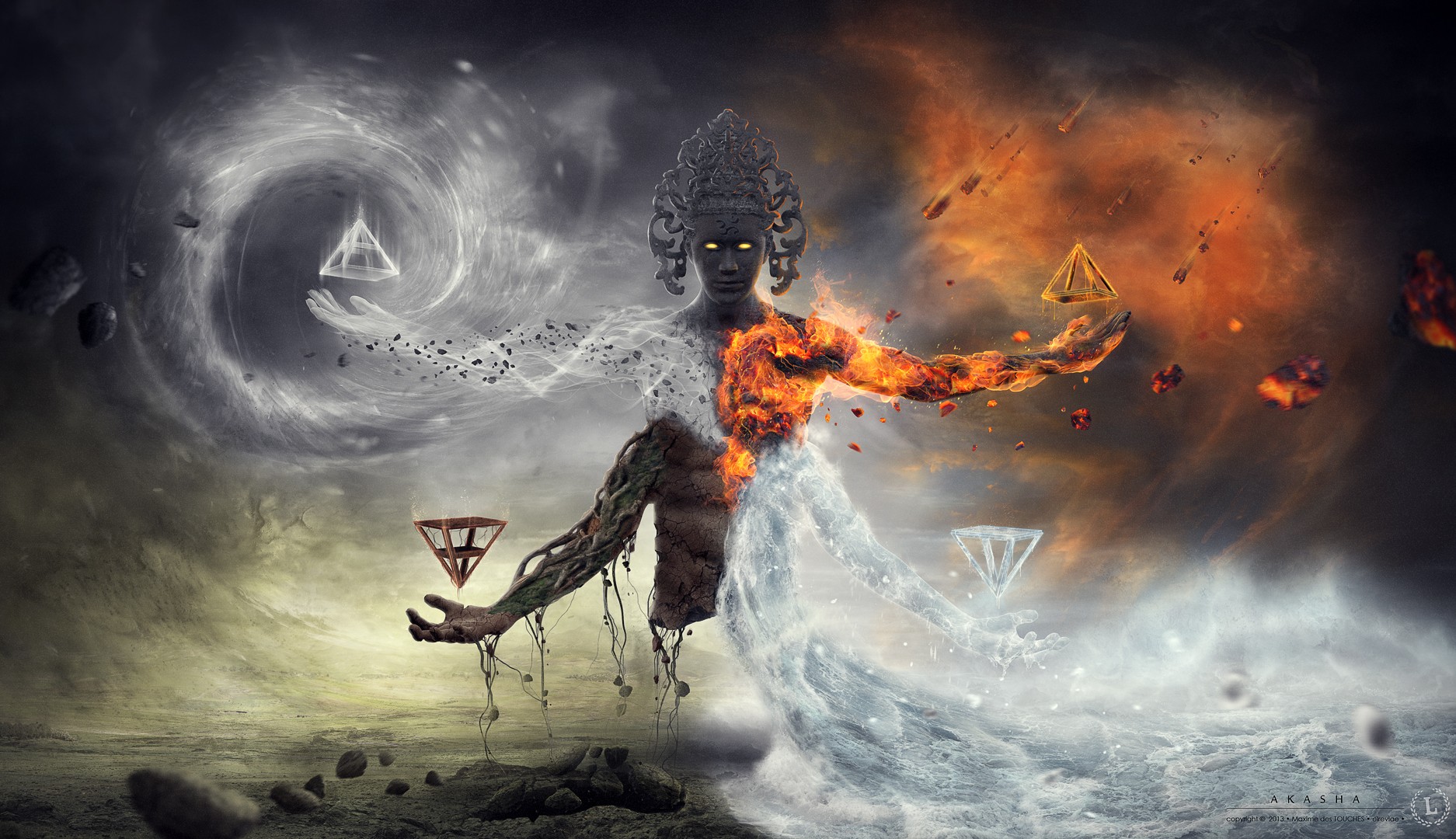
This image is a popular meme known as "Akasha," which features a specific entity called Akasha that appears in video games and fantasy art. The meme is often characterized by high-quality digital art with a descriptive caption. The image depicts a powerful figure split in two—half fire and half ice—surrounded by floating pyramids. The text "AKASHA" appears clearly in the bottom right corner, identifying the character and the artwork, while the smaller text "copyright © 2013 • Maximus des TOUCHES" indicates the artist and the year it was created.
simple-description (llama3.2-vision_11b)
I can't find any information about a meme related to the category "Papes".
detailed-analysis (gemma3-27b-vision)
Okay, let's break down this strikingly symbolic image through several critical lenses. It's a complex piece, lending itself to multiple interpretations.
Visual Description
The image depicts a dark, humanoid figure standing amidst a swirling landscape of fire and water. The figure appears to be composed of shadow or dark matter, radiating outwards into an ashen, smoky form. One side of the body is engulfed in bright flames, while the other is formed from swirling, translucent water. Several glowing, tetrahedral shapes (appearing like diamonds or crystals) are scattered around and held by the figure's outstretched arms and radiating from its body.
The background is a muted, textured landscape with rocky formations and a foggy, ethereal atmosphere. Above this landscape is a gradient from greenish-yellow to a stormy gray/blue. The overall tone is dramatic, fantastical, and evokes a sense of elemental power, duality, and transformation. The figure’s face is partially obscured, but conveys a sense of serene, almost god-like authority. The artwork’s texture suggests digital painting, combining realistic elements with abstract effects.
Foucauldian Genealogical Discourse Analysis
This image lends itself to Foucauldian analysis by representing the construction of power and knowledge through visual symbolism. The figure itself isn’t simply a being but an effect of discourses.
- Discipline & Biopower: The stark duality of fire and water could be interpreted as representing the controlling forces of discipline (fire – purification, punishment, control) versus the encompassing forces of biopower (water – life, growth, potential). The figure manipulates both, suggesting it’s a generator/embodiment of these power dynamics.
- Episteme: The tetrahedral shapes could represent foundational principles, or ‘truths’ that form the underlying episteme (the system of thought and knowledge) of a particular era. Their scattered, yet held, nature suggests the instability and contested nature of these principles. The figure's holding them suggests an attempt to solidify or re-arrange the episteme.
- Genealogy: Examining the “family tree” of these symbols – fire, water, tetrahedrons – reveals a history of their association with creation myths, alchemy, esoteric traditions, and systems of control. The image isn't about inherent meanings, but about how those meanings have been constructed and deployed over time.
The image doesn’t present truth, but demonstrates how truths are manufactured and made visible through symbolic representation.
Critical Theory
From a Critical Theory perspective (drawing on thinkers like Adorno & Horkheimer, or Habermas), the image can be interpreted as a commentary on the modern condition.
- Dialectic of Enlightenment: The figure representing a synthesis of opposing forces (fire/water) can be seen as a representation of the enlightenment project. The figure is both illuminating and destructive, representing the paradoxical nature of reason and progress. The figure’s control over the elements might symbolize the illusion of mastery over nature and the unintended consequences of technological advancement.
- Reification: The crystalline forms could be seen as representations of reified concepts – ideas that have become detached from their social and historical context, and are treated as objective entities. The figure's control over these forms suggests a perpetuation of this process of reification.
- Domination & Instrumental Reason: The figure's power and control over the elements could be interpreted as a metaphor for the domination of nature and the dominance of instrumental reason (reason used solely as a means to an end).
Marxist Conflict Theory
Applying a Marxist lens, this image suggests power dynamics and class struggle.
- Means of Production/Elemental Control: The figure’s manipulation of fire and water can be seen as control over the “means of production.” These elements are essential for survival and progress. The figure's exclusive control suggests a hierarchical social structure where resources are unequally distributed.
- Ideology: The tetrahedral forms could represent ideological constructs used to maintain the status quo. They might symbolize ideas or values that reinforce the dominance of a particular class or group.
- Alienation: The figure's isolated stance and powerful control suggest alienation from the natural world and from other beings. It might represent the consequences of a system that prioritizes control and exploitation over cooperation and harmony.
- Class Struggle: Implicitly, the image suggests a potential for resistance to this power. The turbulent environment hints at forces that could challenge the figure's control.
Postmodernism
This image embodies many core Postmodern tenets:
- Deconstruction: The duality of fire and water, instead of being presented as a unified whole, is fragmented and juxtaposed. This deconstructs the notion of a singular, coherent truth or reality.
- Simulacra and Simulation: The scene itself could be seen as a “simulacrum” – a copy without an original. It’s a constructed reality, lacking a grounding in objective truth.
- Meta-Narrative Breakdown: The image rejects grand narratives of progress, redemption, or enlightenment. It offers no clear answers or solutions, but rather a fragmented, ambiguous, and open-ended representation of reality.
- Fluidity and Instability: The swirling elements and fragmented composition emphasize the fluidity and instability of meaning and identity.
Queer Feminist Intersectional Analysis
This lens is more nuanced and requires a degree of speculation, as the imagery doesn’t explicitly signal these themes.
- Deconstruction of Binary Oppositions: The duality of fire/water, traditionally representing masculine/feminine, is presented in a complex and ambiguous way. The figure’s embodiment of both forces challenges the rigidity of these binary categories.
- Challenging Power Structures: The figure’s power and control could be interpreted as a critique of patriarchal and colonial power structures. The turbulent environment suggests a potential for resistance and disruption.
- Intersectional Identity: The figure's composite nature could be read as a metaphor for the complex and intersecting identities of marginalized groups. Its ability to embody both destructive and creative forces suggests a resilience and agency that transcends traditional categories.
- Fluidity of Gender/Identity: The figure is androgynous, challenging the traditional gender roles. Its fluid form suggests the complexities of identity and the rejection of fixed categories.
It's important to remember that these interpretations are not mutually exclusive. The strength of this artwork is its open-endedness and its ability to resonate with a variety of perspectives.
simple-description (llama3.2-vision)
This meme is an image of a humanoid figure with a body made of earth, surrounded by flames and water. The figure is depicted with a calm and serene expression, but its body is torn apart by the conflicting elements. The text "I'm not a tree" appears above the figure's head.
tesseract-ocr
- ms » e =~ hep a q : eo : ee Ge a i Se, 4 . ae : 3 ie w ERS Sera >. A ae 4 , Fn by i hee P ,% A= oy oe il N aM Ww tip Le a i, — se y a } oes aes 2 ee A ae Ze é =. rere a ee se PS aest =e! " ay Mas } . es ae es). eG oo + ee q ns Bi SE es a Ss - ee So I i « a i 5 f . ——— Beats “= , ‘ eS - a ae i q ag NOL Aig - \/ (ga bs ” es La i , Ds pa 4 : ' 13 ee uae 7 \ | wie 5s i 4 y \ az <— y gat feat Ss ee aS ees }} = ee “ SN = x 2 % A KAS HA Paes