First Seen
2023-05-10T21:03:42+00:00
simple-description (qwen3.5_2b-q8_0)
This image is a surreal take on the "Pope" meme format, which typically features an object with a drawing of Popeye (from the cartoon Popeye the Sea Hero). In this case, a rustic wooden bench has been repurposed to look like a bowl, and a drawing of a dog's face is painted onto it. The dog sits inside the "bowl" and mimics the famous sea hero's signature arm gesture by waving its paw. There is no text visible in the image; the humor relies entirely on the visual pun of a dog mimicking the legendary sea hero.
simple-description (llama3.2-vision_11b)
The meme features a dog sitting on a throne, looking regal and majestic. The image is captioned "Pope Doggo" and shows the dog wearing a papal hat and holding a scepter, implying that it's the "Pope" of the dog community.
detailed-analysis (gemma3-27b-vision)
Okay, here's an analysis of the image, broken down into sections as requested. I'll indicate where a section doesn't apply or isn't particularly strong given the image.
Visual Description
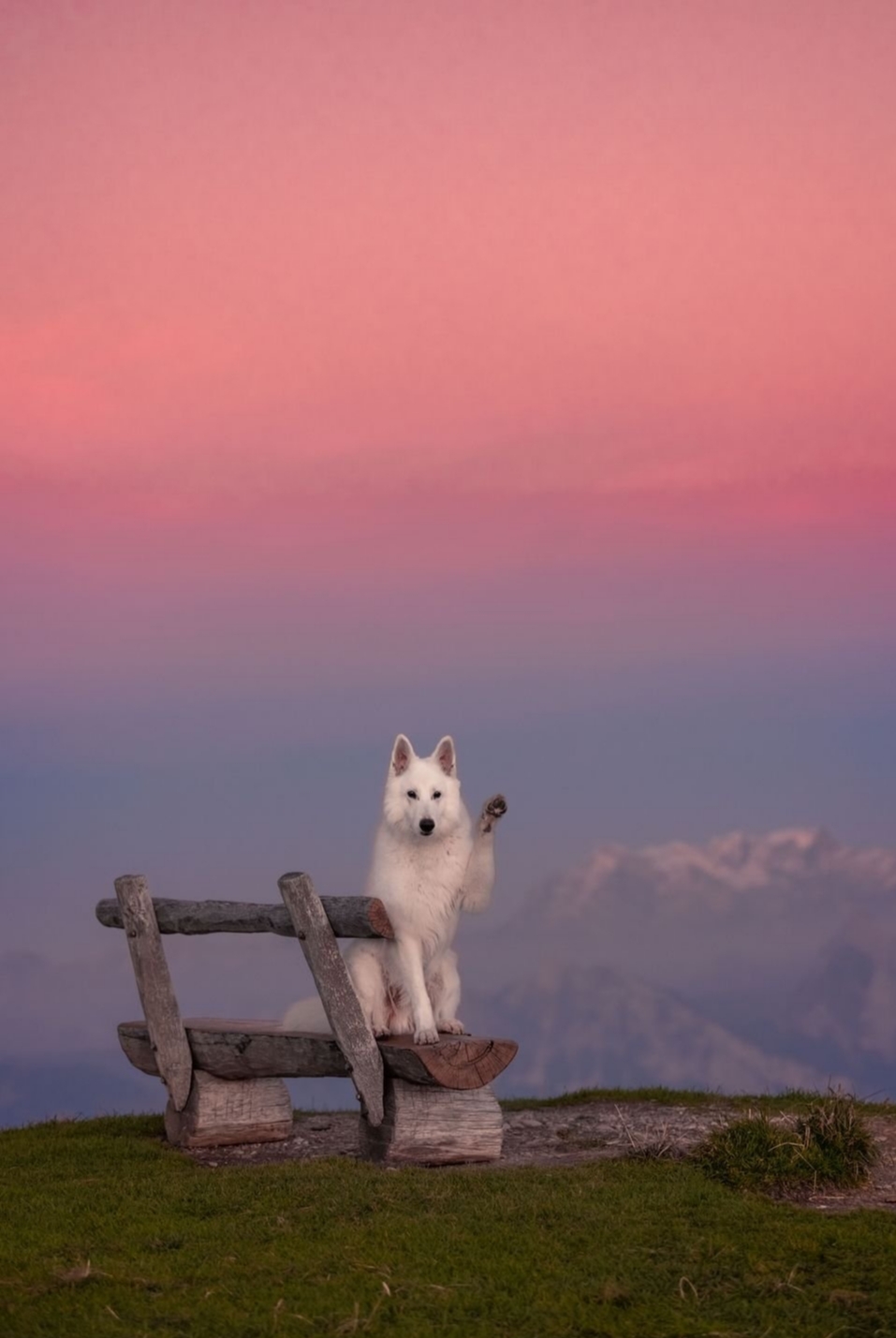
The image presents a striking composition of a white dog perched atop a rustic, wooden bench against a dramatically colored sky. The dog appears to be a white German Shepherd or similar breed, with a confident, alert posture and dark markings around one eye. It is the central focal point.
The bench is simple and weathered, constructed from rough-hewn logs. It sits on a small, grassy rise. The background is dominated by a sky transitioning from shades of pink at the top to deep purples and blues towards the horizon, suggesting either sunrise or sunset. There is a suggestion of fog or clouds below the horizon.
The overall impression is one of stillness, contemplation, and perhaps a touch of melancholy. The contrast between the bright, pure white of the dog and the richly saturated colors of the sky creates visual tension and draws the eye. The lighting is soft and diffused, enhancing the serene mood.
Foucauldian Genealogical Discourse Analysis
This image lends itself well to a Foucauldian analysis, specifically regarding the discourse surrounding animals and “nature.”
- Power/Knowledge: The image represents a constructed ideal of “nature” and “wildness.” The dog, as a domesticated animal placed within a seemingly natural landscape, complicates the distinction. The power dynamics are implicit: humans (the unseen photographer and the dog’s owner) have defined what is considered "natural" and framed this scene. The dog's presence reinforces a particular narrative of harmony between humans and animals.
- Genealogy: Tracing the historical genealogy of the depiction of dogs in art and popular culture reveals how they’ve been used to represent loyalty, protection, companionship, and even wildness. The romanticized landscape further reinforces historical narratives of the "sublime" – an aesthetic concept used to legitimize power structures through the idea of encountering something larger and more powerful than oneself (in this case, "nature").
- Discipline and Normalization: The image could be read as normalizing a certain kind of “pet-owner” relationship – a harmonious connection to nature. The dog's stillness and "good" behavior subtly enforce expectations of animal docility and control. This can be seen as a micro-level form of discipline, where the dog's “natural” state is subtly regulated through human expectations.
Critical Theory
The image offers points for Critical Theory analysis. Specifically around ideas of representation and the sublime.
- Representation of Nature: The image isn’t of nature, it’s a representation of it, constructed through the photographic frame, lighting, and the inclusion of the domesticated dog. This challenges the idea of a pure, untouched nature.
- The Sublime: The dramatic sky and the dog's elevated position evoke the Romantic notion of the sublime – a feeling of awe mixed with terror. However, the presence of the domesticated dog domesticates the sublime. It suggests a control over the overwhelming power of nature, rather than a true experience of its vastness.
- Commodification of Beauty: The image’s aesthetic quality and emotional resonance make it potentially consumable as art or stock photography. This ties into the broader critique of how beauty is commodified and used to reinforce existing power structures.
Marxist Conflict Theory
While this image isn’t explicitly political, we can apply Marxist concepts, albeit a bit indirectly.
- Control of Resources/Land: The landscape, however idyllic, represents a resource. The fact that someone has the time, resources, and leisure to photograph a dog in this setting hints at unequal access to land and leisure.
- Ideology & Distraction: The image’s serene beauty can be seen as an ideological distraction from social and economic inequalities. It promotes a romanticized vision of harmony that masks real-world conflicts.
- Alienation from Nature: While the image appears to depict a connection with nature, the dog's domestication and the act of photographing itself create a distance. This echoes the Marxist concept of alienation – where individuals are separated from the natural world through labor and consumerism.
Postmodernism
Postmodern themes are present, particularly concerning the idea of authenticity and the blurring of boundaries.
- Simulation & Hyperreality: The image isn't a "real" encounter with nature, but a constructed simulation. The saturated colors and perfect composition contribute to a hyperreal effect – where the image feels more “real” than reality itself.
- Deconstruction of Nature: The image challenges the traditional Western concept of "nature" as something pristine and separate from humans. The dog's presence disrupts this binary, highlighting the interconnectedness of all things.
- Irony & Playfulness: There’s a subtle irony in the image’s beauty. The photograph is self-aware—a constructed scene meant to be viewed and interpreted.
Queer Feminist Intersectional Analysis
This image is less immediately suited to a Queer Feminist Intersectional Analysis, but there are potential angles:
- Challenging Anthropocentrism: Feminist and queer ecology challenge anthropocentrism (the view that humans are the central or most important entities in the universe). The image, while still centered on a human-animal relationship, offers a moment of connection that transcends species boundaries. This can be seen as a rejection of the human-centered worldview.
- Deconstructing Domination: The relationship between human and animal can be seen through the lens of power dynamics. While seemingly harmonious, the image implicitly reinforces the human’s dominance over the animal. Deconstructing this dynamic requires recognizing the inherent value and agency of all living beings.
Important Note: These are interpretations, and the image is open to multiple readings. The strength of each analytical approach depends on your specific theoretical focus and how you choose to engage with the visual material.
Let me know if you’d like me to elaborate on any of these sections or explore a different analytical perspective.
simple-description (llama3.2-vision)
The meme features a dog sitting on a bench, looking out at the viewer with a smug expression. The text "I can smell the desperation" appears above the dog, implying that it's commenting on the viewer's emotional state. The image is likely humorous because it's a relatable and ironic take on the common experience of feeling anxious or overwhelmed.
tesseract-ocr
e”4 o bi Ve ¥ Snag 7 . , ¥ i cia. eS ’.! i) ’ ia be . pie 4 = —s See hd ‘ ° A