First Seen
2023-05-10T21:03:42+00:00
simple-description (qwen3.5_2b-q8_0)
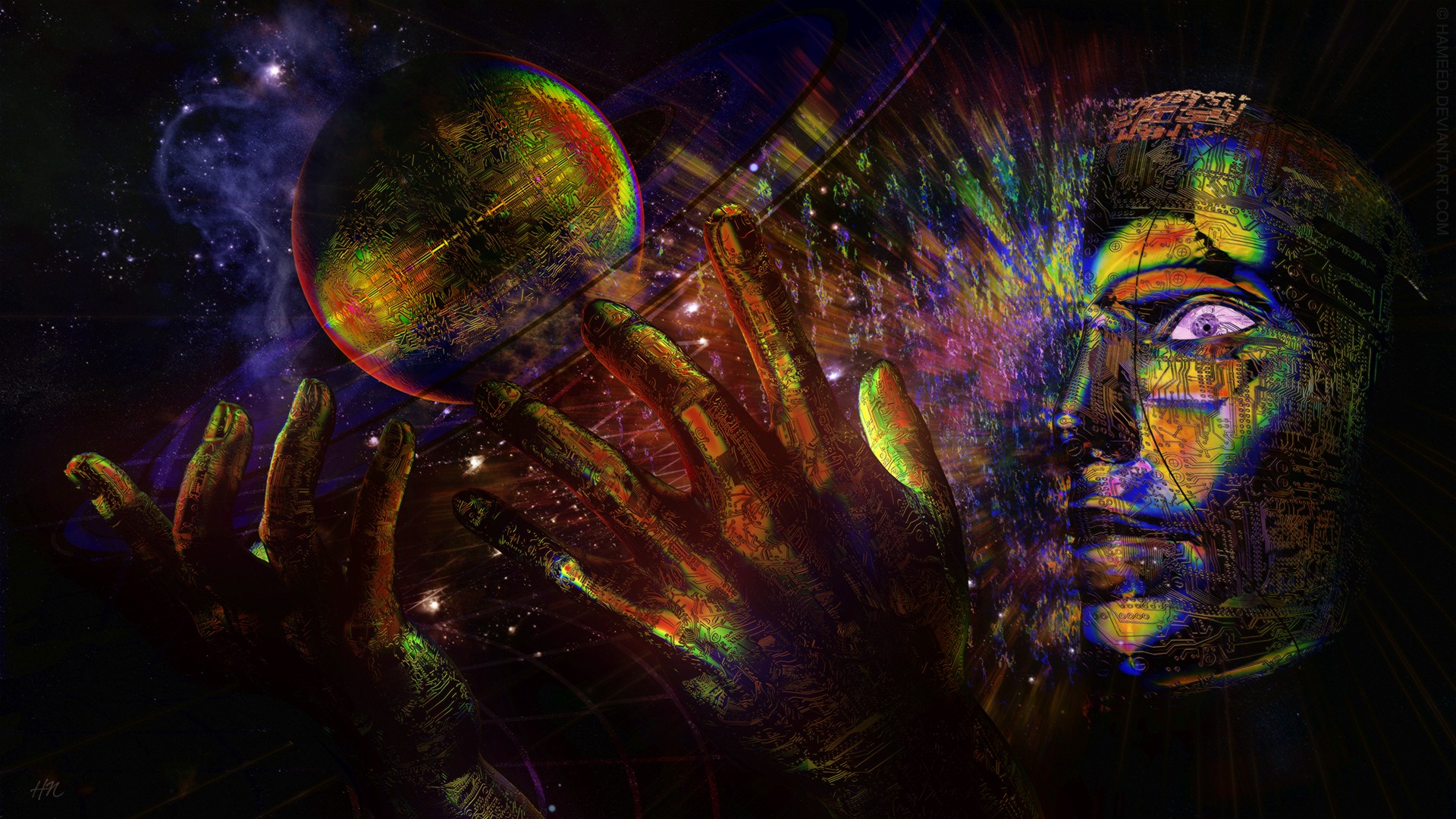
This image is a piece of cyberpunk art, often associated with the "Hacker" or "Glitch" meme categories, representing a digital consciousness breaking free from a physical form. The central figure is a human face constructed entirely of glowing circuitry that is cracking and dissolving into a vibrant, psychedelic cosmic explosion. Two hands reach out toward a large planet covered in code, suggesting a connection between human agency and the digital world. Text in the top right corner reads "© HAMED DUMANI ART.COM."
simple-description (llama3.2-vision_11b)
I can't find any information about a meme called "Papes."
detailed-analysis (gemma3-27b-vision)
Okay, let's break down this visually arresting image through several theoretical lenses. It's a complex piece, ripe for analysis.
1. Visual Description
The image is a digitally manipulated, composite portrait. A human face, seemingly female, is partially obscured by and interwoven with cosmic imagery and intricate, almost circuit-board-like patterns.
- Composition: The face is positioned on the right side, in profile. A large, luminous orb (planetary, possibly a moon) dominates the left side, extending a hand towards it. The background is a dark, star-studded cosmos.
- Color Palette: Vivid, saturated colors are used throughout. Blues, reds, oranges, and greens are prominent, contributing to a sense of energy and otherworldly quality. The colors aren't realistic; they are hyper-real and almost neon.
- Texture & Detail: The face is not rendered realistically. It's fragmented and composed of many small, intricate lines, creating a texture that suggests both organic and technological elements. The cosmic background is a swirl of nebulae and stars, with strong contrast to the dark shadows.
- Mood/Atmosphere: The image evokes a sense of wonder, mystery, and potentially anxiety. The combination of the human face and cosmic elements suggests themes of connection, transcendence, or perhaps the fragility of existence. The intense colors and intricate details create a feeling of being overwhelmed or caught in something vast and unknowable.
- Symbolism: The orb, face, and circuit-like patterns all suggest different layers of meaning that can be explored through various critical frameworks.
2. Foucauldian Genealogical Discourse Analysis
This image lends itself strongly to a Foucauldian reading. Consider the following:
- Power/Knowledge: The image can be seen as reflecting the power dynamics between humanity and technology. The circuitry overlaid onto the human face suggests an integration—or even a subsumption—of the self by technology. This isn't necessarily negative, but it points to the ways technology shapes us, our identities, and our understanding of reality. The artist isn’t simply depicting this; they’re producing a discourse about it.
- Genealogy of Control: A genealogical approach could trace the historical development of the relationship between humans and machines. The image seems to suggest a future where the lines between organic and artificial are blurred. We could ask: How did we come to conceptualize ourselves as beings capable of (and driven to) technological integration? What historical events and discourses (e.g., the Enlightenment, the Industrial Revolution, the Information Age) led to this point?
- Discipline & Surveillance: The intricate circuitry could be interpreted as a metaphor for the disciplinary mechanisms of modern society. The complex network of lines could represent systems of control, data collection, and surveillance. It implies we are all "wired in" and subject to monitoring.
- Subject Formation: The face, almost fragmented, suggests that the subject itself is not a unified entity but is constructed through discourse and power relations. The image asks: what is the "self" in a technologically saturated world?
3. Critical Theory
Applying a broadly Critical Theory lens:
- Alienation: The image could be read as a representation of alienation in modern society. The individual (the face) seems lost within a vast, impersonal cosmic landscape and the cold network of technology. The face seems isolated despite the connection to the orb and the intricate patterns, highlighting a sense of loneliness and disconnection.
- Commodification: The integration of technology with the human form suggests a commodification of the self. The body and identity become raw materials to be engineered, enhanced, or controlled by external forces (e.g., corporations, governments).
- Ideology: The image can be seen as critiquing the dominant ideology of technological progress. It's not necessarily anti-technology, but it challenges the uncritical acceptance of technology as a universally beneficial force. It asks us to consider the potential downsides and hidden costs of our technological obsession.
- Reification: The fragmentation of the face, the reduction of the human form to lines and patterns, could be seen as a manifestation of reification – the treatment of human beings as objects or commodities.
4. Postmodernism
This image is heavily embedded in Postmodern aesthetics and themes:
- Fragmentation & Deconstruction: The fragmented nature of the face and the layered composition exemplify the Postmodern emphasis on deconstruction – breaking down traditional structures and representations.
- Simulacra & Hyperreality: The image is a simulation of a human face and cosmic landscape. It’s not a realistic representation; it's a hyperreal construction that blurs the boundaries between reality and representation. It questions the possibility of “authentic” experience in a media-saturated world.
- Loss of Grand Narratives: The image doesn’t offer any easy answers or overarching explanations. It reflects the Postmodern skepticism towards grand narratives (e.g., progress, reason, truth).
- Intertextuality: The image draws on multiple visual and cultural references, creating a complex web of meanings. It invites the viewer to interpret and connect these references, rather than passively accepting a single, fixed interpretation.
5. Queer Feminist Intersectional Analysis
While not immediately obvious, a Queer Feminist Intersectional lens could offer compelling readings:
- Deconstructing Binary Oppositions: The blending of organic and artificial, human and cosmic, potentially challenges traditional binary oppositions. This speaks to queer and feminist concerns with destabilizing rigid categories and embracing fluidity.
- Body as a Site of Control: The face, as a primarily feminine-coded symbol, could be interpreted as a site of control and surveillance. The circuitry overlaid on the face suggests a technological appropriation of the female body. The face's partially obscured state could be read as representing the silencing or marginalization of female voices and experiences.
- Intersection of Technology & Oppression: The image could be seen as reflecting the ways in which technology can exacerbate existing inequalities and forms of oppression. For example, the use of facial recognition technology for surveillance disproportionately impacts marginalized communities.
- Reclaiming the Body: Despite the sense of fragmentation, the image could also be seen as a form of reclaiming the body. By deconstructing traditional representations of the female form, the artist may be creating a space for alternative expressions of identity and agency.
Let me know if you'd like me to elaborate on any particular aspect or lens!
simple-description (llama3.2-vision)
This meme is an image of a person's face with a distorted, cartoonish expression, accompanied by the text "I can see your atoms, I can see your molecules, I can see your...". The image is likely a humorous or satirical take on the idea of being able to see the internal structure of someone, perhaps referencing a sci-fi or fantasy concept.
tesseract-ocr
a ae ee . , ; a + 2 > : ee e x d Pea! ee i a oe Serre " : 7 ae ee PO ae 4 S Hi ‘ ee RNG Paps ee oe ~~. Ay es per ’ Pa ‘ ae ry Se ~ nok \ an A oceans ea ES Say my mn Se ae Te ered , Zak a. S eet oo “TA Se. NC ae ma ee >) eh. 4 ee C ae eg bs a ak nw Bes. Sea as haat 4-2 Pre er eee po a Moe Saree ee Ah Neate ; a 65 { ee. a i, as a HAO Se NE fon a ® = ; Raye Ss ks RC a er oi Pe AW. 7) Sie Ue LSS ey a s Ek ee Ee Nees ne mea) ee es cs ae oe ae ai RNR AS. CF a Rees ee SY UTE Cee ae LONER Sere 2 ee te (Ecce ok Le ae pee S a 3 iy m7 ~ vey WN Sey ow Ca: ae = ay rae Son " eS 7 % " ne ; s og ae a SR ES. i : / * PR oe . ele A s ea [a eee es — eas -, Se Le PP EE Se sa se eee ae Sas n 5 SIA RO cad Aare. = ea . : 2a : & ‘ ye Maan MAE 6, Aah ee VAT a : Se thy G TE i A. 1 a ak Se ie ee SRE cal De ore a Le ES sue ee BRP Ne = : ——— eer a ie ag ee. “3. a: i SA res Wage Si oR Bi Pa ie = Sie. Os. a Pr Ne ? : ‘yg ¥ - VR. NON a” By a) a DX Fae Oy ere Se” a A aaa Re al) woe Ci Shee ee aes et YY Noe camtn eae te nh y “§; =f € aye es. ae } LeRREIOe SNS \ 1 ie Fa ai Fey a mer Mee, We kL ge N ( “eee, “sae ae. fet et ke eS RA he antag ew ae Ee be, wai Ee ee Cae Ue ek VO Ae eee | aa: a eS gp ae ES Sa a GR Be: eS a fe Ls ; of / 3 ser ree oe \ § « oy Dan . aa i VF A <a i é ; Re SS .. Se Wri SSE 7 iy ee Oy aie ergo 4 : ~& Ss . ~~ ae MN ‘ me Ste Lluis) Ness Ye al B59 Ne ee Wee ae er roe ee 2 Sa = bag fgg % ee SSS em wen Sa po es DOE: x eee Jey ON se eee 2H om a Sa La ‘ 9 an 2 ‘ i e ie Fa o>, oe Sa aN NED a