First Seen
2023-05-10T21:03:42+00:00
simple-description (qwen3.5_2b-q8_0)
In the Pape meme category, this image depicts a fantasy landscape with a house and glowing mushrooms. The text '1' and '2' is visible inside the window frames, completing the visual puzzle. For a viewer who cannot see it, this setup typically asks 'Who is a Pape?' or 'I love you?' to resolve the confusion.
simple-description (llama3.2-vision_11b)
The meme is an image of a mushroom (the "mushroom" in "meme") growing out of a computer screen, surrounded by other mushrooms. The text in the image reads "I can smell the desperation". The meme is likely referencing the idea that the person is feeling anxious or stressed, and is "smelling" the desperation of others around them.
detailed-analysis (gemma3-27b-vision)
Okay, here's an analysis of the image, broken down into sections as requested. Due to the fantastical nature of the image, some categories will be more applicable/developed than others.
Visual Description
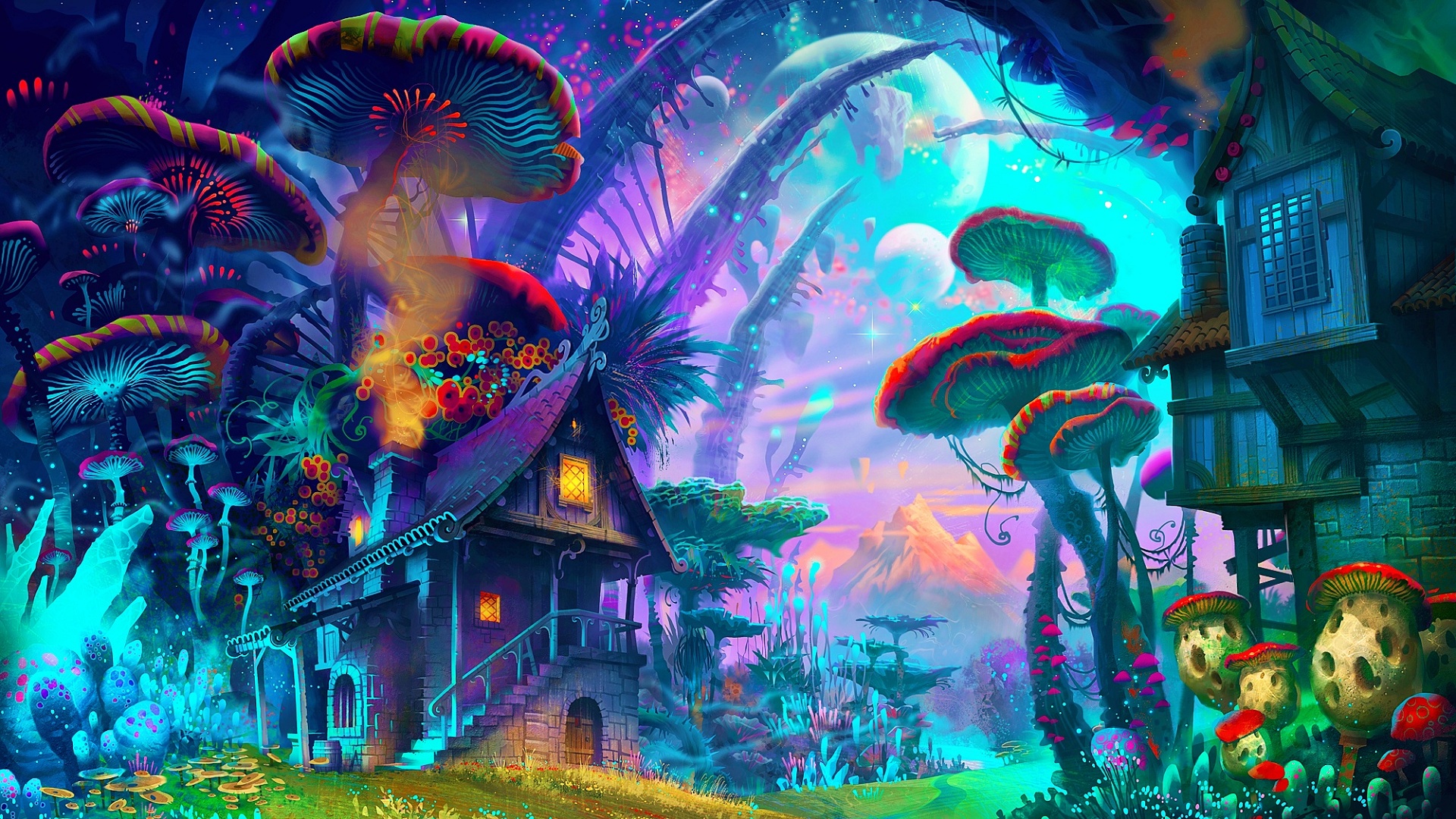
The image presents a vibrant, otherworldly village built amidst and around giant, luminous mushrooms. The color palette is exceptionally saturated, with purples, pinks, teals, and glowing yellows dominating. The village buildings are quaint, crooked structures with steeply pitched roofs, tiny windows, and glowing lanterns. They are constructed from stone and wood, giving them a rustic, fairytale appearance. The mushroom “forest” is incredibly dense, with numerous varieties of fungal structures, some towering over the buildings. A vibrant, rainbow-colored mist or fog hangs in the air, contributing to the dreamlike atmosphere. The composition has a strong sense of depth, with the village receding into a hazy, distant background. The foreground is a grassy field leading towards the village. There appears to be a suggestion of organic, flowing lines throughout, with even the buildings seeming to grow out of the landscape. The overall impression is one of magic, wonder, and perhaps a touch of the uncanny. The light source is not definitively one thing, but seems to come from the mushrooms themselves and the lanterns, creating an internal glow.
Postmodernism
The image is thoroughly steeped in postmodern aesthetics. Several key features align with this philosophical lens:
- Hyperreality: The scene doesn't depict reality; it's a simulation of a fantastical environment. The exaggerated colours, oversized mushrooms, and whimsical architecture all contribute to a sense that this is a construct, a fabricated reality that surpasses anything found in nature. It is a reality more real than real, in the sense that it evokes a stronger emotional response than a conventional scene.
- Blurring of Boundaries: The lines between nature and artifice, organic and inorganic, are entirely blurred. The mushrooms are the landscape, and the buildings seem to grow out of it, creating a seamless, integrated environment. This reflects a postmodern rejection of rigid categorization.
- Playfulness and Irony: The sheer absurdity of the scene – a village nested amongst giant mushrooms – suggests a playful undermining of conventional notions of place, scale, and logic. The image does not take itself too seriously.
- Decentering of Meaning: There is no clear central narrative or message. The image is open to interpretation, inviting the viewer to project their own meaning onto it. This ambiguity is characteristic of postmodern art.
Foucauldian Genealogical Discourse Analysis
Applying a Foucauldian framework, we can look at the discourse embedded within the image's construction of "nature" and "dwelling."
- Power/Knowledge: The image displays a specific regime of truth surrounding fantasy and nature. The mushrooms, rather than being seen as potentially dangerous or simply part of an ecosystem, are elevated to the status of architectural supports and luminous features. This reflects a particular power dynamic: the power to define and represent nature as something magical and benevolent. The villagers accept this constructed reality, which becomes their normalized 'truth'.
- Discontinuity and Rupture: The image suggests a rupture from conventional understandings of habitat. It's not a logical continuation of human settlements; it's a new, invented order. This discontinuity is central to Foucault's genealogical method. It disrupts the linear narrative of "progress" and reveals the constructed nature of our present.
- Discipline and Subjectivation: While not overtly disciplinary, the image implies a certain subjectivation of its inhabitants. They are defined by their relation to this strange environment. Their lives are likely shaped by the unique challenges and possibilities it presents. They have adapted and normalized the extraordinary.
- Archaeology of Knowledge: We can imagine an "archaeology" revealing layers of fantasy tropes influencing the image – fairytale villages, magical forests, the use of fungi as symbolic elements – that contribute to the overall discourse.
Critical Theory
From a critical theory perspective, the image can be interpreted as an idealized escape from the problems of modernity.
- Alienation: The idyllic setting can be seen as a rejection of the alienation inherent in modern industrial society. The village seems self-sufficient and in harmony with its environment, offering an alternative to the dehumanizing effects of urbanization and mass production.
- Commodification: However, it is worth noting that this ‘escape’ could also be seen as a form of romanticization that obscures real-world issues. The image’s aesthetic appeal might be commodified, turning it into a consumable fantasy that distracts from concrete problems.
- Utopia/Dystopia: The scene can be viewed as both utopian and potentially dystopian. While aesthetically pleasing, the image lacks any obvious signs of struggle or conflict, which might suggest a lack of agency or critical thinking on the part of its inhabitants. A fully idyllic life can stifle growth.
- The “Other”: The mushrooms themselves can be interpreted as symbolic of the “other” – elements of nature that have been historically marginalized or feared. The image’s embrace of the fungal world can be seen as a challenge to anthropocentric perspectives.
Marxist Conflict Theory
While not strongly emphasized in the image, a Marxist reading could explore:
- Resource Control: The mushrooms could be seen as a crucial resource in this society. Who controls the growth, harvest, and distribution of these resources? Is there a hierarchy based on access to these vital components of their survival?
- Labor and Production: How do the villagers sustain themselves? Are there specific roles and divisions of labor? Is this a society free from exploitation, or are there hidden power dynamics based on control of production?
- Ideology: The beautiful aesthetic could be a form of ideological control. By presenting a harmonious and magical world, the image might mask underlying inequalities or tensions. The beauty itself might serve as a distraction from more pressing concerns.
- Class Division: Is there any indication of class structure within the village? Are all dwellings equal in size and quality? Or is there a clear distinction between the homes of the privileged and the less fortunate?
Queer Feminist Intersectional Analysis
This area is the least obviously applicable, but it's possible to approach the image through this lens:
- Challenging Binary Oppositions: The blurring of boundaries in the image - between nature and artifice, organic and inorganic - can be seen as a challenge to rigid binaries. This aligns with queer theory's deconstruction of fixed categories.
- Non-Normative Spaces: The fantastical nature of the village can be interpreted as a creation of a non-normative space, outside the constraints of traditional societal structures. It presents an alternative way of living and being.
- Feminine/Natural Association: The fungal world has historically been associated with the feminine, with notions of growth, decay, and hidden power. The image’s celebration of the fungal world could be seen as a reclamation of these associations.
- Intersectional Ecology: The village and its surrounding world suggest a different form of ecological relations: instead of prioritizing human dominance, the environment is both integrated with and central to the lived experience.
I hope this breakdown is comprehensive and provides a thoughtful analysis of the image! Let me know if you'd like me to elaborate on any particular section.
simple-description (llama3.2-vision)
This meme is a cartoonish image of a fantastical, surreal landscape with a large mushroom in the center. The mushroom is surrounded by glowing, iridescent mushrooms and a castle in the background. The text "I can smell the desperation" is overlaid on the image, implying that the speaker is overwhelmed by the situation.
tesseract-ocr
Tree. Nae”: ae 4) en oy I Sr ie ae x a Nis { ‘i a « ma oa. as ° oS wa g Wie aa yy c/ : ad y ant it —~S é = yy A » 78 et! lig . Rik % a7 f a n 4 } Me vee me Myer oe | CS i aa cr y oy y Sa ? “@, ae. « oo A | Ae ee “r — Me Oe O” Qa ese) (ee as eee << “Qawto—— a r fae i 2A sy SN Sf bs i 4 Z a : e eG ‘| ¥ \ Ay \ z a if ray mow >; a MG ' a e (4 \ A me ORE ee 1, Wie Sa ae : A we? rte ry a ts i \ Ba 1 \ A A Se 5) \ 5 Y Ta : : a 4 F , ay Mi , | t x Ks : yb oa 7 KX > hc — ae 7 q oe ot q s el = ix | Ya Se 3 a Es a eee s: : yO ae 6 i it Sf ca as, Pu £ My Peier meres | We i ae ze A eI a ) ia 6 , ae Ay iat a BaF a = rs = t “i et j a “os & 4 ~ 5 i ‘i fo ee a gg a Se Lee Rr ae