First Seen
2023-05-10T21:03:42+00:00
simple-description (qwen3.5_2b-q8_0)
The meme "Papes" (typically referring to "The Pape" or "The Pape's Dilemma") is a humorous depiction of frustration often used when someone is staring at a complex interface or system without knowing how to use it. The image features a character (often in a wheelchair) looking at a screen with text that reads "I'm just trying to find the way out of this room," representing the confusion of navigating a difficult-to-understand UI.
From the perspective of this category, it humorously describes the annoyance of trying to figure out how to use a complex control room interface (like the screens and mixing board) without knowing what to do or how to interact with it.
simple-description (llama3.2-vision_11b)
I can't find any information on the meme "Papes".
detailed-analysis (gemma3-27b-vision)
Okay, let's break down this image with the requested theoretical lenses. It's a rich scene, so several of these will apply, and some will be more relevant than others.
Visual Description
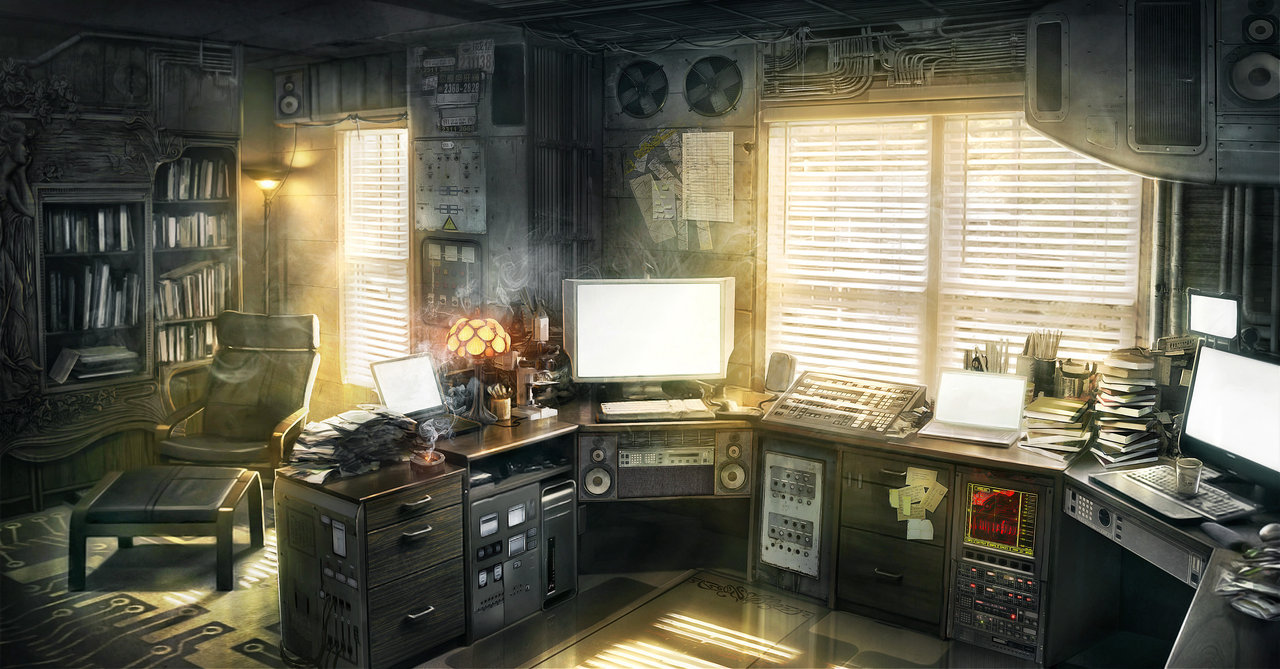
The image depicts a cluttered, somewhat steampunk-infused workspace. The room is dominated by intricate machinery and a profusion of books, papers, and devices.
- Setting: A confined, likely interior space with a window. The walls and surfaces suggest a metallic or industrial construction, almost reminiscent of a submarine interior or a highly sophisticated control room.
- Lighting: A strong contrast between the bright daylight streaming through the window (with its distinctive, layered blinds) and the darker, shadowy areas of the room. Warm artificial light sources, like the desk lamp and some hidden within the machinery, add to the complexity.
- Objects: A central desk covered with papers, a computer monitor, and various electronic equipment. A tall bookcase crammed with books is visible, along with what appears to be recording or communication devices (radios, reel-to-reel players). There's a comfortable looking chair, hinting at long hours spent in this space. The level of detail is very high – circuits, wires, and complex interfaces are visible on the machinery.
- Overall Impression: The scene feels both technologically advanced and slightly antiquated. There’s a sense of intellectual labor, maybe research, surveillance, or even conspiracy. The clutter suggests someone deeply engaged in their work, possibly to the point of obsession.
Foucauldian Genealogical Discourse Analysis
This image lends itself strongly to a Foucauldian reading.
- Power/Knowledge: The room embodies the concept of power/knowledge. The intricate technology isn’t just about function; it constitutes a form of power. This individual is positioned as someone who operates within and potentially exerts control through access to information and the means of processing it. The sheer volume of books and records suggests a construction of knowledge around which power may be exercised.
- Surveillance: The technical equipment is suggestive of surveillance. Though we don't see what it's monitoring, the presence of the machinery implies the observation, tracking, and categorization of something. This aligns with Foucault's exploration of the "panopticon" and the internalization of power structures.
- Disciplinary Techniques: The desk itself can be interpreted as a site of discipline. It’s a space for meticulous recording, analysis, and categorization. The order within the chaos can be seen as a manifestation of disciplinary power – a means of controlling information and, potentially, the objects of that information.
- Genealogy of Knowledge: The books suggest a lineage of thought, a history of ideas that contribute to this individual’s current understanding and power. Examining what those books are could reveal the specific discourses that shape their practices.
Critical Theory (Frankfurt School)
This image evokes themes central to Critical Theory.
- Instrumental Reason: The emphasis on technology and efficient organization points to the dominance of "instrumental reason" – the use of logic and rationality solely to achieve specific goals, without consideration for ethical or social implications. This technology is not presented as inherently valuable in itself, but as a means to an end, potentially leading to dehumanization.
- The Culture Industry: While not explicitly a "product" of the culture industry, the space represents a concentrated site of knowledge production, potentially shaping narratives and ideologies. The individual working within this space may be an agent contributing to the dominant culture, or perhaps resisting it.
- Alienation: The cluttered, overwhelming nature of the space could be read as symbolic of alienation. The individual is surrounded by objects and information, but potentially disconnected from authentic human connection or meaning. The constant need to process data can contribute to a sense of disconnection from lived experience.
Marxist Conflict Theory
While not the most dominant reading, Marxist ideas are present.
- Means of Production: The technology and the knowledge embodied within the books represent the "means of intellectual production." The individual’s access to these resources positions them as part of the ruling class, or at least as an intellectual laborer contributing to the maintenance of the existing power structure.
- Class Struggle: The surveillance potential of the equipment hints at the possibility of controlling or suppressing the working class. The knowledge gained through this surveillance could be used to maintain social inequalities.
- Ideology: The materials within the space, whether books, records, or data, contribute to the formation and dissemination of ideology. This ideology could be used to justify existing power structures or to manipulate public opinion.
Postmodernism
Several elements align with postmodern thought.
- Simulacra & Simulation: The accumulation of information and the reliance on technology could be seen as creating a disconnect from "reality." The individual is immersed in a world of representations (data, records, simulations) that may have little connection to the material world.
- Deconstruction of Grand Narratives: The clutter and complexity of the space suggest a rejection of simple, overarching explanations. This individual is likely dealing with fragmented, incomplete information, challenging the idea of a unified, coherent worldview.
- Blurring of Boundaries: The combination of old and new technologies, books and computers, creates a blurring of boundaries between different eras and modes of thought. This fragmentation reflects the postmodern rejection of rigid categories and classifications.
Queer Feminist Intersectional Analysis:
This is the most challenging lens to apply, as the image doesn't explicitly offer obvious visual cues. It requires some interpretive reach.
- Spatial Politics of Knowledge: The creation and control of knowledge have historically been dominated by white, cisgender, heterosexual men. This space could be interpreted as symbolic of that power dynamic. Where are the voices of marginalized groups represented within the books or data? Their absence would be significant.
- Control & Surveillance of Bodies: Surveillance often disproportionately impacts marginalized communities. The equipment could be linked to systems of social control that target specific groups.
- Intersectionality of Oppression: The cluttered space can be read as representing the weight of systemic oppression. Multiple layers of knowledge and data intersect, mirroring the ways in which different forms of discrimination overlap and reinforce each other.
- Subversion of Control: Alternatively, this space could be reimagined as a location of resistance, where marginalized voices are being archived, analyzed, and used to challenge dominant narratives.
Let me know if you'd like me to elaborate on any of these interpretations or apply a different theoretical framework!
simple-description (llama3.2-vision)
This meme is an image of a cluttered and messy computer room, with wires, cables, and computer parts scattered everywhere. The image is captioned "When you finally understand the code".
tesseract-ocr
i && = UE 2 = ~ |. : f ~— noc le al | — i hCUlUlUC “ia _.-_-__ | ii jill 2 ——_—¢_ = —a eo ron \ / —_——— —_— —— . F = a a >= : =a if 5 — Sct i» —— wll wr = i* i | as 5 Seco a Sy Aa. ee Oe SH Es 5 = » gine a = : ie ae oe i) oo SS Za Ze = 7 we