First Seen
2023-05-10T21:03:42+00:00
simple-description (qwen3.5_2b-q8_0)
This image is a humorous variation on the "shelf of papers" meme, which features a collection of books stacked to look like a massive, elaborate "shelf." By arranging the "papes" into the shape of a Christmas tree complete with a star and fairy lights, the image satirizes the idea of a "hobbyist" or "bookworm" who might spend an entire shelf full of reading material. The inclusion of random book titles, ranging from technical manuals like The Hitchhiker's Guide to random non-fiction, plays on the absurdity of a household full of books, suggesting that the person is so obsessed with reading they could spend an entire "shelf" (or a Christmas tree) of materials just to stay up late.
simple-description (llama3.2-vision_11b)
The meme is a picture of a Christmas tree made entirely of books, with a caption that says "When you finally organize your bookshelf and it's so pretty you want to put it on the front lawn."
detailed-analysis (gemma3-27b-vision)
Okay, here’s an analysis of the image, broken down into sections addressing the requested theoretical frameworks, only where applicable. Given the subject matter, some frameworks will be more relevant than others.
Visual Description
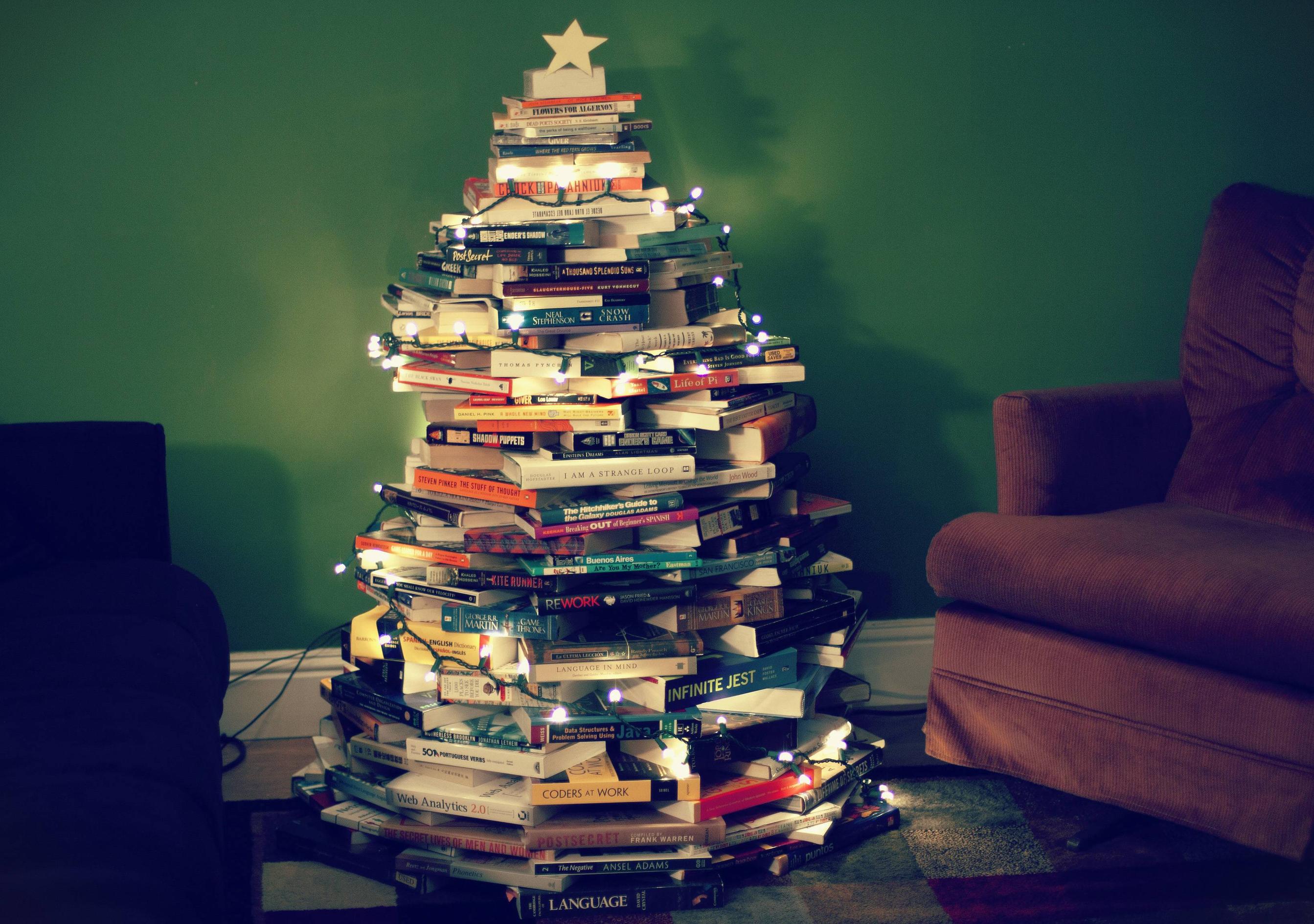
The image depicts a “Christmas tree” constructed entirely of books. The books are stacked in a conical shape, mimicking the traditional evergreen tree form. A bright yellow star is affixed to the top. Strands of warm white Christmas lights are woven throughout the stack, illuminating the spines and creating a festive glow. The books themselves appear to be a mixture of fiction and non-fiction, with titles relating to coding, analytics, literature, and potentially philosophy or social science.
The setting is a darkened room with a dark green wall. To the right, a plush, burnt orange armchair provides a domestic, comfortable contrast to the intellectual construct of the book-tree. A portion of a dark-colored sofa or seating area is visible on the left. The overall impression is one of cozy intellectualism and a playful subversion of traditional holiday imagery. The lighting contributes to a warm, inviting atmosphere, but also casts a slight melancholy.
Foucauldian Genealogical Discourse Analysis
This image is rich for a Foucauldian reading. The “book-tree” isn’t merely an aesthetic choice; it’s an arrangement that performs knowledge and power.
- Discourse and Knowledge: The stacked books represent a discourse—a system of thought, language, and practice—that constitutes "knowledge." The specific titles visible suggest a discourse around technology (coding, data analytics) mixed with literature and potentially humanities disciplines. By building the tree from books, the image suggests that knowledge itself is the foundation of this holiday "ritual," replacing the traditional religious or natural symbolism of the Christmas tree.
- Power/Knowledge: Michel Foucault argues power and knowledge are inextricably linked. The books represent access to power—the power of information, education, and intellectual authority. The act of constructing the tree suggests an attempt to exert control over this power, to shape and define it within a domestic setting. The creator is not simply a consumer of knowledge, but a producer of a discourse.
- Genealogy: A genealogical approach would trace the historical development of the "book" itself as a technology of power and knowledge. The tree isn’t simply about the current state of books, but a layered history of literacy, education, and the institutional structures that regulate knowledge production.
- Disciplinary Power: The very act of stacking books implies a certain order, a taxonomy of knowledge. This ordering reflects a form of disciplinary power, shaping how knowledge is categorized, valued, and disseminated.
Critical Theory
The image lends itself to a Critical Theory reading, specifically relating to the Frankfurt School and the critique of consumer culture.
- Reification: The "book-tree" can be seen as an example of reification—treating abstract concepts (knowledge, learning) as concrete objects. By physically constructing the tree, the image solidifies knowledge into a material form, potentially obscuring the complex social and historical processes that create it.
- Culture Industry: The image subtly critiques the commodification of knowledge and the "culture industry." Books, typically symbols of intellectual pursuit, are repurposed as mere decorative objects, fitting into a festive, consumerist aesthetic. While the image doesn’t necessarily condemn this, it presents it as something to be observed and questioned.
- Enlightenment Critique: The image can be interpreted as a self-aware critique of the Enlightenment project. While books are often seen as vehicles of reason and progress, the image suggests that knowledge can also be repackaged and rendered into a spectacle, potentially losing its critical edge.
Postmodernism
Postmodern themes are prominent within the image.
- Pastiche and Intertextuality: The image is a clear example of pastiche—combining elements from different contexts (Christmas tradition, intellectual culture) in a playful and unconventional way. The books themselves are intertextual, referencing other texts and ideas.
- Deconstruction of Meaning: By subverting the traditional Christmas tree, the image deconstructs the conventional meaning of the holiday symbol. It challenges the viewer to question the assumptions and ideologies embedded within this tradition.
- Simulation and Hyperreality: The book-tree can be seen as a simulation—a copy without an original. It's a representation of a representation—a Christmas tree constructed from symbolic objects. This blurring of boundaries between reality and representation is a key feature of postmodernism.
- Playfulness and Irony: There's a clear sense of playfulness and irony in the image. It's not a serious attempt to replace the traditional Christmas tree, but a playful commentary on culture and knowledge.
Queer Feminist Intersectional Analysis
This is the least directly applicable framework, but can still offer insights.
- Subversion of Norms: The construction of the book-tree can be seen as a subtle subversion of heteronormative and patriarchal traditions associated with the Christmas holiday. It’s an alternative creation that doesn’t adhere to traditional gender roles or cultural expectations.
- Knowledge as Power: From a feminist perspective, access to knowledge has historically been limited for marginalized groups. The image, while not explicitly addressing this, highlights the importance of knowledge and intellectual pursuit. The creator taking agency in constructing this intellectual representation can be viewed as an act of empowerment.
- Intersections of Identity: The books themselves could, depending on their content, represent the voices and experiences of diverse communities. While we can't know this from the image alone, the potential for intersectional representation is there.
I hope this breakdown is thorough and helpful! Let me know if you'd like me to delve deeper into any of these theoretical frameworks or explore other angles.
simple-description (llama3.2-vision)
The meme is an image of a Christmas tree made entirely out of books, with strings of lights and a star on top. The tree is surrounded by a cozy living room, with a couch and a coffee table in the background. The image is captioned "I've been reading a lot this year".
tesseract-ocr
a TLOWPRS FOR ALGERNON = =——___ Ba : SS 7 2 sb a, | __« el a ' 4 cs cee a rer ee i Fy __ = - « = u eee a — i ee a - , a |ADs . S 1 Peas" = a . eer ; een Fs : a al ena ae eb ; r eee ras pelle — e : | a ; * o . ane | a : tad ] Lat Eee ‘ Sone ae fs i = . a iH inate sali ttt = nn pa a ig 2 a ——_— a ey oe) i) . i "1 Bt ial — - * a EE a Gee =. SS ae Se te a r Ui °. ee ieee = : Y A coo dtl ent | hae es Le ee ee oo elk ree | = NY KINGS) — Bada! URNS | = j ee ‘ o ENGLISH i os fl ry ee ibe = Een le ; women an e ~ N al a & ae i Ty ae #8 ae ae yi ; nl = a ee ey ; SU Ty Ee . > oe or fy - eg Prema aati ae < B = NFIN A A bee He au f od, _— etl b i unae "7 Pon a A ie : ar} “A = “Sie > ee | ti ~ \ 2 7 2® © pore oe, agoly jE sss cH me eg A oe Ee 52); iy Mn ia ETS << ; i 6 y oo Ne as , ase ee ad i aa ; \ a - eee eae ig di ae a - } th me a \ a CODERS At WORK se ee be : Bee naly tics 3 sae ; a OF fe a = if He ai ry ae acess eee Gace Be tieneqsive ANSEL ADAMS 8 a £ ne ee | Be Wo 7 a ! 2 : ai evo P