First Seen
2023-05-10T21:03:43+00:00
simple-description (qwen3.5_2b-q8_0)
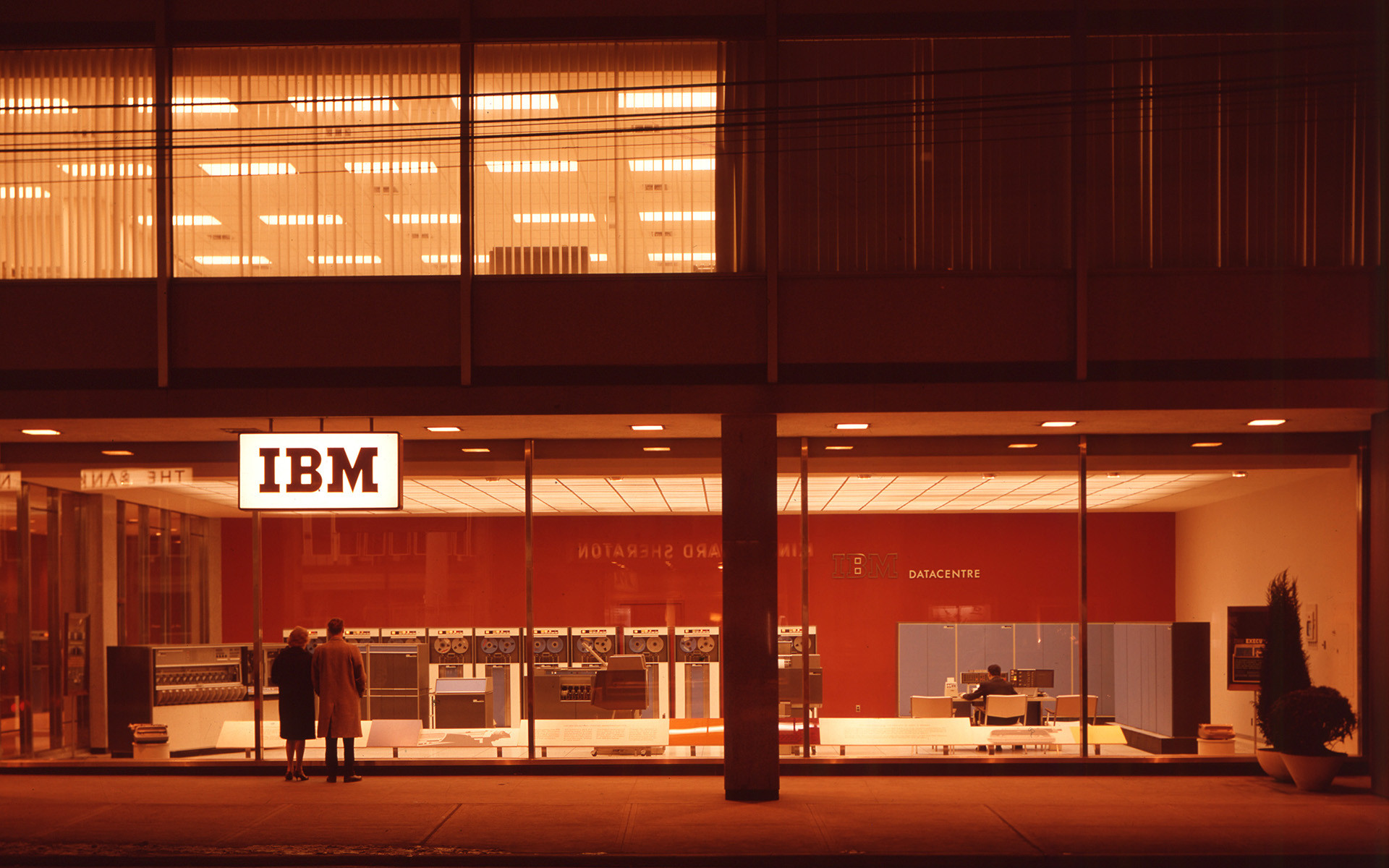
I saw the front of an IBM building at night, complete with massive tape machines lined up outside and people standing on the sidewalk looking at them. Inside, you can see a 'IBM DATACENTRE' on the red wall. There is also a 'THE BANK' written upside down on a pillar to the left.
simple-description (llama3.2-vision_11b)
The meme is a screenshot of a 1984 IBM advertisement featuring a smiling baby with the caption "On Screen" and "Off Screen". From the category of Papes, the meme is likely a joke about the baby's parents, as the caption suggests that the baby is "on screen" (visible) and "off screen" (not visible) at the same time, implying that the parents are somehow both on and off screen simultaneously.
detailed-analysis (gemma3-27b-vision)
Okay, here's an analysis of the image, broken down into sections based on the theoretical frameworks requested. Not all frameworks apply equally or at all, so I'll indicate when that's the case.
Visual Description
The photograph depicts the exterior of an IBM datacenter at night. The architecture is strikingly modernist, characterized by clean lines, a rectangular structure, and a large glass facade. The building is illuminated internally, creating a strong contrast with the darkness surrounding it. The interior reveals rows of bulky, early mainframe computers, typical of the mid-20th century. We see two figures in the foreground, appearing as silhouettes, standing in front of the glass. The lighting is warm and somewhat reddish, giving a distinct, almost retro, aesthetic. Signage is visible, including the prominent "IBM" logo and the word "DATACENTRE". The composition is symmetrical, emphasizing the scale and monumentality of the building. The overall impression is one of technological power, contained within a starkly geometric environment.
Foucauldian Genealogical Discourse Analysis
This image is incredibly rich for a Foucauldian analysis. The datacenter itself is a physical manifestation of the emerging "discourse" of information, control, and power in the mid-20th century.
- Discipline and Surveillance: The rows of mainframe computers, visible through the glass, represent the early stages of data processing and storage. These machines aren't just tools; they embody a new logic of observation and control. The ability to collect, store, and analyze information creates the potential for new forms of surveillance – not necessarily a "Big Brother" scenario, but a more subtle and pervasive form of normalizing judgement. The building constructs the possibility of mass data analysis, which then shapes the ways individuals are categorized and understood.
- Genealogy of Power/Knowledge: The image can be read as a snapshot in the genealogy of power/knowledge. The building's very existence demonstrates how technical knowledge (computer science, engineering) became intertwined with economic and political power (IBM as a corporate entity). It's a historical moment where a particular way of organizing information and exercising control began to solidify.
- Panoptic Effect: Though not a perfect panopticon, the glass facade, revealing the complex interior, evokes the feeling of being observed. The machines are "watching" in a metaphorical sense, collecting data that could be used for various purposes.
- The Archive: This datacenter is an early archive. It houses and categorizes information, effectively shaping how the past is understood and how the future is predicted. This architecture of information storage is a key element in the formation of modern knowledge systems.
Critical Theory
The photograph readily lends itself to a critical theoretical interpretation, particularly drawing upon the Frankfurt School’s ideas of instrumental reason and the culture industry.
- Instrumental Reason: The datacenter is a powerful symbol of the increasing dominance of instrumental reason – the logic of efficiency, calculation, and control. The pursuit of technological advancement, as embodied by IBM and the mainframe computers, becomes an end in itself, potentially divorced from broader ethical or social concerns.
- Technological Rationality: This image embodies the idea of technological rationality. The datacenter represents a system designed to optimize efficiency and predictability, prioritizing quantifiable data over qualitative experiences or human values. The building’s starkness reinforces this idea of a purely rational, unfeeling system.
- Alienation: The impersonal scale of the building and the complex machinery within it could be interpreted as contributing to a sense of alienation. The photograph lacks any visible human activity beyond the two figures, suggesting a detachment between technology and the human experience. The datacenter becomes a symbol of a system that prioritizes processes over people.
- Reification: The datacenter can be seen as an instance of reification – the process by which abstract social relations become perceived as concrete things. The datacenter itself appears to be an objective entity, masking the social and economic forces that created it.
Marxist Conflict Theory
This photograph has clear resonance within a Marxist framework, especially concerning issues of class, control of the means of production, and the commodification of information.
- Means of Production: The datacenter is a prime example of the "means of production" in the emerging information age. Control over these machines and the data they process represents a significant source of economic and political power. IBM, as the owner of the datacenter, embodies the capitalist class that controls these crucial resources.
- Class Struggle: The datacenter symbolizes the growing power of those who control information. This control can be used to maintain existing power structures and exploit labor. The photograph subtly suggests a power imbalance between those who have access to information and those who do not.
- Commodification of Information: The image hints at the process of turning information into a commodity. The datacenter’s function is to collect, store, and process data, which can then be sold or used to generate profit. This commodification of information has implications for privacy, access to knowledge, and social equality.
- Ideological Control: The very visibility of the IBM logo reinforces the corporation's dominance and its role in shaping the emerging information landscape. The building becomes a symbol of capitalist power and its ability to influence social and economic structures.
Postmodernism
While the architecture is very modernist, certain aspects of the image can be read through a postmodern lens, particularly concerning issues of simulation, hyperreality, and the breakdown of grand narratives.
- Simulation and Hyperreality: The datacenter, as a repository of data, can be seen as creating a simulated version of reality. The data it contains isn't the "real" world, but a representation of it. As this simulation becomes increasingly sophisticated, it can begin to blur the lines between reality and representation – a key concept in postmodern thought.
- Breakdown of Grand Narratives: The image subtly challenges the modernist belief in progress and technological determinism. The datacenter, while impressive, also raises questions about the social and ethical consequences of technological advancement. It suggests that technology isn't necessarily a force for good, but a tool that can be used for various purposes, both positive and negative.
- Deconstruction of Authority: The photograph deconstructs the idea of monolithic technological authority. While IBM is a powerful corporation, the image also hints at the potential for complexity and contradiction within the system. The datacenter isn’t simply a symbol of progress, but a complex artifact with multiple layers of meaning.
Queer Feminist Intersectional Analysis
This is the most challenging framework to apply directly to this image. The photograph doesn’t immediately signal issues of gender, sexuality, or intersectionality. However, a thoughtful reading could explore the absence of these perspectives and the ways in which technology has historically been shaped by patriarchal and heteronormative values.
- Masculinity and Technology: The image evokes a sense of masculine authority. The starkness of the architecture and the powerful machinery within it align with traditional associations between technology and masculine domains. This reinforces the historical exclusion of women and LGBTQ+ individuals from STEM fields.
- Surveillance and Control: The datacenter's capacity for surveillance can be seen as disproportionately impacting marginalized communities. Historically, surveillance systems have been used to monitor and control LGBTQ+ individuals and communities of color.
- Erasure and Invisible Labor: The photograph doesn't show the human labor involved in operating and maintaining the datacenter. This invisibility reflects the historical erasure of women and people of color from the technological workforce and their contributions to technological innovation.
- Absence of Diverse Representation: The complete lack of visible representation of diverse gender identities and sexual orientations in the image highlights the systemic biases that have shaped the development and deployment of technology.
I hope this comprehensive analysis is helpful. Let me know if you'd like me to elaborate on any specific aspect or apply another theoretical lens.
simple-description (llama3.2-vision)
This meme is an image of a 1970s IBM advertisement featuring a large, imposing mainframe computer in a dimly lit room. The text in the image reads "IBM - The System/360" and "IBM - The System/360 - The System/360 - The System/360 - The System/360". The meme is likely a humorous commentary on the outdated and nostalgic nature of the image, possibly referencing the idea that technology has moved on significantly since the 1970s.
tesseract-ocr
Cee ee ee tt] BML LL SS eee Paes Tt ame TTT oe i . ns 7 = _ = Ae. i ee | ir H 5 DATACENTRE a of | tm - rn i tal) ead eo EIT IE) al a ap ae | is toa aS ll ei le ea : ¥ Dia Lhod ] : — ws | iN 2s “| ag io | r . iT ie ee ee es oe —— Th mie eS | mes i —— es — ld erm os af i