First Seen
2023-05-10T21:03:43+00:00
simple-description (qwen3.5_2b-q8_0)
This image depicts a fantasy battle scene where a glowing, ethereal hero with clawed hands fights a massive, dark, mechanical-arm-like monster. While the provided artwork is a piece of fan art that shares the visual aesthetic of the popular internet meme "Papes" (Pape), it does not feature the actual characters from My Hero Academia. The meme typically shows Kenta Tomura using his shadow manipulation powers to defeat the "Armada of Darkness," a gigantic mechanical arm villain.
simple-description (llama3.2-vision_11b)
I'm sorry, but I don't have any information about a meme called "Papes".
detailed-analysis (gemma3-27b-vision)
Okay, let's break down this evocative image across several theoretical lenses. It's a rich visual with a lot to unpack, and some sections will be more pertinent than others.
Visual Description
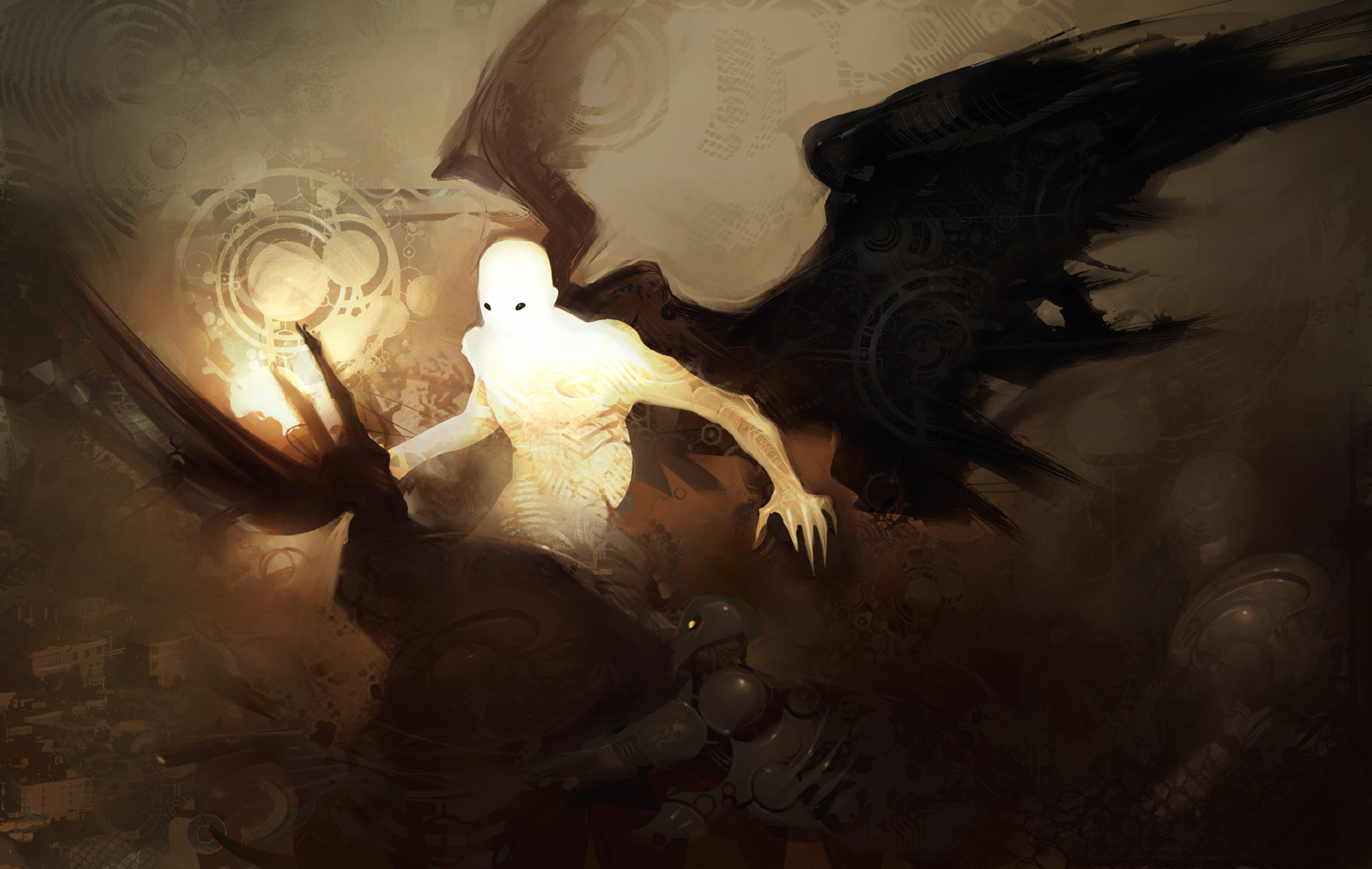
The image presents a digitally painted scene characterized by dramatic contrast and a sense of mystery. The color palette is predominantly warm, using shades of ochre, sepia, and brown, creating an almost antique or dreamlike atmosphere.
A central figure is depicted, comprised of two distinct entities. On the left stands a humanoid figure bathed in bright, almost blinding light. It is nearly featureless, with a smooth, white, mask-like face and a vaguely defined, muscular body. The figure is rendered in a soft, almost ethereal style, suggesting an otherworldliness or purity.
Juxtaposed with this luminous figure is a dark, shadowy entity on the right. This being appears to be formed of feathered wings and swirling darkness, with glowing yellow eyes visible within the shadows. It is rendered with rougher, more chaotic brushstrokes, indicating aggression or a lack of clear form.
The background is composed of layered geometric patterns and circular designs, reminiscent of clockwork mechanisms or alchemical symbols. These elements are partially obscured by the darkness, creating depth and a sense of hidden meaning. At the bottom of the image, there appears to be a robotic or mechanical sphere with glowing eyes, further contributing to the overall atmosphere of mystery and mechanical power.
The overall impression is one of duality, conflict, and potentially, the battle between light and darkness, order and chaos, or the rational and the irrational.
Foucauldian Genealogical Discourse Analysis
This image lends itself strongly to a Foucauldian analysis. We can interpret the visual elements as manifestations of power/knowledge relationships.
- The Light Figure as 'The Rational': The luminous, almost angelic form can be seen as a visual representation of Enlightenment rationality, the 'subject' constructed through discourses of order, control, and reason. Its lack of defining features suggests it is a universalized ideal, a standardized form of power.
- The Shadow Figure as 'The Repressed': The dark, chaotic entity represents everything that is repressed, marginalized, or deemed 'abnormal' by the dominant discourse of rationality. It embodies the darker impulses, instincts, and elements of chaos that are deemed unacceptable to the structures of power.
- The Clockwork/Mechanical Background: This reinforces the idea of control and systematization—the desire for a perfectly ordered world, a Panoptic apparatus visible within the background's repetitive nature. The mechanical sphere with glowing eyes could be seen as a representation of surveillance and the exercise of power through technology.
- Genealogical Trace: A genealogical approach would ask how these categories – light/dark, rational/irrational – came to be constructed as oppositions. The image doesn't show a historical narrative, but it evokes the processes by which certain categories are privileged over others, and how these power dynamics manifest visually.
This image is not about inherent good vs. evil, but about the construction of these categories through discourse and the exercise of power. It points to the ongoing struggle between established systems and the forces that threaten to disrupt them.
Critical Theory
From a Critical Theory perspective (drawing upon thinkers like Adorno and Horkheimer), the image can be read as a representation of the contradictions within modernity.
- Dialectic of Enlightenment: The image visually embodies the idea that the pursuit of reason and control (represented by the light figure) paradoxically generates its own opposite—the darkness, chaos, and irrationality that it seeks to suppress. The dark figure isn't 'evil' but the inevitable byproduct of the attempt to impose absolute order.
- Alienation: The faceless, smooth forms of both figures suggest a loss of individuality and authentic experience. They are archetypes, symbols of abstract forces, rather than fully realized beings. This reflects a concern with the alienating effects of modern society.
- Commodification of Symbolism: The image, as an artwork itself, can be seen as a product of the culture industry, a commodified form of symbolism that obscures deeper truths about power and control. It offers a visual spectacle that might distract from critical engagement.
Marxist Conflict Theory
A Marxist reading of this image would focus on the inherent class struggles visualized.
- Oppressor and Oppressed: The light figure could symbolize the ruling class—those in power, possessing knowledge, and maintaining control. The shadow figure then represents the oppressed, the marginalized, or the exploited, striving against domination.
- The Mechanical Elements as Tools of Control: The clockwork and robotic elements suggest the tools and machinery used by the ruling class to maintain their power and suppress the oppressed.
- The Struggle for Liberation: The composition, with the two figures seemingly in confrontation, implies a struggle for liberation. The shadow figure may be seen as attempting to overthrow the established order, while the light figure seeks to maintain the status quo.
- Alienation of Labor: The faceless figures might also symbolize the dehumanizing effects of capitalist labor, where individuals are reduced to mere cogs in a machine.
Postmodernism
A postmodern interpretation would likely dismantle the idea of a fixed meaning or grand narrative.
- Deconstruction of Oppositions: The light/dark dichotomy would be seen as a constructed opposition, rather than an inherent truth. The image suggests that these categories are fluid and permeable.
- Simulation and Hyperreality: The stylized, digitally painted aesthetic contributes to a sense of artificiality and simulation. The image isn’t a representation of reality, but a constructed image that draws upon pre-existing symbols and tropes.
- Fragmentation and Subjectivity: The layered composition and ambiguous forms reflect a fragmentation of meaning and a rejection of objective truth. The image invites multiple interpretations, rather than offering a single, definitive answer.
- Irony and Parody: The image might be read as a parody of traditional archetypes—the angel, the demon—undermining their established meanings.
Important Note: These interpretations are not mutually exclusive. The strength of this image is that it is rich enough to support multiple layers of analysis from different theoretical perspectives. It would be the specific focus of the researcher, as well as their theoretical position, that would lead to the most nuanced analysis.
Let me know if you would like me to expand on any of these sections or explore a different theoretical lens.
simple-description (llama3.2-vision)
This meme is an image of a character from the video game " Portal" with a confused expression, and the text "I'm not even mad, I'm just disappointed" appears above the character's head. The image is likely a humorous take on a situation where someone's expectations are not met, and they're left feeling disappointed rather than angry.
tesseract-ocr
- f - . ss \ - | —— “SS