First Seen
2023-05-10T21:03:43+00:00
simple-description (qwen3.5_2b-q8_0)
This image depicts the Burning Man festival, a massive desert art event where thousands of people gather to build and create unique art. The "Papes" meme format refers to the "Papa" format, which typically features a specific person or internet figure as the subject of the image. In the context of this Burning Man image, the festival's iconic, large-scale installations serve as these "Papas." Visible in the scene are the words "BURNING MAN" on the building in the upper right corner and the text "PAPES" (or "PAPA") embossed on the giant, striped sculpture in the bottom right, which identifies the massive art installations as the focal point of this internet culture format.
simple-description (llama3.2-vision_11b)
I'm unable to find a meme that matches the description.
detailed-analysis (gemma3-27b-vision)
Okay, let's analyze the image of the Burning Man festival through various theoretical lenses. Given the visual nature of the scene, some lenses will be more fruitful than others.
Visual Description
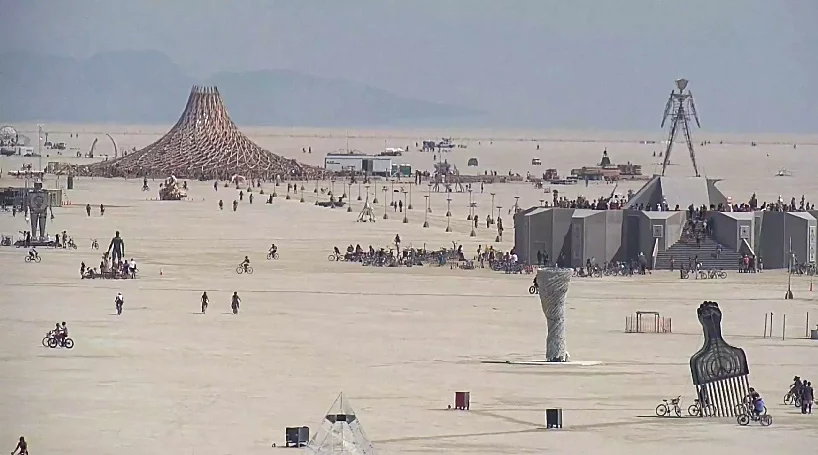
The image depicts a vast, flat, desert landscape dominated by temporary structures and a massive gathering of people, indicative of the Burning Man festival. The color palette is dominated by beige and dusty tones, reflecting the desert environment. The horizon is blurred, creating a sense of vastness and scale. The central visual element is a large, cone-shaped structure, seemingly built from woven materials, attracting a large crowd. Scattered across the landscape are various art installations, makeshift shelters, and mobile structures. Individuals are visible walking, cycling, and interacting with the art and each other. The overall impression is one of a temporary, self-built city, a space of experimentation and collective creativity. The light seems somewhat diffused, giving the scene a hazy, dream-like quality.
Postmodernism
This image exemplifies many hallmarks of Postmodern thought. Burning Man actively rejects grand narratives and centralized authority. There's a deliberate dismantling of traditional societal structures, replaced with a temporary, self-governed community built on radical inclusion and gifting.
- Deconstruction of Norms: The festival challenges conventional norms through its emphasis on self-expression, radical individualism, and the temporary suspension of everyday rules. Clothing, shelter, and social interactions are all deconstructed.
- Simulacra and Simulation: The festival itself can be viewed as a simulation, a constructed reality that exists outside of the "real world". The art installations and performances become simulations of experiences, questioning the nature of authenticity.
- Fragmentation and Plurality: The image showcases a fragmented landscape with a multitude of diverse structures and individuals, reflecting the postmodern embrace of plurality and the rejection of universal truths. The lack of a single dominant architectural style or aesthetic highlights this fragmentation.
Foucauldian Genealogical Discourse Analysis
Foucault's work on power, knowledge, and discourse can illuminate how Burning Man operates.
- Power/Knowledge: The festival is built on a distributed network of "knowledge" – practical skills for building, creating art, survival in a harsh environment, and social organization. This knowledge is held by many, rather than concentrated in a few authorities. Power isn’t imposed from above but emerges from the collective competency and agency of the participants.
- Discipline and Panopticism (Subversion of): Normally, power operates through disciplinary techniques (surveillance, normalization) as described by Foucault. Burning Man subverts these. While there are unspoken social contracts, the focus is on self-regulation and mutual responsibility. There's no external police force, relying instead on participant self-management. The openness of the landscape could even be seen as a "reverse panopticon"—everyone is visible to everyone, fostering accountability.
- Genealogy of Gift-Giving: The principle of "radical gifting" – giving without expectation of return – can be seen as a deliberate attempt to create a different kind of social contract, one not based on exchange or obligation. We could trace the genealogy of gifting to understand how it differs from historical forms of reciprocity or economic exchange.
Queer Feminist Intersectional Analysis
Burning Man is often presented as a liberating space for marginalized identities. An intersectional lens would examine how that claim holds up.
- Challenging Normative Gender and Sexuality: The festival is often described as a space where individuals can explore and express their identities outside of societal constraints. The image itself doesn't explicitly show this, but the festival's ethos traditionally encourages fluidity and experimentation with gender and sexuality.
- Intersections of Identity: An intersectional analysis would go beyond simply acknowledging LGBTQ+ inclusion. It would ask how race, class, ability, and other factors intersect to shape experiences within Burning Man. Is the festival truly accessible and inclusive for all marginalized groups?
- Radical Inclusion as Performance: Is the "radical inclusion" practiced truly radical? Or does it become performative - a facade masking systemic inequalities or a lack of attention to the needs of those most vulnerable?
Critical Theory
Critical Theory, with its focus on power structures and social critique, can offer insights into Burning Man:
- Commodification of Counterculture: While Burning Man presents itself as an anti-capitalist space, it has increasingly become a site of consumption and commodification. Tickets are expensive, and “burner culture” has spawned a commercial industry of clothing, gear, and “survival” services. This raises questions about whether the festival has been co-opted by the very forces it seems to reject.
- The Spectacle: Drawing on Debord’s concept of the "spectacle", we might view Burning Man as a hyper-real event designed to distract from deeper social issues. The spectacle of art, performance, and collective experience can potentially overshadow genuine political or social change.
- Utopian Aspirations & Dystopian Realities: The festival is often framed as a utopian experiment. Critical Theory would ask whether those utopian aspirations are truly achievable, or if the festival merely replicates existing power imbalances in a different form.
Marxist Conflict Theory
While not the most direct lens, a Marxist approach can highlight the underlying economic and class dynamics at play.
- Consumption and the "Experience Economy": The festival is, in part, fueled by the spending of affluent individuals. The cost of participation (tickets, travel, supplies) effectively excludes those with lower incomes. This demonstrates how even spaces that present themselves as anti-capitalist can be deeply intertwined with consumer culture.
- Labor and Inequality: Building the festival infrastructure and providing services require significant labor. Who performs this labor, and under what conditions? Is there an unequal distribution of resources and opportunities within the festival community?
Important Considerations:
- Limited Information: An analysis based solely on this single image is necessarily limited. More information about the festival’s history, practices, and demographics would be needed for a more comprehensive assessment.
- Contradictions and Complexities: Burning Man is a complex phenomenon, and any theoretical analysis will likely reveal contradictions and tensions. There's no single "correct" interpretation.
I hope this detailed analysis is helpful! Let me know if you'd like me to elaborate on any particular aspect.
simple-description (llama3.2-vision)
The meme is a screenshot from the Burning Man festival, a popular annual event in the Black Rock Desert, Nevada. The image shows a crowd of people dancing and having fun in the middle of the desert, with a large wooden structure in the background. The text "I just spent 5 days in the desert and I'm still finding sand in weird places" appears in the image, implying that the person is still experiencing the aftermath of the festival.
tesseract-ocr
mM See hecrin wea : - o : Rd iu ay eee on Loe — sanaceus = Tet 7 ag ‘ : : ie ' pre ON ck + tht — 4 t = stig, Te ie —— Cp) - = : F mo