First Seen
2023-05-10T21:03:43+00:00
simple-description (qwen3.5_2b-q8_0)
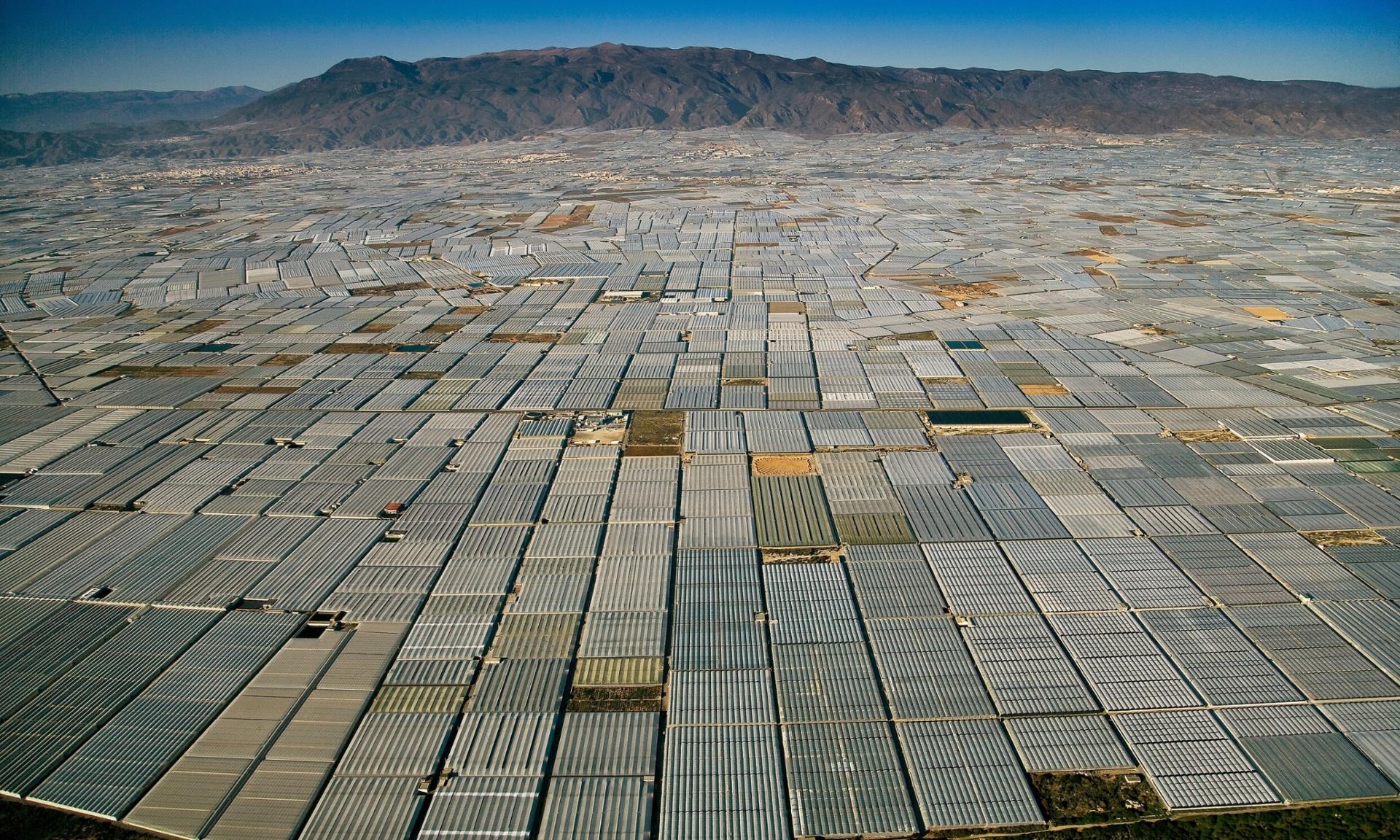
The image displays a massive, grid-like agricultural landscape viewed from a high aerial angle, characterized by thousands of rectangular greenhouse structures that stretch out into the distance. These silver, reflective roofs form a chaotic yet repetitive pattern across a vast, arid plain, with arid mountains rising in the background under a bright blue sky. While the visual is dominated by the field of greenhouses, the scene is widely recognized as the "Papes" meme, symbolizing the sheer scale of modern industrial farming. (Note: No text appears in the image itself.)
simple-description (llama3.2-vision_11b)
I couldn't find any information on a meme related to the category "Papes".
detailed-analysis (gemma3-27b-vision)
Okay, here’s an analysis of the image, broken down into the requested sections. I’ll indicate when a section doesn't quite fit the image and explain why. The image is very strong for certain theoretical interpretations, and weaker for others.
Visual Description
The image is a high-angle aerial photograph depicting an immense expanse of plastic-covered greenhouses stretching across a broad, flat plain. The greenhouses are organized in a grid-like pattern, creating a visually repetitive and almost overwhelming texture. The plastic appears silver or translucent, reflecting sunlight. In the background, mountainous terrain rises abruptly, creating a stark contrast between the manufactured, artificial landscape of the greenhouses and the natural, rugged beauty of the mountains. There are roads and paths visible cutting through the greenhouse sea. The scale is immense, suggesting industrial or large-scale agricultural production. The color palette is muted, dominated by silver, grey, and the browns/greens of the distant mountains and sparse vegetation. The sky is a clear, bright blue, further emphasizing the artificiality of the scene below.
Foucauldian Genealogical Discourse Analysis
This image is highly amenable to a Foucauldian reading. The greenhouses represent a complex discourse surrounding food production, control, and regulation.
- Power/Knowledge: The organization of the landscape is power/knowledge in action. The grid-like structure is not “natural”; it’s a deliberate system designed to maximize production, control growing conditions, and ultimately, profit. The technology (plastic, irrigation systems, climate control) represents a specific body of knowledge used to exert control over the natural world and extract resources.
- Discipline and Surveillance: The greenhouses, seen as part of a larger agricultural system, act as a disciplinary apparatus. They create controlled environments, monitoring and regulating plant life (and, by extension, the conditions of labor within). The repetition of the structures suggests standardization and efficiency, implying a broader system of control.
- Genealogy of Agricultural Practices: We can trace the genealogy of this landscape. From traditional farming practices, through the development of horticultural technologies, to the intensification of agricultural production driven by global markets, the greenhouses represent a specific historical moment in the evolution of how we produce food.
- The Panopticon Effect: While not a literal panopticon, the image evokes similar principles. The pervasive grid and control over the environment suggest a system where observation (of yields, conditions, and labor) is inherent.
Critical Theory
The image strongly supports a Critical Theory analysis, particularly aligned with the Frankfurt School.
- Instrumental Reason: The landscape exemplifies the dominance of “instrumental reason” – a focus on efficiency, productivity, and control, divorced from ethical or aesthetic considerations. The entire plain is reduced to a means of production. The beauty of the natural landscape is subsumed by the demands of maximizing agricultural output.
- Commodification of Nature: This landscape is a clear illustration of the commodification of nature. Natural resources (land, water, sunlight) are treated as inputs into a production process, and the result (agricultural products) are transformed into commodities to be sold on the market.
- Alienation: While we don't see people in the image, the landscape evokes a sense of alienation. The artificiality of the environment, the repetitive structures, and the absence of natural diversity suggest a detachment from the natural world and potentially, from meaningful labor.
- Culture Industry: We can connect this to the "culture industry" concept; the demand for year-round availability of certain produce creates a system that forces this type of intensive production, shaping our desires and expectations.
Marxist Conflict Theory
This image is powerfully linked to Marxist Conflict Theory.
- Means of Production: The greenhouses are the means of production. They represent the capital invested in the agricultural system. The ownership of these greenhouses, and the land beneath them, is likely concentrated in the hands of a relatively small number of people or corporations.
- Class Struggle: This landscape implies an underlying class struggle. The profit generated by the agricultural production is likely extracted from the labor of a working class (farm workers) who may be exploited and subject to poor working conditions. The visual contrast between the immense scale of the greenhouses and the likely anonymity of the workers highlights this power imbalance.
- Capital Accumulation: The sheer scale of the greenhouses demonstrates the relentless drive for capital accumulation. The system is designed to maximize profit, even at the expense of environmental sustainability or social justice.
- Commodification of Labor: The agricultural products are commodities, but so is the labor that produces them. The workers are reduced to a factor of production, their value determined by their ability to generate profit.
Postmodernism
Postmodern analysis is more complicated. It's not a strong fit, but some points can be made.
- Simulacra and Simulation: The image could be interpreted as a simulacrum – a copy without an original. The artificial environment of the greenhouses creates a simulation of natural growth, removing it from its ecological context.
- Hyperreality: The endless repetition of the structures creates a sense of hyperreality – a simulation that becomes more real than the real. The consumer's expectation of perfectly shaped, year-round produce might be more “real” to them than the actual process of growing food.
- Deconstruction of Nature: The image deconstructs the traditional notion of “nature.” The landscape is no longer pristine or untouched; it is entirely constructed and controlled by human intervention.
- However... Postmodernism often emphasizes fragmentation, relativism, and a lack of grand narratives. While the image is striking, it doesn’t necessarily embody these characteristics as strongly as the other theoretical frameworks.
Queer Feminist Intersectional Analysis
This is the most difficult fit, and requires some significant effort. It's not as immediately apparent as the previous analyses, but can be constructed.
- Labor and Exploitation: The agricultural labor force is often composed of marginalized communities (migrant workers, women, people of color). A queer feminist lens would highlight the intersectional forms of exploitation they face – based on gender, sexuality, race, and class.
- Environmental Justice: The intensive agricultural practices associated with these greenhouses can have negative environmental consequences (water depletion, pesticide use). This disproportionately affects marginalized communities living near the agricultural area.
- Control and Containment: The grid-like structure of the greenhouses can be seen as a metaphor for systems of control and containment – historically used to regulate and oppress marginalized groups. The "order" of the greenhouses is not neutral; it’s imposed and maintained through power dynamics.
- Disruption of Natural Cycles: Queer theory often challenges normative ideas about nature and reproduction. The artificial environment of the greenhouses disrupts natural cycles and imposes a controlled, artificial system of “growth.” This can be interpreted as a parallel to societal pressures to conform to traditional gender roles and reproductive norms.
- However... The image is not explicitly queer or feminist. It requires a degree of metaphorical interpretation to apply these lenses.
I hope this detailed breakdown is helpful! Let me know if you'd like me to elaborate on any specific section.
simple-description (llama3.2-vision)
The meme is a picture of a massive, sprawling city of identical, windowless, grey concrete buildings stretching out to the horizon. The text overlay reads: "When you finally get to your destination but it's just a never-ending sea of IKEA warehouses".
tesseract-ocr
ss sag Ne FY, LN ee ee eee ee 2B if i x SS SS = 7 OR OA SSE eZ, pecsiiy et SN SS ee = ees 1 rae a i en ee Sea Se ee eT LE Liesl MLM a ata AAS I SE EES a gd (Ea VS CS VV FLY A WX NS YZ Y VM MME a | | KN i. \ MISSES CSS ae IS _ Ys Uy HY ie VULTIVIANAAN I, (IAAL \ > KS Vf A-SI | ees ASS. Wh DA fi: 4 TAY\\\\Weaigiets SSS SS