First Seen
2023-05-10T21:03:43+00:00
simple-description (qwen3.5_2b-q8_0)
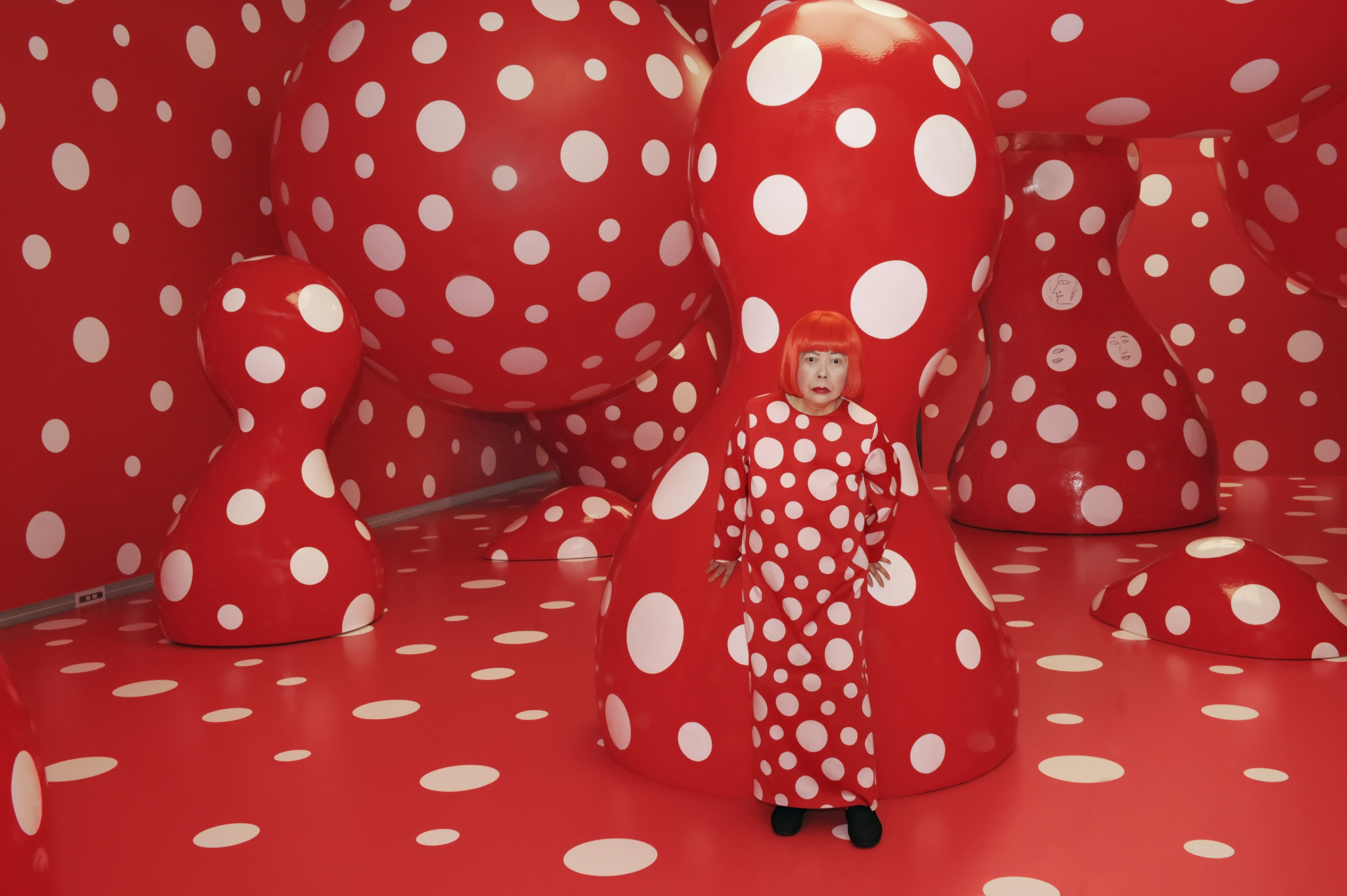
This meme, known as "Popeye," refers to an internet culture trend where people wear costumes that look like a character named Popeye. In this specific context, it is a reference to Yayoi Kusama’s famous art style and her giant red polka-dot mushroom installations. The person in the image is dressed in a red dress with white polka dots and is wearing red hair, making it look almost exactly like the famous internet meme character "Popeye" standing in front of the giant mushroom. While it looks like a serious photo shoot, it is clearly a visual pun on that popular internet meme.
simple-description (llama3.2-vision_11b)
The meme is a picture of a woman with a large head and a small body, surrounded by many other women with similar features. The text "I can smell the desperation" appears in the image. The meme is likely a commentary on the societal pressure to conform to traditional beauty standards, with the women in the image representing the idealized female form.
detailed-analysis (gemma3-27b-vision)
Okay, let's break down this image through the lenses you've requested.
Visual Description
The image depicts Yayoi Kusama, a Japanese contemporary artist, fully immersed in one of her iconic "Infinity Mirror Rooms," specifically a version featuring red and white polka dots. The room is a highly saturated, intensely patterned space. Rounded, bulbous, polka-dotted structures – resembling giant mushrooms or soft sculptures – fill the room and are reflected endlessly in what appears to be mirrored walls and floor. This creates a disorienting, seemingly limitless environment.
Kusama herself is dressed in a matching red and white polka-dot outfit, essentially blending in with, and becoming a part of, the environment. Her face is heavily made up, drawing attention to her eyes and mouth. The lighting is bright and even, enhancing the vibrancy of the red and the starkness of the white dots. The room appears to be part of an exhibition, with a visible air conditioning unit and a doorway suggesting an exit. The overall impression is one of immersive, repetitive, and potentially overwhelming visual experience.
Postmodernism
This artwork very strongly reflects Postmodern characteristics. The "Infinity Mirror Rooms" intentionally dismantle traditional notions of space, perspective, and representation. Postmodernism often rejects grand narratives and embraces the fragmented, the illusory, and the subjective.
- Simulacra and Simulation: Kusama’s work can be read through Baudrillard's concept of simulacra – copies without originals. The polka dots, endlessly multiplied in the mirrors, become a self-referential system, divorced from any original meaning. The room isn't representing something; it is a constructed reality.
- Loss of Authenticity: The repetition and artificiality of the environment challenge the notion of an authentic experience. It's a manufactured reality, designed for consumption and photographic documentation rather than genuine engagement.
- Deconstruction of Space: The room deconstructs traditional notions of space and perspective. The mirrors create a limitless, disorienting environment, challenging the viewer's (and the artist's) sense of spatial awareness.
- Playfulness & Irony: Postmodernism often involves a playful subversion of traditional art forms. Kusama's work, while visually captivating, also possesses an element of irony, suggesting that the endless repetition may be unsettling or even absurd.
Critical Theory (Specifically, the concept of the Gaze)
Kusama's work, especially in the context of how it is experienced and documented, directly engages with the idea of the "gaze," a central concept in Critical Theory, particularly through the writings of Laura Mulvey and others.
- The Spectacle: The "Infinity Mirror Rooms" create a spectacular environment. The work is designed to be seen, to be photographed, and to be shared on social media. This highlights how art can become a commodity within a "society of the spectacle," where image and appearance dominate.
- Subject/Object Relationship: Kusama, in blending into the environment, complicates the subject/object relationship. Is she the artist creating the spectacle, or is she a participant within it? The viewer, similarly, becomes part of the spectacle, often documenting their own image within the room.
- The Female Gaze (potentially): While the interpretation is debated, some argue that Kusama's work offers a distinctly female gaze, challenging traditional artistic representations of women as passive objects of the male gaze. Her self-representation within the environment can be seen as an assertion of agency.
Queer Feminist Intersectional Analysis
This image offers fertile ground for a Queer Feminist Intersectional analysis, focusing on the themes of confinement, repetition, and the subversion of normative space.
- Confinement and Boundary Dissolution: The repeating polka dots and mirrored surfaces create a claustrophobic yet expansive space. This can be interpreted as a metaphor for the confining boundaries imposed on women, and on queer individuals, by patriarchal and heteronormative structures. The dissolution of spatial boundaries in the room can represent a desire to break free from these constraints.
- Repetition and Madness: Kusama's lifelong struggle with mental health, and her incorporation of repetitive patterns in her art, are significant. Historically, women and queer individuals have been pathologized and labeled as "hysterical" or "mad." The obsessive repetition in Kusama's work can be seen as a reclaiming of these labels, and a celebration of the unconventional.
- Subversion of Domestic Space: Polka dots were historically associated with domesticity and "feminine" aesthetics. Kusama’s scaling up and saturating the environment with them disrupts this association, transforming the traditionally cozy pattern into something overwhelming and unsettling.
- Visibility & Erasure: Kusama’s very presence, blending with the polka dots, can be seen as a paradoxical act of both visibility and erasure. She becomes part of the pattern, suggesting a desire to disappear into the art while simultaneously asserting her presence.
Important Considerations:
- Artist's Intent: While these analyses offer interpretations, it is crucial to remember that the artist's intent is complex and multi-layered.
- Multiple Readings: Art is open to multiple readings, and different viewers will bring their own perspectives and experiences to the interpretation.
- Context: Historical, cultural, and social context plays a crucial role in understanding the meaning of the artwork.
I hope this breakdown is thorough and insightful. Let me know if you'd like me to elaborate on any of these points, or explore other theoretical frameworks.
simple-description (llama3.2-vision)
The meme is an image of a woman (Kojo Kometo) with a red wig and a red dress, standing in a room filled with red and white polka dots. The image is a recreation of a 2013 Yayoi Kusama retrospective at the Museum of Modern Art in New York.
tesseract-ocr
= ao ~~ a Vee ee aids rn ad 6 on \. ( peaty cd A ry Aa e rE) 9 ey a - ) | 9» & ee ae I ‘ i] e ® e € e e° ~_~\ ®& @® A 6\ OS ee a € . od Fog = pa : "s sil we la a \ tg 2 Cd -@ c)-4 ee) - Ps » a) ' ae Laer . € % @e ) / q a » Orveesr-, * a = _ Cf »p ) oe @s A Oa’ : e ) - 2 mt” “> 7 > = | ——., eed =e eo £2 - . gers. ry » - ac ae aA 0 _ - _—_ LF y@ o% os en - Patio _ A . (= a a A 8 or fi <=> x ry aa er _ =