First Seen
2023-05-10T21:03:43+00:00
simple-description (qwen3.5_2b-q8_0)
The image depicts the Statue of Joseph Stalin standing in front of a building in Moscow, recognizable by his cap and tool in hand. While the user's prompt suggests a category called "Papes" (likely a play on the word "Pope"), this image is not a meme of a religious Pope.
The "Papes" category is likely a meme-slang reference to the political metaphor where Stalin is jokingly nicknamed the "Pope" (or "Pope Stalin"), due to his towering, bearded, and cap-bearing appearance and his role as a central, albeit brutal, leader of the Soviet Union. In internet culture, this refers to Stalin being the "Pope" of Industry or simply the "Pope" (a dark political joke). The meme format often uses the image to represent this "Pope" stereotype.
There is no text visible in the image. The only text you can see is your prompt's category: "PAPES".
simple-description (llama3.2-vision_11b)
The meme is an image of a Popeye cartoon character with a speech bubble saying "I yam what I yam and that's all what I yam". The meme is making fun of the Popeye character's iconic phrase, implying that he's being overly confident and proud of his identity.
detailed-analysis (gemma3-27b-vision)
Okay, let's break down this image of a statue with several theoretical lenses.
Visual Description
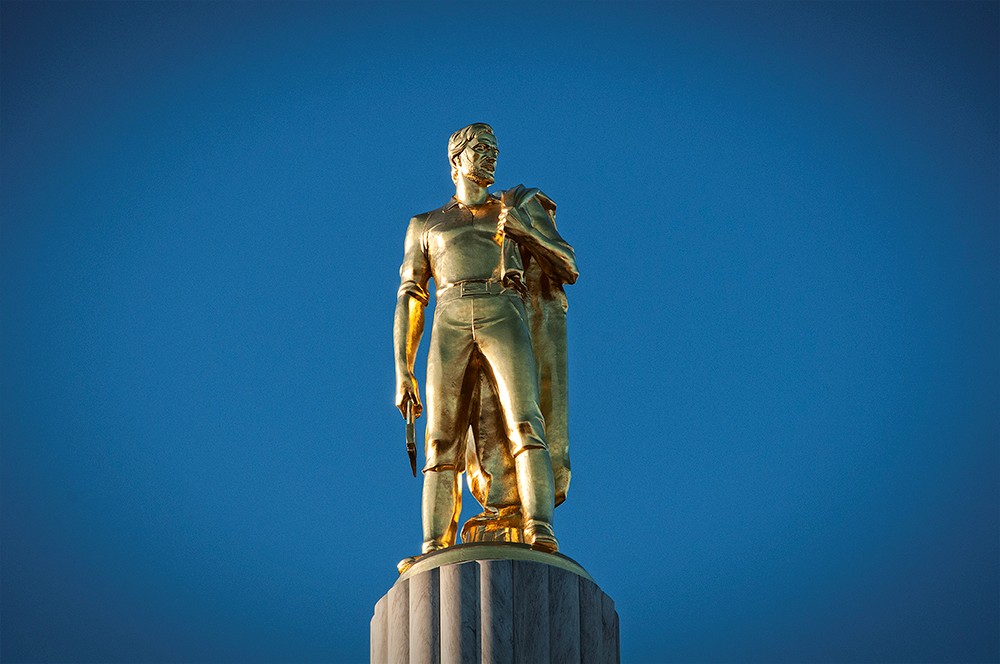
The image depicts a bronze or gold-toned statue of a man, likely representing a historical figure, against a vibrant, solid blue sky. The statue is in full body, appearing to be a worker or laborer dressed in practical, though somewhat dated clothing - overalls, a long-sleeved shirt, and boots. He’s holding a tool in one hand, possibly a pickaxe or a similar mining implement. The statue is positioned on a substantial stone pedestal with fluted vertical detailing. The lighting suggests it’s either early morning or late afternoon, casting long shadows. The statue has a strong, monumental quality. The statue is bathed in golden light, enhancing its color and highlighting its contours. The overall composition is symmetrical and centered, emphasizing the power and importance of the figure.
Foucauldian Genealogical Discourse Analysis
This statue represents a constructed discourse around labor, power, and societal values. A Foucauldian analysis wouldn't ask who the man is, but what the statue does. The image creates a “regime of truth” surrounding manual labor. The statue is not merely a representation of a worker, but a monument to a particular version of work.
- Power/Knowledge: The act of monumentalizing this figure signifies power. Who decided this person (or this type of person) deserved to be elevated to such a high position? This act demonstrates how those in power (the commissioning entity – likely a government or organization) shape collective memory and understanding. It projects the idea of specific virtues associated with labor (strength, resilience, contribution) as ‘natural’ or universal.
- Discipline and Normalization: The statue can be seen as part of a larger discourse of discipline. It encourages the “normalization” of a certain work ethic and a particular type of worker. It establishes an ideal type against which others might be measured. The depiction of the laborer as strong and stoic potentially reinforces expectations of how workers "should" behave.
- Genealogy: A genealogical investigation would trace the historical origins of this particular representation of labor. What historical and social forces led to the creation of this monument? How does it connect to broader narratives of industrialization, class structures, and national identity?
Marxist Conflict Theory
From a Marxist perspective, this statue is deeply embedded in class struggle and the ideology of the ruling class.
- Class Representation: The statue ostensibly honors labor, but it also serves to contain its potential for disruption. By presenting labor as heroic and contained within a monument, it may obscure the inherent exploitation of the working class. The statue presents a version of labor that reinforces existing power structures rather than challenging them.
- Ideology: The monument constructs an ideology of work: the idea that hard work is inherently virtuous and beneficial to society. This ideology obscures the fact that the fruits of labor are not always equitably distributed.
- Superstructure: This statue is part of the “superstructure” – the cultural and ideological institutions that support the economic base. It functions as a tool of legitimation for the existing economic system.
- False Consciousness: The statue can be interpreted as contributing to "false consciousness." By presenting labor as purely positive and without conflict, it obscures the lived realities of workers who may be facing exploitation, poor working conditions, or economic insecurity.
Postmodernism
A postmodern reading would focus on the constructedness of meaning and the inherent instability of representations.
- Hyperreality: The statue can be seen as a simulacrum— a copy without an original. It’s not actual labor being represented, but a representation of a representation. The idealized image of the worker may have little connection to the complex realities of work.
- Deconstruction: The image is open to deconstruction. What is not represented in the statue? What voices are silenced? Who is excluded from this narrative of labor? It might highlight the absence of women, people of color, or different types of work.
- Fragmentation of Meaning: A postmodernist would challenge the notion of a singular, unified meaning. The statue can be interpreted in multiple ways, depending on the viewer's perspective and background. It questions the very idea of a “heroic” worker.
- Meta-narratives: The statue participates in a meta-narrative of progress and national identity, which a postmodernist would view with skepticism. It challenges the idea that there is a single, overarching story that explains history and society.
Queer Feminist Intersectional Analysis
This analysis considers how the statue interacts with systems of power based on gender, sexuality, and other intersecting identities.
- Masculinity and Labor: The statue explicitly embodies a specific form of masculinity – strong, stoic, and physically capable. This reinforces the historical association of labor with masculinity, often marginalizing or excluding women and those who don't conform to traditional gender roles. It reinforces the idea that “real” work is done by men.
- Gendered Division of Labor: The statue’s exclusive focus on a male laborer obscures the significant contributions of women to all forms of work, both paid and unpaid. It perpetuates the historical gendered division of labor.
- Intersectionality: The statue doesn’t exist in a vacuum. A queer feminist analysis would also consider how race, class, and other forms of social identity intersect with gender to shape experiences of labor. It might question whose story is being told, and whose stories are being silenced.
- Challenging Hegemony: A queer feminist critique might see the statue as a symbol of patriarchal power and a need to challenge traditional representations of labor. It advocates for a more inclusive and equitable vision of work that recognizes the contributions of all people, regardless of gender or sexual orientation.
I hope this comprehensive breakdown is helpful! Let me know if you'd like me to delve deeper into any of these analyses.
simple-description (llama3.2-vision)
This meme is an image of the iconic "Man on the Moon" statue, but with a twist: the statue's face has been Photoshopped to look like a meme of a man with a concerned or worried expression. The image is captioned "When you realize you're still paying off student loans 10 years after graduation".