First Seen
2025-03-17T21:03:11.774546+00:00
simple-description (qwen3.5_2b-q8_0)
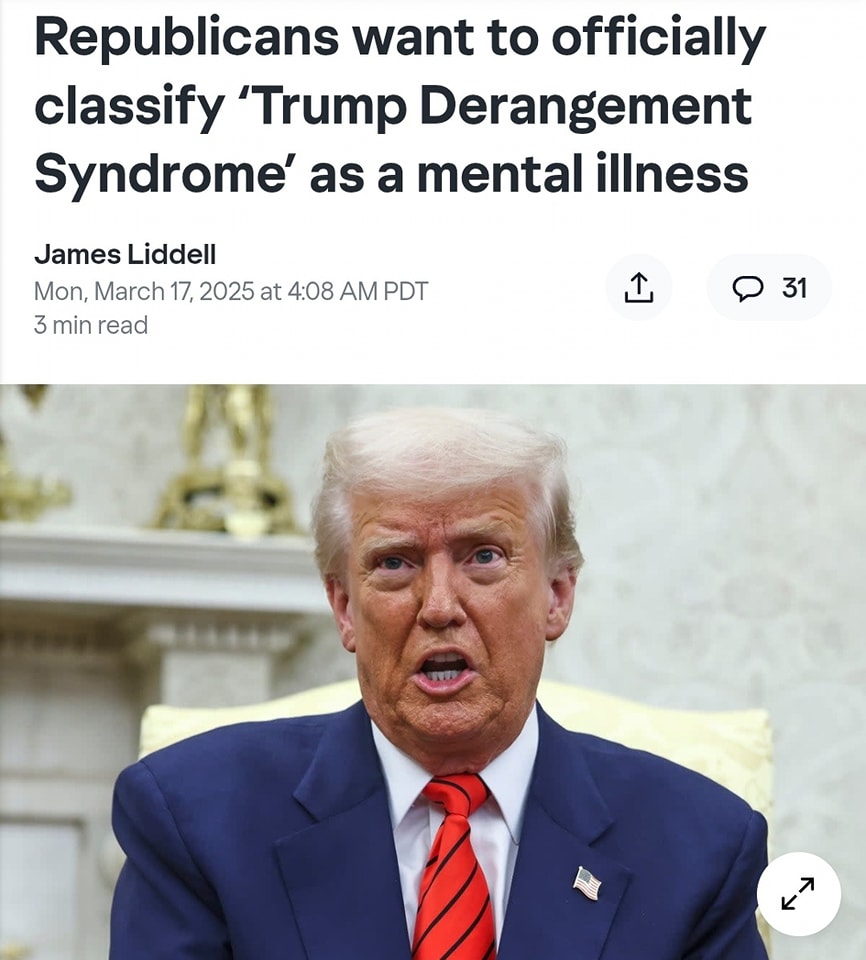
This meme illustrates the concept of pathologization, where political behavior is reclassified as a medical disorder. In this scenario, the headline explicitly states that the President's emotional state ("Trump Derangement Syndrome") is being treated as a mental illness, effectively turning a public figure's behavior into a diagnosable condition.
detailed-analysis (gemma3_27b-it-q8_0)
Okay, let's analyze this image and its headline ("Republicans want to officially classify ‘Trump Derangement Syndrome’ as a mental illness") through the lens of the category "Pathologization," and then delve into the relevant theoretical frameworks.
Overall Framing: Pathologization
This image and headline are prime examples of pathologization: the process of defining behavior or conditions as pathological (deviant, diseased, or dysfunctional) that are, in reality, normal responses to abnormal situations or simply expressions of disagreement/opposition. The attempt to define opposition to Trump as a "syndrome" (a set of symptoms) seeks to discredit that opposition by framing it as irrational, mental illness, and therefore unworthy of serious consideration. The intent is to medicalize political disagreement and silence dissent. The entire premise relies on establishing a ‘normal’ baseline against which opposition is judged. In this case, the implicit baseline is uncritical acceptance of (or agreement with) Trump and his policies. Anything deviating from that is labeled as pathological.
1. Visual Description
The image is a close-up photograph of Donald Trump, a former president of the United States. He is wearing a dark suit and bright red tie. His expression is stern, somewhat scowling, with a furrowed brow and pursed lips. He appears to be speaking or addressing someone. The lighting is somewhat harsh, accentuating his facial features. The image composition (close-up and stern expression) contributes to a portrayal of authority and potential threat. The American flag pin is prominently displayed, emphasizing nationalistic connotations. The visual is designed to evoke a strong emotional response, whether positive or negative, and to reinforce the figure of Trump as a dominant presence.
How it relates to Pathologization: The visual of Trump, particularly his expression, is frequently employed as a trigger for those who oppose him. Presenting this image in conjunction with the claim of "Trump Derangement Syndrome" links the emotional reaction to Trump to a pathological state. It subtly suggests that any negative response to him is itself a sign of mental instability.
2. Foucauldian Genealogical Discourse Analysis
Michel Foucault's work on power, knowledge, and discourse is incredibly relevant here. His genealogical method examines how concepts like "madness" and "illness" are historically constructed through discourse.
- Power/Knowledge: The headline embodies a power/knowledge dynamic. The act of defining what constitutes a "syndrome" is an exercise of power. Those with the authority to define – in this case, suggested to be Republicans – control the narrative and can delegitimize opposing viewpoints. Knowledge of mental illness is used as a tool of power to control and suppress dissent.
- Discursive Formation: "Trump Derangement Syndrome" is a discursive formation: a cluster of ideas, language, and practices that establish a specific way of understanding a phenomenon. This formation is not based on genuine medical consensus but rather on a politically motivated effort to pathologize opposition. The term itself creates a category of people who are automatically seen as ‘sick’ or irrational.
- Normalization: By attempting to formally recognize TDS as a mental illness, the goal is to normalize a specific ideological position – i.e., pro-Trump alignment – and abnormalize all alternatives. This creates a hierarchy where dissenting views are framed as deviations from a healthy, rational mindset.
3. Critical Theory
From a Critical Theory perspective, particularly drawing on the Frankfurt School, this example reveals how ideology operates to maintain the status quo.
- Ideology: The notion of “Trump Derangement Syndrome” serves as an ideological tool to protect the dominant power structure. It deflects criticism of Trump's actions and policies by shifting the focus onto the supposed psychological failings of his critics. It prevents a genuine critique of power.
- False Consciousness: The attempt to pathologize opposition can be seen as an effort to induce false consciousness: leading people to internalize beliefs that are contrary to their own interests. If people believe that their opposition to Trump is a sign of mental illness, they may be less likely to engage in political action.
- Commodification of Critique: In a broader sense, framing dissent as pathology allows for the commodification of psychological "solutions" – therapy, medication, etc. – rather than addressing the root causes of political discontent.
4. Marxist Conflict Theory
Although less directly applicable than the above frameworks, Marxist Conflict Theory can offer some insight.
- Ideological Hegemony: The framing of opposition to Trump as a “syndrome” reinforces the ideological hegemony of conservative forces. This means that their worldview, and their narrative of what is “normal,” becomes dominant and unquestioned.
- Class Interests: While not explicitly about class, the effort to discredit opposition can serve the interests of those who benefit from the existing power structure (often, though not exclusively, the wealthy and powerful). Suppressing dissent ensures the continuation of policies that favor those groups.
- Distraction: Focusing on "Trump Derangement Syndrome" functions as a distraction from real material issues (economic inequality, social justice, etc.) that might threaten the status quo.
5. Postmodernism
Postmodernism highlights the constructed nature of reality and the instability of meaning.
- Deconstruction: We can deconstruct the idea of "Trump Derangement Syndrome" by revealing its underlying assumptions and contradictions. The term itself is ambiguous and lacks a clear, objective definition. What constitutes "derangement"? Who gets to decide?
- Narrative: The headline presents a narrative that is not grounded in scientific evidence but is instead a political construct. It's a story designed to persuade and control.
- Relativism (caution): Postmodernism’s emphasis on the relativity of truth must be applied cautiously here. While all knowledge is constructed, not all constructions are equal. Attempting to pathologize genuine political dissent is harmful and should be critically opposed.
In conclusion, this image and headline are not merely a news item, but a powerful demonstration of how language, discourse, and the construction of “illness” can be used as tools to silence opposition, reinforce power structures, and control the narrative. The act of labeling political disagreement as a mental illness is a deeply problematic form of pathologization.
simple-description (llama3.2-vision_11b)
The meme is a screenshot of a CNN article with the title "Republicans want to officially classify 'Trump Derangement Syndrome' as a mental illness". The image shows a photo of Donald Trump, with the text overlayed on top of it. The meme is making fun of the idea that Republicans want to classify a mental illness that is actually a political term used to describe the anger and frustration some people feel towards Trump and his policies.
detailed-analysis (gemma3-27b-vision)
Okay, here's an analysis of the image and headline provided, broken down into sections based on the requested theoretical frameworks, only including those that apply.
Visual Description
The image is a close-up portrait of Donald Trump, former President of the United States. He is wearing a dark blue suit, a white shirt, and a red tie with a pattern. His face is the primary focus, revealing a stern expression. His lips are pursed, and his eyebrows are furrowed, conveying a sense of seriousness or perhaps displeasure. The lighting is somewhat harsh, with shadows highlighting the lines on his face. The background is out of focus, appearing to be an interior space with a glimpse of green foliage. The overall impression is one of power, formality, and potentially, confrontation. The image seems to be a capture from a political event or a formal setting.
Foucauldian Genealogical Discourse Analysis
The headline itself ("Republicans want to officially classify ‘Trump Derangement Syndrome’ as mental illness") is ripe for a Foucauldian analysis.
- Discourse & Power: The very attempt to classify something like ‘Trump Derangement Syndrome’ as a formal mental illness is an act of power. Foucault argued that discourses (ways of talking and thinking about something) are not neutral; they actively construct the reality they describe. By framing opposition to Trump as a pathology, Republicans are attempting to delegitimize dissent and pathologize those who criticize or oppose Trump. It's a way of saying "they are sick," not simply "they disagree."
- Genealogy: A genealogical approach would explore the historical emergence of this concept. Where did ‘Trump Derangement Syndrome’ originate? What social and political conditions allowed for its construction? Likely, it emerged in response to strong opposition to Trump, as a counter-narrative. The genealogy would track how it gained traction and became a tool for political discourse. It's not a naturally occurring 'illness', but a constructed category with a specific political purpose.
- Normal/Abnormal: This framing relies on a binary opposition between 'normal' (support/acceptance of Trump) and 'abnormal' (opposition to Trump). Foucault would emphasize that what is considered 'normal' and 'abnormal' is socially constructed and shifts over time. This classification is about defining the boundaries of acceptable political behavior.
Critical Theory
The headline and image engage with several themes central to Critical Theory.
- Ideology: The attempt to medicalize opposition to Trump can be viewed as an ideological move. By framing it as a mental illness, Republicans are attempting to mask the underlying political factors driving dissent. This move serves to naturalize and normalize support for Trump while demonizing opposition. It obscures the legitimate political concerns that fuel opposition.
- Domination & Control: Classifying dissent as a pathology is a way of exercising power and control. If those who oppose Trump are 'sick,' they can be silenced, marginalized, or dismissed as irrational. This helps maintain the status quo and suppress alternative viewpoints.
- Critique of Reason: Critical Theory questions the claim to objective reason and neutral observation. The very act of defining a "syndrome" implies a scientific objectivity that is questionable. The definition of the syndrome is likely to be biased and politically motivated, serving to reinforce existing power structures.
Marxist Conflict Theory
While not the central focus, a Marxist lens can illuminate the underlying dynamics.
- Class Conflict: While 'Trump Derangement Syndrome' is framed as an individual pathology, the opposition to Trump often stems from broader social and economic grievances. People who felt left behind by globalization, economic inequality, or the political establishment were more likely to oppose Trump. Framing opposition as mental illness obscures these underlying material conditions.
- Hegemony: The attempt to define ‘Trump Derangement Syndrome’ can be seen as part of a broader effort to maintain the hegemony of conservative ideology. By delegitimizing dissent, Republicans seek to reinforce their dominance in the political sphere.
Note: The other theoretical frameworks (Postmodernism and Queer Feminist Intersectional Analysis) aren't as directly applicable in this case, as the central focus is on power, discourse, and the medicalization of political opposition.
Let me know if you’d like me to elaborate on any of these points or explore additional angles.
simple-description (llama3.2-vision)
The meme is a screenshot of a news article with the title "Republicans want to officially classify 'Trump Derangement Syndrome' as a mental illness". The article is a satirical take on the idea that some people are so opposed to Trump that they are experiencing a mental health issue, and the article is poking fun at the idea that such a condition could be officially recognized. The image is likely a photo of a person looking shocked or confused, with a caption or quote from the article that is not visible.