First Seen
2023-05-10T20:59:58+00:00
simple-description (llama3.2-vision_11b)
The meme is an image of a wooden dome structure, likely a geodesic dome, being constructed in a permaculture setting. The text "Permaculture Shelter" appears above the image, suggesting that the structure is being built as a sustainable and environmentally-friendly dwelling. The image itself shows a wooden framework, with some components still being assembled, implying that the structure is still in the early stages of construction.
detailed-analysis (gemma3-27b-vision)
Okay, here's an analysis of the image based on the requested theoretical frameworks, broken down into sections. I'll only include sections where the framework is demonstrably applicable to the image.
Visual Description
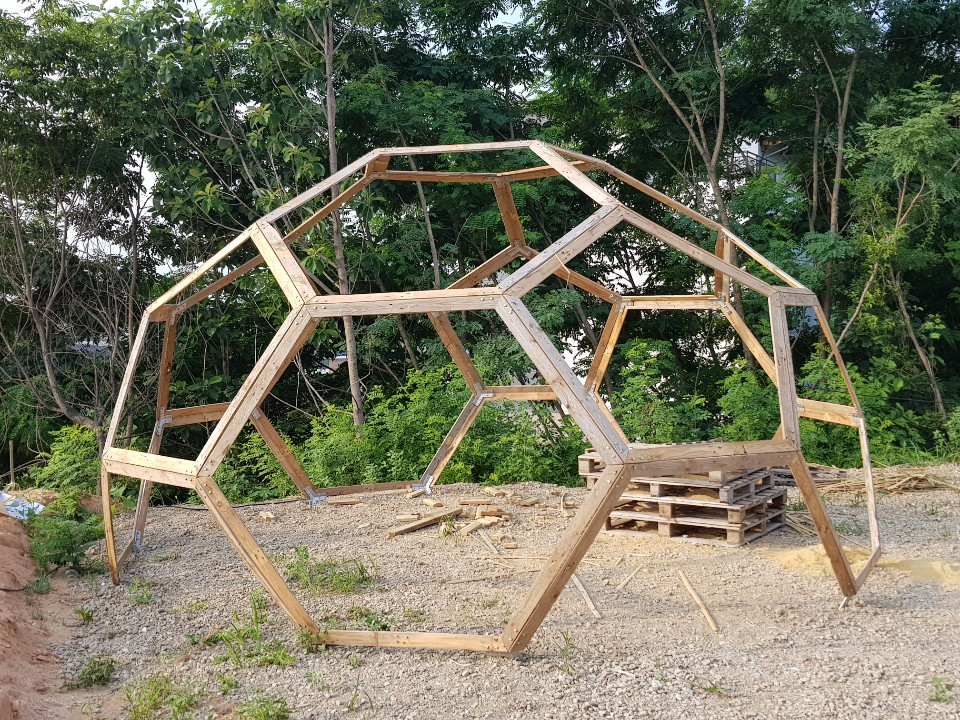
The image depicts a partially constructed geodesic dome frame in an outdoor setting. The dome is made of raw, untreated wood and appears to be in the early stages of completion. It’s a network of triangles and pentagons forming a semi-spherical structure, with gaps where more framing is needed.
The ground beneath and surrounding the dome is covered in gravel and sparse, low vegetation. In the background, a dense thicket of trees provides a blurred, natural backdrop. A wooden pallet is lying to the side, suggesting ongoing construction. The lighting indicates either late afternoon or early morning, casting shadows within the dome’s framework. The overall impression is one of a nascent, self-built project within a somewhat overgrown, natural environment.
Foucauldian Genealogical Discourse Analysis
The dome, as an architectural form, can be understood through a Foucauldian lens as a manifestation of changing discourses around space, living, and utopian ideals. The geodesic dome itself gained prominence in the mid-20th century, popularized by Buckminster Fuller. Tracing its genealogy reveals a history connected to the counterculture movement, post-war aspirations for technological solutions, and even Cold War anxieties (the dome’s efficient use of materials and potential for shelter aligned with civil defense thinking).
The dome here, however, is not a polished, fully realized structure. It’s under construction. This is critical. It signifies a practice of building, a site where discourses about sustainability, self-sufficiency, and alternative living are performed rather than simply represented. The raw materials, the visible labor, and the incomplete nature of the structure disrupt the smooth narrative of a pre-fabricated “solution.” It’s a “site of power/knowledge” where the dominant discourses of conventional housing and consumerism are actively challenged, but in a highly localized and imperfect way.
The discarded pallet further reinforces this idea—it represents the repurposing of existing systems of distribution, a micro-level resistance to established economic norms. The gravel-covered ground, too, could be seen as a deliberate rejection of manicured landscapes, a claim over natural space. This construction is a visible disruption of what's considered "normal" space and builds towards an alternative.
Critical Theory
From a Critical Theory perspective (drawing from the Frankfurt School), the dome can be interpreted as a potentially emancipatory project complicated by its inherent limitations. The dome embodies a desire to break free from the ‘iron cage’ of rationalization and commodification—the standardized, mass-produced housing that characterizes much of modern life.
However, a truly critical approach demands acknowledging the potential for co-option. Could this "alternative" living space, in the long run, become another commodity, gentrifying the surrounding area or becoming a symbol of middle-class "authenticity?" The fact that the dome requires skill and resources to construct means it isn’t universally accessible, potentially reinforcing existing social inequalities.
The dome promises a different way of living—one closer to nature, more sustainable, and less reliant on mainstream systems. But whether that promise is fulfilled depends on the broader social and political context. The dome itself is not inherently revolutionary; it's the potential for a shift in consciousness and social organization that makes it worthy of critical analysis.
Marxist Conflict Theory
Seen through a Marxist lens, the dome represents a potential site of class struggle and a challenge to the means of production. Traditional housing relies on capitalist systems of land ownership, construction, and finance. This dome, being self-built, attempts to bypass those systems. It signifies a reclaiming of labor and resources, a move toward a more communal, self-sufficient mode of production.
The use of salvaged materials (as suggested by the pallet) directly opposes the logic of consumer capitalism, which thrives on planned obsolescence and the constant creation of new demand. However, this act of resistance is inherently limited. The individual or group building the dome likely still operates within the broader capitalist system – they may need to earn money to acquire tools, materials, and land.
The dome, therefore, can be seen as a microcosm of the larger class struggle. It represents a desire to break free from exploitation and alienation, but the conditions for true emancipation remain elusive. It is an attempt to realize the Marxist concept of 'from each according to his ability, to each according to his needs' at a local, personal level.
I hope this analysis is helpful. Let me know if you'd like me to elaborate on any of these points or explore other theoretical frameworks.
simple-description (llama3.2-vision)
This meme is an image of a large, elaborate wooden structure, likely a geodesic dome, with a sign on the front that reads "Abandon all hope ye who enter here". The image is a humorous take on the classic "Abandon all hope" sign from Dante's Inferno, but applied to a more mundane and humorous context.
tesseract-ocr
ra Mace eae ae oa es fa get oe ao sey Ri ene a ae a * et —— Dyn ee a ay ; x ee bo eee : TR SS es a a } EA S Vis kee ‘a Sie? pan = Dio eee ag A | gees ae Da, cane ONC a a = a oe oe RN a, a eat A aes Cx Canes a» aS Wien Rte begers ae Be eee ee, e. ey ae ANN nie J i wage Oe © a ee x soi oe) } 4 Va ‘ 3 fe 4 Behe ie ke ee SQ Fi Ss Lap ge Banc I Ae a0 et Yi, DOA” gee i Me Soe 84 a iS ae D.” ee. oy a pee as AS | ae: | ‘i IN 28s i ee) 2 Mee eee OU) cone ae >» ie ir: sae ED eo ia C N Gee oe, see a Se oo es i aM Ce 2Z oo =~ ~ . oii \" a Be aS el _ o kee z ae ae ee ree fh = = <a = ee a EN Ge SS j | . a Es — =< oe oN +a ee ee 4 man up : SG Axle. ones ee. Ge: jo RR oes: ee aera em ~ £ S :