First Seen
2023-05-25T22:49:54+00:00
simple-description (qwen3.5_2b-q8_0)
The image provided is not a meme. It is a product listing for Hexayurt Shelters, a brand of canvas tents manufactured in India. The text in the image includes specific dimensions (e.g., "166 sq ft", "13' 10"", "8'"), material properties (e.g., "70 sq ft", "72 oz"), and instructions for installation (e.g., "Fold, Fold, Fold").
I understand you might be expecting a reference to the 6174 meme (often used in math puzzles where 1234567890 is manipulated to form a palindrome), but this image does not appear to contain that specific content or structure.
If you have a different image in mind or are looking for information about this specific product, please feel free to clarify.
simple-description (llama3.2-vision_11b)
The meme is an image of a permaculture-inspired shelter design, featuring a hexagonal structure with a sloping roof and a central entrance. The text "6' x 6' x 6'" is written at the top, and the image is captioned "6' x 6' x 6' = 216 cubic feet". The image is meant to poke fun at the idea of designing a shelter that is only 6 feet by 6 feet by 6 feet, which is a humorous and relatable take on the concept of permaculture.
detailed-analysis (gemma3-27b-vision)
Okay, let's break down this image of Hexayurt shelters through the lenses you've requested. Given the image primarily depicts architectural designs for temporary shelters, some of these theoretical frameworks will be more applicable than others. I'll organize the response accordingly, noting where a particular lens doesn't quite fit.
Visual Description
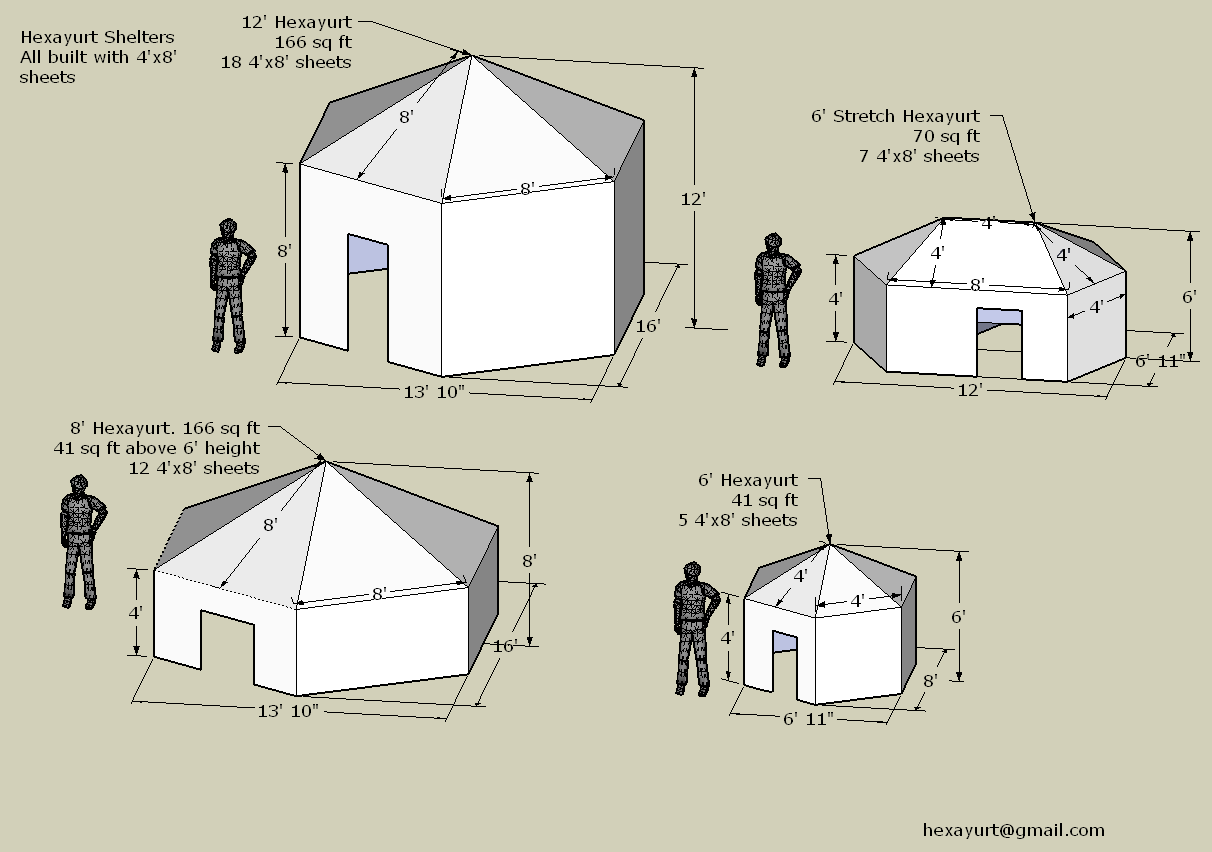
The image presents a technical illustration comparing four different designs of Hexayurt shelters. These shelters are geodesic dome-like structures built with triangular panels. A small human figure is included in each rendering to provide a scale reference. The image is diagrammatic, with dimensions (height, width, length, area in square feet) clearly labeled for each design.
The shelters vary in size and construction details:
- 12' Hexayurt: Largest, utilizes 18 panels of 4’ x 8’ sheets.
- 8' Hexayurt: Intermediate size, with 12 panels and an area of 166 sq ft above 6’ height
- 6' Stretch Hexayurt: Slightly smaller, requires 7 panels.
- 6' Hexayurt: Smallest, requires 5 panels.
The design emphasis is clearly on practicality and efficiency of construction, as evidenced by the focus on panel dimensions and overall square footage. The line drawings are simple and functional, prioritizing clarity of information over aesthetic concerns. A small email address "hexayurt@gmail.com" is visible in the bottom right corner.
Foucauldian Genealogical Discourse Analysis
This framework is moderately applicable. We can see the emergence of a discourse around low-cost, accessible shelter construction. The Hexayurt design isn’t simply an architectural form; it's a product of a specific set of historical conditions and power dynamics.
- Historical Context: The emergence of these shelters likely relates to growing concerns about homelessness, disaster relief, sustainable living, and perhaps even off-grid living movements. The focus on readily available materials (4x8 sheets) suggests a response to resource limitations or a desire to bypass traditional, expensive building methods.
- Power/Knowledge: The diagrammatic presentation of the design isn't neutral. It presents a specific way of understanding shelter and its construction as efficient, economical, and easily reproducible. This "knowledge" becomes a form of power, potentially displacing or marginalizing other forms of shelter building or approaches to housing. The creator positions themselves as possessing expertise and offering a solution.
- Discipline: While not overtly disciplinary, the very act of standardizing shelter design through pre-cut panels and precise dimensions can be seen as a form of subtle social control. It encourages a specific mode of building, limiting improvisation or individual creativity.
Marxist Conflict Theory
This lens is quite relevant. The Hexayurt design can be analyzed through the lens of class struggle and access to resources.
- Means of Production: The focus on using readily available, inexpensive materials (4x8 sheets) is a direct response to economic constraints. The design aims to democratize access to shelter by lowering the barriers to construction.
- Class Conflict: The Hexayurt can be seen as a potential tool for those marginalized by the housing market – the homeless, those in disaster areas, or those seeking alternative living arrangements. It represents a challenge to the existing capitalist system that often prioritizes profit over basic human needs like shelter.
- Alienation: Traditional housing construction can be expensive and time-consuming, alienating many from the ability to create their own living space. The Hexayurt attempts to reduce this alienation by providing a simplified, replicable design.
- Commodity Fetishism: In a capitalist society, housing becomes a commodity—something to be bought and sold. The Hexayurt offers a way to de-commodify shelter by empowering individuals to build their own housing with readily available materials.
Postmodernism
Postmodern aspects are visible in the deconstruction of traditional architectural norms.
- Rejection of Grand Narratives: The Hexayurt design implicitly challenges the "grand narrative" of traditional, expensive, professionally-built housing as the only legitimate form of shelter. It proposes an alternative that prioritizes practicality and accessibility.
- Emphasis on Local Context: While the basic design is standardized, it could be adapted and modified to suit local materials and environmental conditions. This adaptability reflects a postmodern emphasis on context and difference.
- Deconstruction of Form: The Hexayurt's geodesic dome structure is a departure from traditional rectilinear building forms. It represents a deconstruction of conventional architectural aesthetics.
- Simulacra and Simulation: The diagrammatic representation of the shelter is, in itself, a simulation—a representation of a future living space. This reflects the postmodern concept of simulacra, where representations often become more real than the original.
Queer Feminist Intersectional Analysis
This lens, while not immediately obvious, can be applied with a degree of nuance.
- Challenging Normative Spaces: Traditional housing is often designed around heterosexual, nuclear family norms. The Hexayurt, as a flexible and adaptable shelter, could be used to create alternative living arrangements that challenge these norms – communal living, intentional communities, or spaces for LGBTQ+ individuals.
- Intersection of Precarity: Those most vulnerable to homelessness and housing insecurity are often those at the intersection of multiple marginalized identities – LGBTQ+ individuals, people of color, people with disabilities, etc. The Hexayurt, by providing a low-cost shelter option, could potentially mitigate some of the precarity faced by these groups.
- Decentering the Architect: The DIY nature of the Hexayurt design decenters the traditional role of the architect as the sole expert and empowers individuals to participate in the creation of their own living spaces. This aligns with feminist principles of agency and empowerment.
- Challenging Spatial Politics: Traditional spatial planning often reinforces power imbalances and social hierarchies. The Hexayurt, by offering an alternative to conventional housing, could contribute to the creation of more equitable and inclusive spatial environments.
Disclaimer: Some of these analyses require an interpretation and are not directly evident in the image itself. They rely on an understanding of the broader context and potential applications of the Hexayurt design.
Let me know if you'd like me to elaborate on any of these analyses or explore another theoretical framework!
simple-description (llama3.2-vision)
The meme is a screenshot of a 3D model of a building with a series of rooms and corridors. The text "I can see 4 rooms" is written in the top left corner of the image.
tesseract-ocr
12’ Hexayurt Hexayurt Shelters 166 sq ft All built with 4x8" 4g. 4x" sheets P sheets 6' Stretch Hexayurt 70 sq ft 7 4'x8' sheets ] 12° HY 16" Hy ES vy yt FI =. : <7] 43' 10" 12’ 8' Hexayurt. 166 sq ft 41 sq ft above 6' height 12 4'x8' sheets F _ 2 6' Hexayurt > tsa tt ay d 5 4'x8' sheets et - 8 es a Hi 2 y F [ py 4 i , 6 4 WY > | fo ble nyt - 13° 10" Ls 11" hexayurt@gmail.com