First Seen
2023-05-10T20:59:59+00:00
simple-description (llama3.2-vision_11b)
The meme is a photo of a large, intricately designed wooden structure that resembles a giant insect's exoskeleton. The structure is made up of interconnected wooden modules, each one featuring a unique design and shape. The text accompanying the image reads "Permaculture Shelter" and the image is captioned "We need to make our homes out of wood and plants and hope that no one wants to live there".
detailed-analysis (gemma3-27b-vision)
Okay, here's an analysis of the image, broken down into sections as requested. I'll note if a section doesn't apply. I'll aim for a balance of analysis that is appropriate to the photo's content.
Visual Description
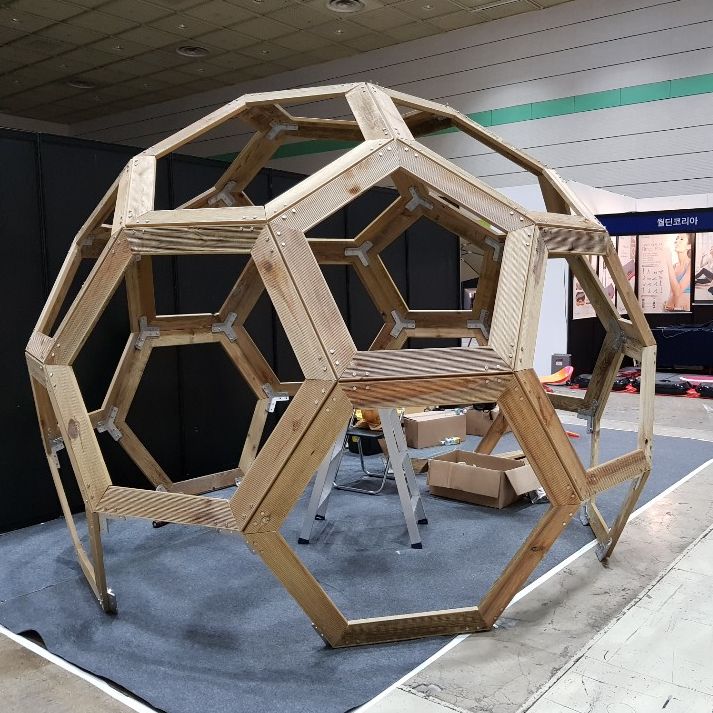
The image depicts a partially constructed geodesic dome. The frame is constructed from what appears to be light-colored wood, likely plywood or lumber. It’s a polygonal structure comprised of numerous triangular and pentagonal panels connected to form a sphere-like shape. The structure is not fully enclosed; many panels are missing, revealing the interior framework.
It’s situated on a dark blue carpeted floor inside a convention or exhibition hall (as suggested by the tiling, low ceiling, and distant signage). Scattered around the dome are construction materials including cardboard boxes and a folding chair, indicating ongoing assembly. The lighting is fluorescent and somewhat flat, typical of such indoor spaces. The dome is quite large, appearing as a substantial installation, and it dominates the foreground of the image. The background is out of focus, but hints at further exhibition displays and signage (some of which appear to be in Korean).
Foucauldian Genealogical Discourse Analysis
This structure can be analyzed through a Foucauldian lens by examining the discourse surrounding geodesic domes and their historical association with concepts like ‘utopian living’, ‘systems thinking’, and ‘counter-culture’. Buckminster Fuller, the architect most closely associated with the geodesic dome, sought to create efficient, sustainable structures that would revolutionize living.
A genealogical tracing of this discourse would reveal how the dome transitioned from a radical architectural proposition to a somewhat mainstream symbol of 'eco-friendliness' and alternative lifestyles. We could examine the power dynamics at play in framing the dome as either 'progressive' or 'naive', and how this framing serves particular ideological purposes. The unfinished state of the dome in the image could be seen as a representation of the incomplete nature of utopian projects. It's an attempt to build a "total" system that inevitably encounters limits and contradictions. The lack of finality and the visible construction elements expose the underlying structure of power and control involved in any building project.
Critical Theory
From a critical theory perspective, the geodesic dome presents itself as a site of rationality and order. Its geometric precision suggests a desire to impose structure on the "chaos" of the external world. However, a critical examination questions whose rationality is embodied in this structure. It's important to ask what values and norms are embedded within its design. Is it truly a “neutral” space?
Furthermore, the dome can be seen as an embodiment of a certain technological optimism. The belief that technology can solve social and environmental problems is implicit in the dome’s promise of efficiency and sustainability. However, critical theorists would caution against a naive faith in technology, arguing that it can also perpetuate existing power imbalances and create new forms of control. The exhibition space and the materials present around it indicate a cultural context and raise questions as to the power dynamics within that space.
Marxist Conflict Theory
While not overtly about class struggle, the dome can be interpreted through a Marxist lens by considering the labor involved in its construction and the resources required to build it. The image shows an unfinished product, and thus indirectly points to the exploitation of labor. Who built the components? Where did the materials come from? What were the working conditions like for those involved in its construction?
The dome itself could be viewed as a symbol of control and containment. The sphere-like shape evokes a sense of enclosure, and the structure could be seen as a metaphor for the social forces that seek to regulate and control individuals. Furthermore, the exhibition hall environment suggests a space of commodity fetishism, where objects are valued for their symbolic meaning rather than their use value.
Postmodernism
The unfinished nature of the dome lends itself well to a postmodern interpretation. It’s a fragmented, incomplete structure that resists totalization. It doesn’t present itself as a finished, perfect object, but rather as a process of becoming.
The dome could also be seen as a pastiche of geometric forms, referencing both ancient architectural traditions and modern engineering. It doesn’t adhere to a single stylistic category, but rather mixes and matches elements from different sources. This eclecticism is characteristic of postmodern aesthetics.
Furthermore, the image challenges the traditional notion of the author (Buckminster Fuller) and the original design. The dome is likely being re-constructed or adapted by others, blurring the boundaries between the creator and the user.
Queer Feminist Intersectional Analysis
This category is the least directly applicable, but still yields some interesting readings.
The dome, as a non-rectangular, non-traditional architectural form, can be seen as a rejection of traditional, patriarchal structures. It disrupts the linear, rigid forms that have historically dominated architecture, which can be symbolically linked to masculine power. The incomplete and potentially fluid nature of the dome also allows for openness and non-binary interpretations.
However, it’s important to acknowledge that the dome’s design was created by a male architect. A truly intersectional analysis would require considering the experiences and perspectives of marginalized groups who might not have been represented in the original design process. Furthermore, the exhibition space and the surrounding environment should be examined for gendered and racial biases. Is the space inclusive and accessible to all? Who is represented in the signage and displays?
I hope this comprehensive analysis, broken down by these critical frameworks, is helpful! Let me know if you'd like me to expand on any of these sections or explore other interpretations.
simple-description (llama3.2-vision)
The meme is a picture of a large, empty, wooden framework resembling a giant, hollow, geodesic dome. The text "I'm not lazy, I'm just on energy-saving mode" appears at the top of the image, implying that the speaker is conserving energy by not doing anything. The image is humorous because it's a clever, tongue-in-cheek way to describe being idle or procrastinating.
tesseract-ocr
: ———< = — ), 7 es SS. a py \_ Bia ee : | Go ae’ \\ ot, N= Cel = Nee | a es