First Seen
2023-05-10T20:59:59+00:00
simple-description (llama3.2-vision_11b)
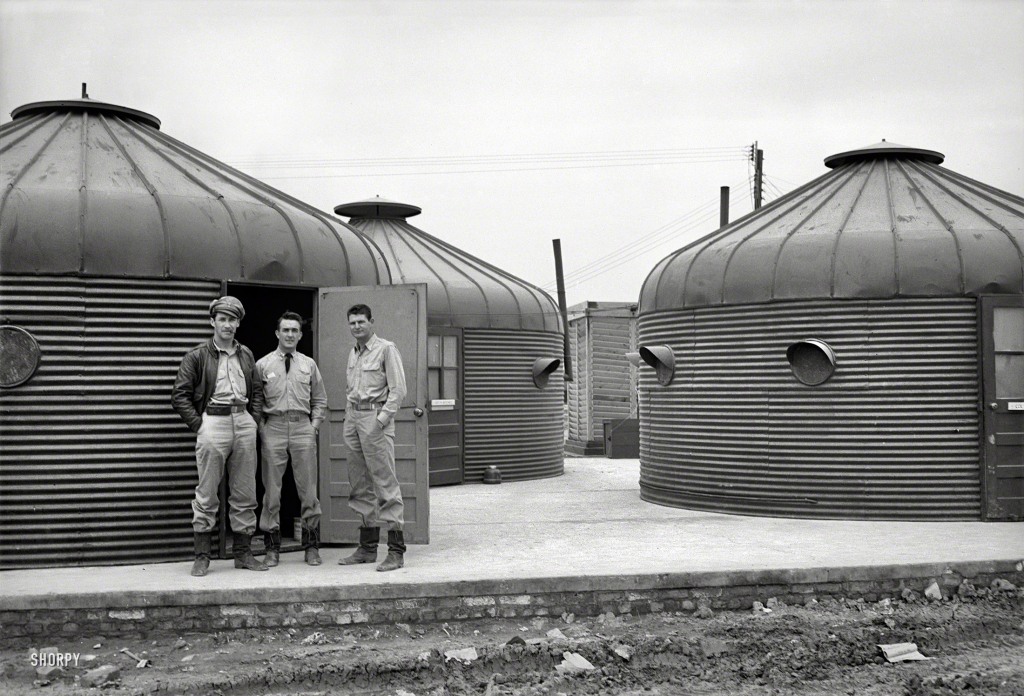
The meme is a photo of three men standing in front of a row of small, round, earth-sheltered homes. The image is captioned "Permaculture - Shelter" and features a quote from a book about permaculture, which is "The permaculture movement is the best way to live." The image is likely a humorous take on the idea that permaculture is the best way to live, and the quote is a playful way to poke fun at the idea that permaculture is the best way to live.
detailed-analysis (gemma3-27b-vision)
Okay, here's an analysis of the image, broken down into sections as you requested, focusing on the areas where the image lends itself to those critical lenses. I'll indicate when a section is not directly applicable.
Visual Description
The photograph is a monochrome, likely mid-20th century, shot of three young men standing in front of a row of peculiar, dome-shaped structures. The structures appear to be metal, corrugated, and built close together. They are cylindrical at the base and curve upwards to a rounded dome, each with a small, oval window and a vent on top. There are doorways in several of them. The men are dressed in work clothes—overalls, jackets, and work boots—suggesting a work or military environment. They are posed, looking towards the camera with a mixture of confidence and slight stoicism. The ground is rough and uneven, showing dirt and patchy grass. The sky is overcast, and the overall mood is utilitarian and functional, though not particularly bleak. The composition is centered around the men and the structures, creating a strong sense of place and time. The image has a documentary feel, suggesting it was captured as a record of a specific setting or moment.
Foucauldian Genealogical Discourse Analysis
This image is highly conducive to a Foucauldian reading. The structures themselves immediately suggest the exercise of discipline and control. The repetitive, almost cell-like nature of the domes evokes panopticism, even if there isn't a literal central tower. While not perfectly fitting Bentham's ideal panopticon, the design implies a system of surveillance and regulation. The rounded shapes discourage cornering or hiding.
- Discourse of Containment: The very architecture embodies a discourse of containment and normalization. The structures aren't designed for comfort or individuality, but for efficient processing—likely of something (people, materials, information). We can ask: what is being contained within these structures? What practices occur inside them?
- Genealogy of Power/Knowledge: A genealogical investigation might trace the historical development of this type of architecture (likely related to wartime housing, radar installations, or industrial facilities). Tracing this history would reveal how certain ideas about efficiency, control, and security became normalized through the built environment.
- Subjectivation: The men’s poses, while appearing casual, are also performed. They are presenting themselves as workers, as subjects within this system. The environment influences their behavior and shapes their identities. Their seeming casualness could be read as a means of negotiating their position within the disciplinary framework.
- Biopower: The structures potentially speak to a focus on managing life, maintaining a workforce, or preparing for war - facets of Foucault's idea of biopower.
Marxist Conflict Theory
This image readily invites a Marxist interpretation.
- Means of Production: The domes represent a means of production—a place where labor is performed and value is created. Examining what this labor is would be crucial. Are these structures for manufacturing, defense, or housing workers?
- Class Relations: The men are clearly part of the working class. Their clothing and the utilitarian environment suggest a life of labor and limited resources. The image doesn't show the owners or managers who benefit from this production, but their absence is significant.
- Alienation: The uniformity of the structures and the seemingly repetitive nature of the work could be seen as emblematic of alienation – the separation of workers from the products of their labor, from each other, and from themselves.
- Ideology: The image could be read as normalizing a system of industrial or military production. The lack of overt hardship or protest might suggest that the ideology of the system has successfully internalized among the workers.
- Potential for Conflict: While the image doesn’t show conflict, the conditions within this environment could create the potential for conflict. Examining the context of this photograph would reveal whether there were labor disputes or other forms of resistance.
Postmodernism
The image isn’t a strong fit for a solely postmodern reading, but certain elements can be interpreted through that lens.
- Deconstruction of Form: The domes are unconventional building forms, breaking away from traditional architectural conventions. This can be seen as a rejection of grand narratives and established structures.
- Simulation/Hyperreality: The functional, somewhat sterile environment could be seen as a simulacrum, a copy without an original. The structures exist primarily to fulfill a purpose, not to create a meaningful or aesthetically pleasing space.
- Loss of Authenticity: The image lacks a clear sense of place or identity. The uniformity of the structures and the lack of personal touches suggest a loss of authenticity.
- Fragmentation: The image feels fragmented and disjointed. The structures are arranged in a row, but they don't seem to connect to each other or to the surrounding environment.
Critical Theory
Critical Theory as a broad umbrella incorporates many of the ideas above.
- Domination & Emancipation: A critical theorist might examine how the structures and the environment they create contribute to systems of domination. How do these structures limit individual freedom and autonomy? How can they be resisted or transformed?
- Ideological Critique: The image could be seen as perpetuating an ideology of efficiency, control, and conformity. A critical theorist would seek to uncover the underlying power relations that shape this ideology.
- The Role of Technology and Architecture: The image highlights the ways in which technology and architecture can be used to shape human behavior and social relations. A critical theorist would examine the ethical implications of these technologies.
- Social Justice: The image raises questions about social justice and equality. Are the workers in this environment being treated fairly? Are their needs being met?
Queer Feminist Intersectional Analysis
This is the least directly applicable lens without more contextual information. The image does not immediately reveal any gender or sexual dynamics. However:
- Hidden Histories: The image represents a male-dominated industrial or military space. Intersectionality reminds us that who performs this labor and under what conditions is crucial. Further research might reveal the absence of women or LGBTQ+ individuals, or the specific forms of discrimination they faced within this environment.
- Masculinity & Control: The men’s poses and the structures themselves could be interpreted as embodying a certain type of hypermasculinity and a desire for control. A queer feminist analysis would examine how this masculinity is constructed and how it intersects with power relations.
- Space & Exclusion: The uniformity and control inherent in the architecture could symbolize forms of social exclusion. Who has access to this space, and who is denied access?
- Reclaiming Space: A queer feminist might explore the possibilities for reclaiming this space, for challenging its existing power structures, and for creating a more inclusive and equitable environment.
Important Notes:
- Context is Crucial: These analyses are based solely on the visual information in the image. A deeper understanding would require more contextual information—the location, the date, the purpose of the structures, and the lives of the people in the photograph.
- Overlapping Theories: Many of these theoretical lenses overlap and complement each other. A comprehensive analysis would draw on insights from multiple perspectives.
Let me know if you'd like me to elaborate on any of these points or explore other theoretical frameworks!
simple-description (llama3.2-vision)
The meme is a black-and-white image of three men in military uniforms standing in front of a row of bunkers or shelters. The image is captioned "When you're trying to get out of work but your boss is always on your case"
tesseract-ocr
—_ i : 4 | SS ES = ve = = Sens ae