First Seen
2024-11-13T17:46:21.831399+00:00
simple-description (qwen3.5_2b-q8_0)
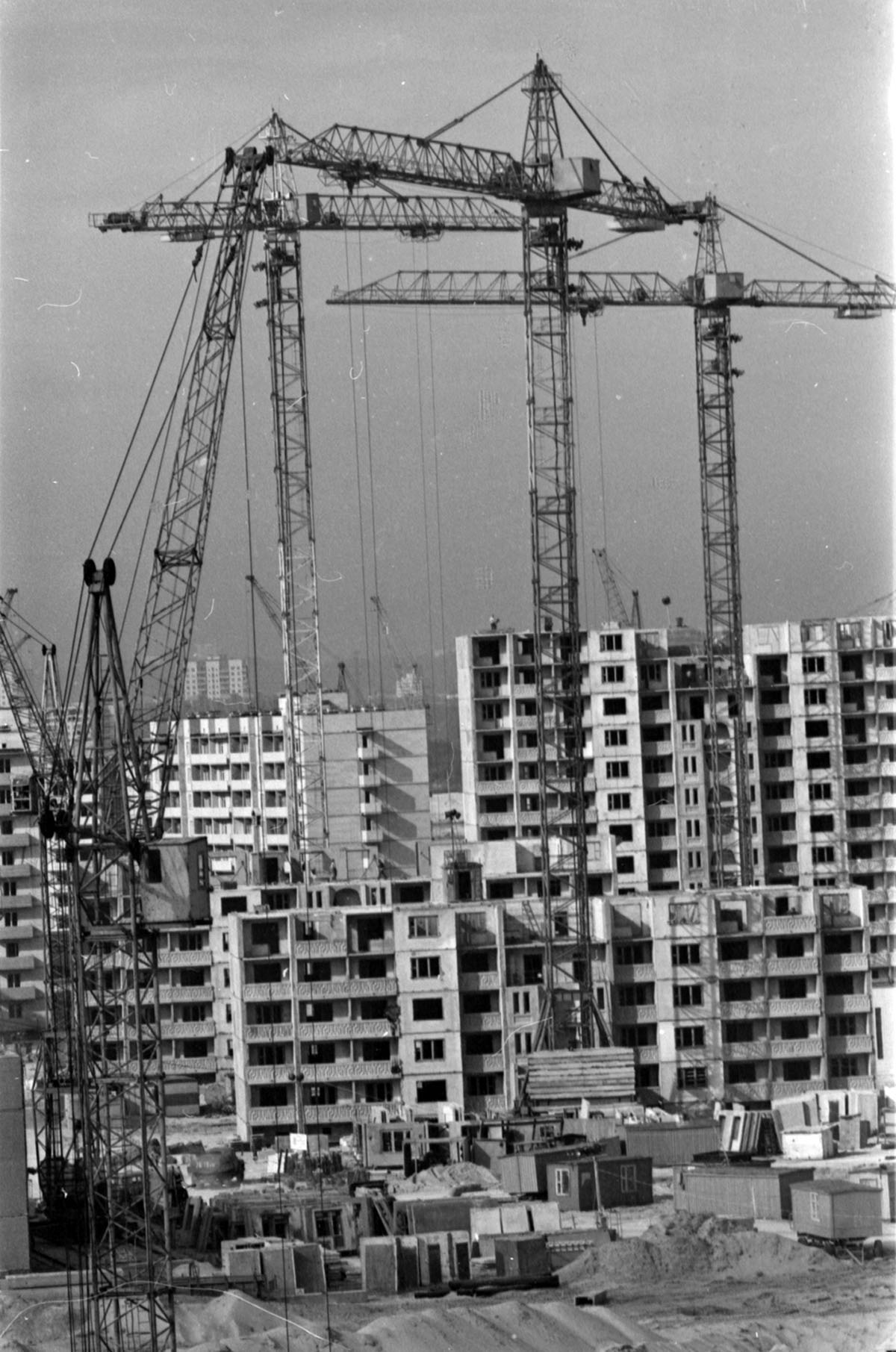
This image depicts a massive industrial construction site featuring towering steel cranes and unfinished concrete apartment blocks. From the perspective of Permaculture Shelter design, this resembles an ambitious, early attempt at building a functional "honeybee" home or large-scale residential complex. You can also see the word "BANK" written on the windows of the buildings, suggesting a mix of housing and commercial properties.
detailed-analysis (gemma3_27b-it-q8_0)
Okay, let's break down this image through the lens of Permaculture and Shelter, and then engage with the requested theoretical frameworks where relevant.
Visual Description
The image is a stark, black and white photograph depicting a large-scale, unfinished housing project. Several massive, skeletal tower cranes dominate the skyline, looming over rows of partially constructed, repetitive apartment blocks. These structures are mostly concrete, with rows of identical windows, creating a sense of uniformity and incompleteness. The foreground is a chaotic mix of construction debris – piles of bricks, metal containers, and raw materials. There's a feeling of industrial process and a lack of organic integration with the landscape. It evokes a sense of a rapidly-built, potentially impersonal living environment.
Permaculture – Shelter Perspective
From a permaculture perspective focusing on shelter, this image represents a failed attempt at creating sustainable human habitat. Permaculture's core principles prioritize:
- Observation & Interaction: This project appears to have little observable interaction with the existing ecosystem or local climate. It's imposed onto a landscape, rather than integrating with it.
- Catch & Store Energy: Concrete is incredibly energy intensive to produce, and the design seems to offer little capacity to “catch” and store renewable energies (solar, wind, water) for the residents.
- Obtain a Yield: While the intention is a yield of housing units, the lack of attention to natural systems and community needs likely results in a limited and potentially unsustainable yield over time. The aesthetics and quality of life are likely reduced, influencing overall wellbeing.
- Apply Self-Regulation & Accept Feedback: The repetitiveness and rigid design suggest a lack of adaptability. A permaculture approach would focus on building with feedback loops and allowing systems to evolve, rather than enforcing a static plan.
- Use & Value Renewable Resources & Services: The heavy reliance on concrete, a non-renewable and environmentally damaging resource, is directly at odds with permaculture principles.
- Integrate Rather Than Segregate: This construction appears to lack integration with existing natural and social systems.
The image suggests a purely engineered solution to the housing problem, divorced from the principles of ecological design, social equity, and long-term sustainability. The unfinished state suggests potential failure. This is a classic example of a system designed for efficiency of construction, but not for the long-term flourishing of inhabitants or the ecosystem. Permaculture would advocate for smaller-scale, more resilient, and ecologically integrated forms of shelter.
Critical Theory
This image can be approached through Critical Theory, specifically focusing on the ways power structures are materialized in the built environment. The sheer scale and standardization of this project point to:
- Instrumental Reason: The project embodies Max Horkheimer and Theodor Adorno's critique of "instrumental reason" - where rationality is reduced to efficiency and control. The buildings aren't designed for human flourishing but for a specific goal (housing units) and measured against metrics of productivity and cost.
- The Culture Industry: The uniformity of the structures and the emphasis on mass production can be seen as a reflection of the "culture industry" (Adorno & Horkheimer). These buildings are essentially standardized products, denying individuality and critical thought. They contribute to a homogenized and passive population.
- Spatialization of Power: The image shows how power is embedded in the organization of space. The commanding presence of the cranes and the repetitive, impersonal architecture reinforce hierarchies and control. The project effectively dictates how people will live and interact, rather than responding to their needs and desires.
Marxist Conflict Theory
From a Marxist perspective, this image screams class conflict and exploitation. The construction project can be analyzed as:
- Means of Production: The cranes, concrete, and labor all represent the means of production, owned and controlled by a capitalist class.
- Alienation: The repetitive, dehumanizing architecture represents the alienation of labor. Workers are involved in producing something they have no control over, and which doesn't fulfill their creative or human needs. The residents are also alienated from the process of creating their own living spaces.
- Commodity Fetishism: The apartment units themselves become commodities, divorced from the labor and resources required to produce them. Their value is determined by market forces, not by their inherent worth as habitable spaces.
- Infrastructure of Control: These massive structures can be seen as an infrastructure of control, reinforcing the existing power structures and regulating the lives of the working class. Providing "housing" doesn't necessarily mean providing decent housing or empowering the residents.
Foucauldian Genealogical Discourse Analysis
Michel Foucault's work on power and knowledge is highly relevant here. The project can be analyzed as:
- Discipline and Punish: The structured, repetitive architecture functions as a form of spatial discipline. It enforces norms of behavior and creates a panoptic effect, making individuals visible and subject to surveillance (even if there is no active surveillance).
- Governmentality: The project represents a form of "governmentality" – the ways in which the state seeks to govern the conduct of its citizens. By providing housing (however inadequate), the state is attempting to manage the population and regulate their lives.
- The Production of Normality: The standardized design establishes a norm for living – a specific way of inhabiting space that is considered "normal" and desirable. This norm excludes alternative forms of housing and ways of life.
- Discourse of Progress: The very act of building on such a large scale participates in a discourse of "progress" – the belief that technological advancement and large-scale projects are inherently good. This discourse obscures the negative consequences of such projects.
Note: Postmodernism and Queer Feminist Intersectional Analysis are less directly applicable, given the image's focus on large-scale structural power dynamics. However, a postmodern reading might deconstruct the idea of "shelter" itself, questioning whether these buildings truly provide it. A Queer Feminist Intersectional Analysis could point to the ways in which these projects often exacerbate existing inequalities, disproportionately affecting marginalized communities and creating spaces that are not safe or welcoming for all.
Let me know if you'd like me to expand on any of these perspectives!
simple-description (llama3.2-vision_11b)
The meme is an image of a building site with a large, empty space where a building's foundation is being laid. The text in the image reads "Permaculture - Shelter" and the image is captioned "When you finally find a place to build your permaculture shelter".