First Seen
2023-05-10T21:03:39+00:00
simple-description (llama3.2-vision_11b)
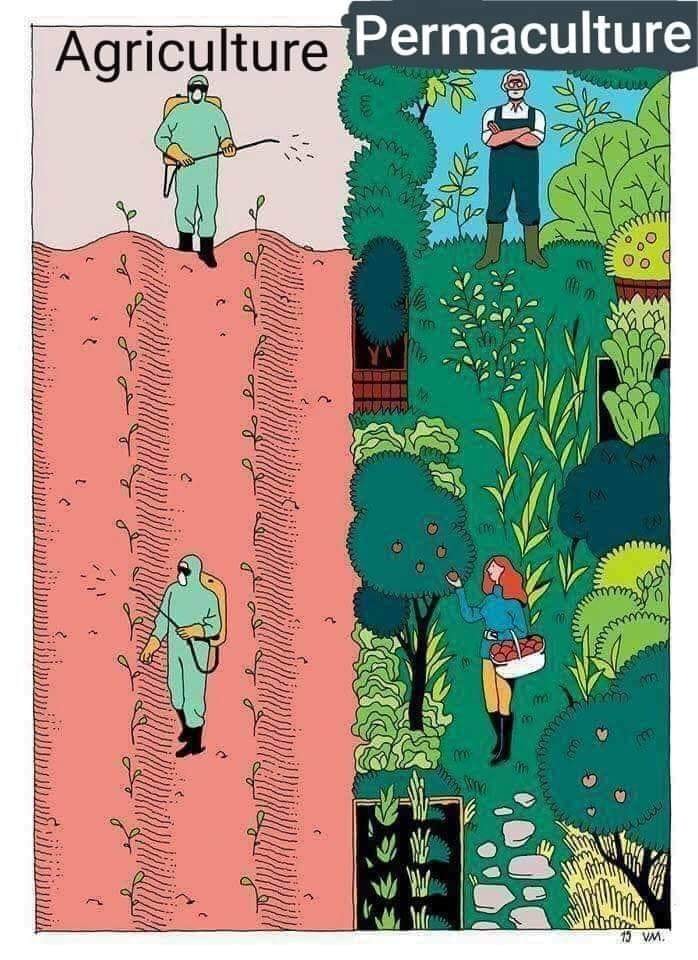
The meme is a humorous comparison between the agricultural and permaculture approaches to farming. It shows a farmer (left) in a traditional agricultural setting, using pesticides and machinery, while a permaculture farmer (right) is shown in a more natural, sustainable environment, using techniques like composting and crop rotation. The text "Agriculture" and "Permaculture" are written above the two scenes, highlighting the contrast between these two approaches to farming.
detailed-analysis (gemma3-27b-vision)
Okay, here's an analysis of the image, broken down into sections addressing the prompts you provided. Note that not all sections will be strongly applicable, and I will indicate that where appropriate.
Visual Description
The image is a side-by-side comparison visually contrasting “Agriculture” and “Permaculture”. It’s done in a stylized, illustrative format, reminiscent of vintage botanical illustrations with a slightly satirical edge.
- Agriculture Side (Left): Shows a desolate, red-toned field. The land is tilled in straight, sterile rows. A figure in a full-body hazmat suit (yellow, with a face mask and hood) walks among the rows, seemingly involved in maintenance or application (perhaps pesticides/fertilizers). Another figure, identical in attire, is shown tilling the field. The focus is on straight lines, exposed soil, and a sense of industrial sterility.
- Permaculture Side (Right): Is a lush, overflowing green space, densely packed with fruit trees, vegetables, and other plants. People (two women and one man) are depicted harvesting produce, pruning, and generally interacting with the ecosystem. The scene is full of varied plant life, winding paths, and a sense of abundance. The people are dressed in normal clothing.
- Composition: The stark contrast between the two sides is the dominant feature. The illustration plays heavily on the concept of "natural" versus "artificial," "abundance" versus "monoculture," and "health" versus "sterility".
Foucauldian Genealogical Discourse Analysis
This image is rich in opportunities for Foucauldian analysis. The illustration can be understood as a demonstration of the historical development of “truth” and “knowledge” regarding food production.
- Power/Knowledge: The hazmat-suited figure on the “Agriculture” side embodies the modern, scientific control over nature. This represents a discourse where "expertise" and “efficiency” are valued above all else. The hazmat suit signifies the perceived need to protect from the very land being cultivated, creating a paradox that reinforces the idea of agriculture as a dangerous, unnatural activity. The discourse of scientific agriculture dictates the necessity of these protective measures, thereby constituting the danger.
- Genealogy of Control: The genealogy of modern agriculture can be traced back to a shift from localized, traditional farming practices to large-scale industrialization. This shift wasn’t simply a matter of "progress" but a deliberate construction of a new way of understanding and controlling the natural world. The illustration implies that the hazmat suit is not a response to a naturally dangerous situation but a product of a system that creates danger through its practices.
- Discipline and Biopower: The rows of identical plants, and the controlled, methodical actions of the figures in hazmat suits, represent the exercise of discipline over the land and the living organisms within it. This is also a display of biopower - the exertion of control over life itself, seeking to maximize production through standardized, controlled means.
Critical Theory
The image lends itself strongly to a Critical Theory interpretation, particularly concerning the ways in which systems of power shape our relationship with the natural world.
- Domination of Nature: The “Agriculture” side illustrates the dominant Western worldview of separating humanity from nature and exercising control over it. The illustration depicts nature as something to be conquered and manipulated for human benefit. The red, barren soil symbolizes the exploitation and depletion of natural resources.
- Reason and Instrumentalization: The image suggests that modern agriculture is based on a rational, instrumental mindset, where nature is reduced to a set of resources to be efficiently exploited. The focus is on maximizing yield, regardless of the ecological or social consequences.
- Ideology and False Consciousness: The illustration can be read as a critique of the ideology that promotes industrial agriculture as the only viable solution to food production. It questions the assumptions that underlie this system and suggests that alternative, more sustainable approaches are possible. The abundance on the permaculture side serves as a counter-example to the scarcity narrative often used to justify industrial farming.
Marxist Conflict Theory
While not the primary lens through which to view the image, elements of Marxist thought can be applied.
- Relationship to the Means of Production: The “Agriculture” side highlights the capitalist mode of production. The tilled land and rows of crops represent the means of production controlled by large-scale agricultural businesses. The figure in the hazmat suit can be seen as a worker alienated from the land and acting as a cog in the industrial machine.
- Exploitation of Resources: The red, depleted soil symbolizes the exploitation of natural resources for profit. The drive for maximizing yield leads to the overuse of fertilizers and pesticides, which damage the environment and ultimately threaten the sustainability of the system.
- Class Relations: The illustration can be interpreted as a critique of the power imbalances within the food system. The control of land and resources is concentrated in the hands of a few, while the majority of people are dependent on this system for their food.
Postmodernism
A Postmodern reading emphasizes the deconstruction of grand narratives and the challenge to fixed meanings.
- Deconstruction of "Natural": The illustration destabilizes the notion of what is "natural" or "authentic." The "Agriculture" side, despite being a human-engineered system, presents itself as the "normal" or "default" way of producing food. The "Permaculture" side, with its abundance and diversity, challenges this assumption.
- Relativism of Truth: The image suggests that there is no single, objective truth about food production. The contrast between the two sides highlights the fact that different approaches are possible, each with its own set of values and assumptions.
- Challenge to Metanarratives: The illustration can be seen as a critique of the metanarrative of "progress" and the idea that industrial agriculture is the only way to feed the world. It proposes that alternative, more sustainable approaches are possible.
Queer Feminist Intersectional Analysis
This is the least directly applicable lens, but some connections can be made.
- Care and Relationality: The permaculture side, with its interconnected web of life, embodies a logic of care and relationality. This aligns with feminist ethics of care, which emphasize the importance of nurturing relationships and recognizing the interdependence of all beings.
- Rejection of Domination: The illustration's critique of the domination of nature can be connected to queer feminist critiques of patriarchal power structures. Both critiques challenge systems of control and exploitation, and both advocate for more equitable and sustainable ways of relating to the world.
- Intersection of Systems: The image subtly suggests the intersection of multiple systems of oppression – the domination of nature, the exploitation of labor, and the concentration of wealth. A queer feminist analysis could explore how these systems reinforce each other and disproportionately affect marginalized communities.
I hope this detailed breakdown is helpful! Let me know if you’d like me to elaborate on any specific section.
simple-description (llama3.2-vision)
This meme is a humorous comparison between two lifestyles: a traditional agricultural (Agriculture) and a sustainable community-driven (Permaculture) approach to living. The image shows a contrast between a person working hard in a field with toxic chemicals, versus a person living in harmony with nature, surrounded by lush gardens and wildlife. The text at the top reads "Agriculture" and "Permaculture" respectively.
tesseract-ocr
; Xv eaarLuliaelas Agriculture i pilbinds ES oe ; (seal) i | . a fl Ss 3A | eng mR (| SS ww. oe ess E (s ASN A & = XS 3 om AY nv Al & > Sh SN AN... c ‘ | Sh ) & Ca +e) d iS - . S ti a = = I my = ~ SS On | LAAN < Pare NY E s : va | x ATA See = | Pe A\\ i