First Seen
2023-05-10T21:03:39+00:00
simple-description (llama3.2-vision_11b)
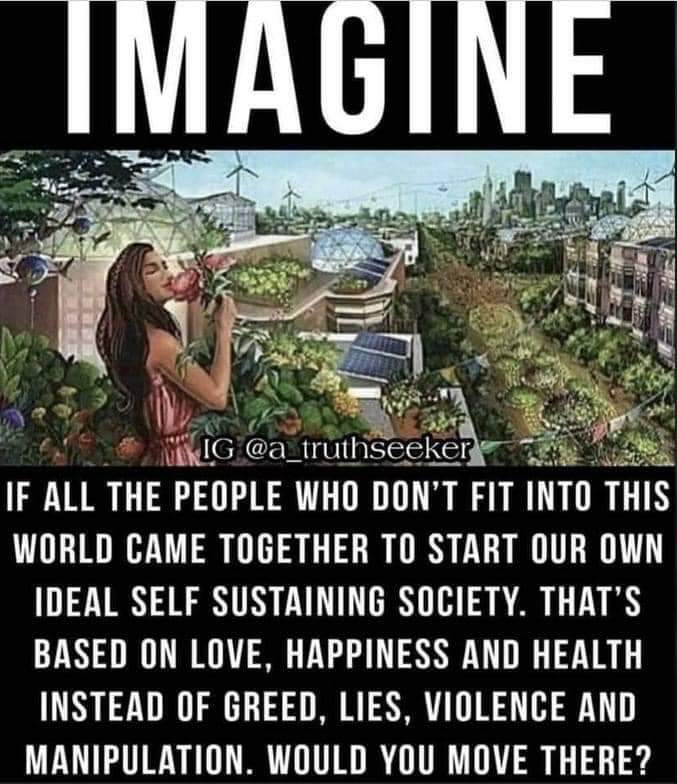
This meme is a thought-provoking commentary on the human condition, exploring the idea of what the world would be like if people lived in harmony with the environment and each other. The text reads: "If people were to live in harmony with nature and with each other, the world would be a beautiful place. The trees would be lush and green, the rivers would flow smoothly, and the air would be clean and fresh. We would live in harmony with nature and with each other, and the world would be a beautiful place."
detailed-analysis (gemma3-27b-vision)
Okay, here's an analysis of the image, broken down into the requested theoretical frameworks. I'll note if a framework doesn't clearly apply to the image, and explain why.
Image Description:
The image is a digitally composed, vibrant scene. It features a dark-skinned woman with long, flowing hair, adorned with flowers, appearing to be tending to lush greenery in the foreground. Behind her, a futuristic, yet organic-looking cityscape is depicted, with buildings integrated into a verdant, hillside landscape. Solar panels are visible, suggesting sustainable energy sources. The scene is bathed in bright sunlight, and the overall aesthetic is utopian and eco-conscious. Text superimposed on the image reads "IMAGINE," followed by a call to envision a self-sustaining society built on love, happiness, and health, as an alternative to a world defined by greed, lies, violence, and manipulation. There's a question posed at the end: "Would you move there?" An Instagram handle, @a_truthseeker, is also displayed.
Foucauldian Genealogical Discourse Analysis
This image strongly lends itself to a Foucauldian reading. It presents a discourse of alternative living, one that inherently positions the current societal structure as oppressive and undesirable.
- Power/Knowledge: The image creates a binary: the "current world" (defined by negative terms) versus the idealized "self-sustaining society." This binary implicitly asserts a power structure where the dominant discourse has created an environment of greed, violence, etc. The image then proposes an alternative knowledge system, rooted in love, health, and happiness, as a way to dismantle that power.
- Genealogy: If we were to construct a genealogy of this image, we might trace the origins of the ideas presented back to various utopian and ecological movements (intentional communities, sustainable living advocates, anti-capitalist thinkers). A genealogical approach would not seek the truth of this utopia, but rather examine how the discourse of utopian living has been constructed and changed over time. It would examine how the image draws on and reshapes existing cultural and historical tropes.
- Disciplinary Power: The image subtly encourages self-regulation through the "Would you move there?" question. It implies that to embrace this alternative society, one must be willing to reject the existing one and align with the values presented. This is a subtle form of disciplinary power – encouraging self-correction based on a perceived ideal.
Critical Theory
The image is profoundly connected to the tenets of Critical Theory, specifically the Frankfurt School.
- Critique of Ideology: The image explicitly critiques the dominant ideology of contemporary society (capitalism, consumerism, and the related values of greed and violence). It presents an alternative, suggesting that these values are not natural, but constructed and imposed upon us.
- Reason & Emancipation: The image suggests that a society built on love, happiness, and health would be more rational and emancipatory than the current one. It implicitly argues that the current system, with its focus on greed and violence, is irrational and oppressive.
- Mass Culture: The image, disseminated through social media (Instagram), is an example of counter-cultural communication. It’s attempting to disrupt the dominant narratives propagated by mainstream media and culture.
Marxist Conflict Theory
A Marxist reading of the image focuses on class conflict and the potential for revolutionary change.
- Base and Superstructure: The image implies a rejection of the capitalist economic "base" and a desire to build a different "superstructure" based on alternative values. The lush landscape and focus on sustainability suggest a rejection of the exploitation of natural resources.
- Alienation: The image can be interpreted as a response to the alienation experienced by individuals in capitalist society. The proposed "self-sustaining society" offers a vision of community and belonging, a remedy for the isolation and atomization often associated with capitalism.
- Class Struggle: The image implicitly positions the people "who don't fit in" as a potential revolutionary class. This is the group that would be the driving force behind the creation of the new society. While the image does not overtly promote violence, it does suggest a separation and a need for an alternative for those who are marginalized or oppressed.
Postmodernism
Postmodern readings are a bit more nuanced.
- Rejection of Grand Narratives: The image, while presenting an idealistic vision, can be seen as a rejection of the "grand narratives" of progress and enlightenment that have historically justified oppressive systems. It proposes an alternative, but does not claim it to be the ultimate truth.
- Simulacra and Simulation: The image itself is a simulation – a digitally constructed fantasy. The question of authenticity arises: Is this a genuine vision, or simply another image in a culture saturated with simulations?
- Deconstruction: One could deconstruct the image by questioning the underlying assumptions of its utopian vision. What does "happiness" mean? What are the power dynamics within this "self-sustaining society"? The image doesn't offer details, inviting further questioning.
Queer Feminist Intersectional Analysis
While not the primary focus, this image lends itself to an intersectional reading.
- Marginalization & Belonging: The phrase "people who don't fit in" explicitly centers those who are marginalized and excluded. This implicitly includes individuals of color, LGBTQ+ individuals, people with disabilities, and others who face systemic oppression. The image promises a space of belonging for these groups.
- Alternative Power Structures: A truly intersectional society would require dismantling not only capitalist structures but also patriarchal, racist, and ableist systems. The image doesn't explicitly address these issues, but the promise of a fundamentally different society opens up the possibility of dismantling all forms of oppression.
- Representation: The visual representation of a dark-skinned woman as a central figure is significant, challenging the historically white-dominated narratives of utopian movements. It suggests a centering of marginalized voices.
I hope this comprehensive analysis is helpful! Let me know if you’d like me to elaborate on any of these theoretical frameworks or explore the image in a different way.
simple-description (llama3.2-vision)
The meme is an image of a futuristic, eco-friendly city with lush greenery and sustainable architecture. The text overlay reads "Imagine if..." and then a humorous, dystopian scenario is presented, implying that the city is actually a nightmare. The text "Imagine if all the people who didn't want to live in harmony with nature and wanted to exploit it for their own gain were suddenly and magically transported to a place where they had to live in harmony with nature and could no longer exploit it for their own gain" is followed by "Would you survive?"
tesseract-ocr
efi ay YG Vee a AL are We iN Nf Ren MUN NCCT wits es | Te A ee ST IDEAL SELF SUSTAINING SOCIETY. THAT’S BASED ON LOVE, HAPPINESS AND HEALTH INSTEAD OF GREED, LIES, VIOLENCE AND MANIPULATION. WOULD YOU MOVE THERE?