First Seen
2023-05-10T21:03:39+00:00
simple-description (llama3.2-vision_11b)
The meme is a play on the concept of permaculture, which emphasizes living in harmony with nature. The image depicts a person in a garden, surrounded by lush greenery, with the text "I've finally found the permaculture lifestyle" and the caption "I've finally found the permaculture lifestyle". The meme is poking fun at the idea that one can achieve a perfect balance with nature, but in reality, it's a never-ending process.
detailed-analysis (gemma3-27b-vision)
Okay, let's break down the image and the accompanying text using the frameworks you've requested.
Visual Description
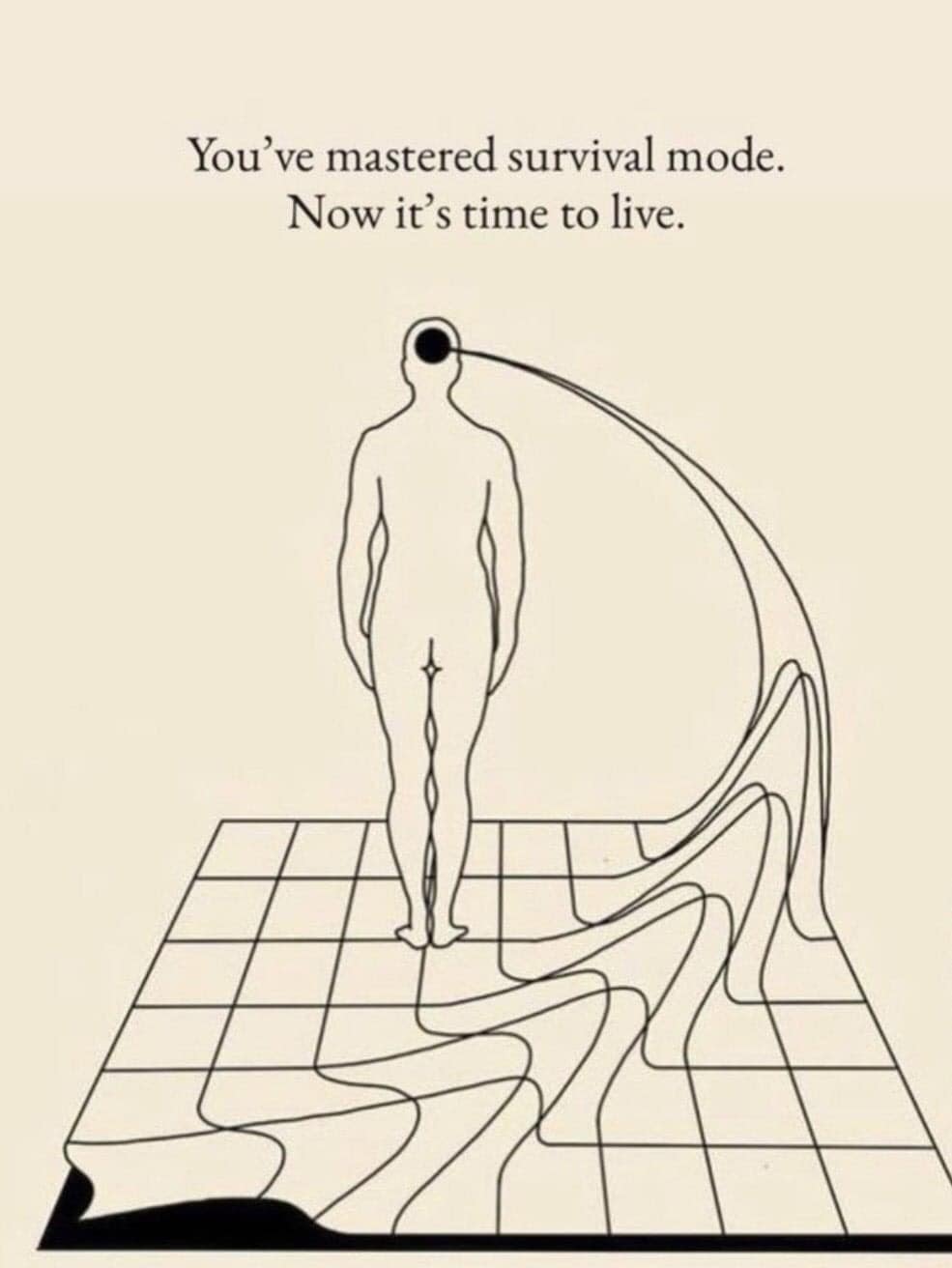
The image is a stark, monochromatic illustration, resembling a pen-and-ink drawing. It depicts a simplified human figure standing on a surface constructed from grid-like tiles. The figure is rendered in profile, with its head tilted upward and an abstract, organic form emerging from its back. This form flows and curves, resembling a plant root system or fluid movement, and fills a significant portion of the image's space. It appears to be rising and then falling in layers. The background is a soft, muted beige. The overall aesthetic is minimalist and symbolic. Above the image is the text, “You’ve mastered survival mode. Now it’s time to live.”
Foucauldian Genealogical Discourse Analysis
This image and text lend themselves powerfully to a Foucauldian analysis. The phrase "mastered survival mode" speaks directly to the concept of discourse and power/knowledge. Michel Foucault argues that knowledge isn’t neutral; it's always tied to power relations. “Survival mode” is a discourse – a way of talking and thinking about the self – that has been produced within systems of power. This “mode” likely refers to a state of constant self-regulation, anxiety, and adaptation in response to demands (social, economic, emotional). It's a way of being constructed by and responding to systems that prioritize efficiency, productivity, and control.
The “organic” form arising from the figure can be interpreted as a challenge to this survival-based discourse. The flowing, complex lines represent something emerging – a move away from the rigid grid (representing systems of control) towards a more embodied, complex, and potentially liberating way of being. The "time to live" suggests a desire to move beyond the disciplinary techniques that define “survival mode”. Foucault would focus on the history of how "survival mode" became normalized and the strategies individuals might employ to resist its grip. The image suggests that "living" isn't simply the opposite of "surviving," but a complex, active process of self-creation after deconstructing the discourses that have shaped you.
Critical Theory
From a Critical Theory perspective (drawing from the Frankfurt School), the image highlights the alienation inherent in modern life. "Survival mode" represents the rationalized, instrumental logic of capitalism and its impact on the individual. The figure, trapped on the rigid grid, symbolizes the individual subsumed by the demands of a system that reduces people to units of production. The emergence of the flowing form can be seen as a yearning for authenticity and self-realization - a desire to break free from the constraints of a society that prioritizes profit over human flourishing.
The image also speaks to the concept of reification – the process by which social relations are perceived as natural, fixed, and external. The grid represents these reified structures. The call to "live" is a call for critical consciousness, urging the viewer to recognize the constructed nature of their reality and to actively engage in creating a more just and meaningful existence.
Postmodernism
Postmodern thought would emphasize the deconstruction of the binary opposition between “survival” and “living.” The image challenges the idea of a fixed, essential “self.” The flowing form isn’t necessarily a return to a natural state but a recognition that identity is fluid, fragmented, and constantly constructed through experience.
The image's minimalist aesthetic and its reliance on symbolism align with postmodern sensibilities. It doesn’t offer a grand narrative or a clear solution but rather a suggestive image that invites multiple interpretations. It reflects a skepticism towards universal truths and a focus on individual subjectivity. The grid itself could be interpreted as a metaphor for the postmodern condition: a fragmented and chaotic landscape where traditional structures have lost their authority.
Queer Feminist Intersectional Analysis
From a Queer Feminist Intersectional perspective, “survival mode” is likely experienced differently based on intersecting identities (race, class, gender, sexuality, ability, etc.). For marginalized individuals, “survival mode” may not be a temporary state but a chronic condition necessitated by systemic oppression. The image could be read as a commentary on the ways in which dominant structures demand conformity and self-erasure from those who don’t fit neatly within established norms.
The flowing form rising from the figure could symbolize the reclaiming of agency and the assertion of a complex, multifaceted identity. It represents a move away from the pressure to assimilate and a celebration of difference. The image hints at the possibility of creating new, liberatory forms of being that challenge the limitations of existing social categories. Queer feminist thought would emphasize the importance of recognizing the multiplicity of experiences and the need for solidarity in the struggle against oppression.
I hope this analysis is thorough and useful! Let me know if you'd like me to elaborate on any of these points or explore other theoretical frameworks.
simple-description (llama3.2-vision)
This meme is a humorous illustration of a person standing in a room with a large, gaping hole in the floor. The text above the person reads, "You've mastered survival mode. Now it's time to live." The image implies that the person has finally overcome their struggles and is ready to move on to a more fulfilling life.
tesseract-ocr
FeAl FEE eee