First Seen
2023-05-10T21:03:39+00:00
simple-description (llama3.2-vision_11b)
The meme is a humorous illustration of a group of people from different professions and time periods, including Albert Einstein, Marie Curie, and Albert Einstein's wife Elsa, all gathered around a table with a banner that reads "Permaculture" and "Regenerative Living". The image pokes fun at the idea that these historical figures would be interested in permaculture, a sustainable lifestyle approach that emphasizes living in harmony with nature. The meme is captioned "When Albert Einstein, Marie Curie, and Albert Einstein's wife Elsa all start permaculture"
detailed-analysis (gemma3-27b-vision)
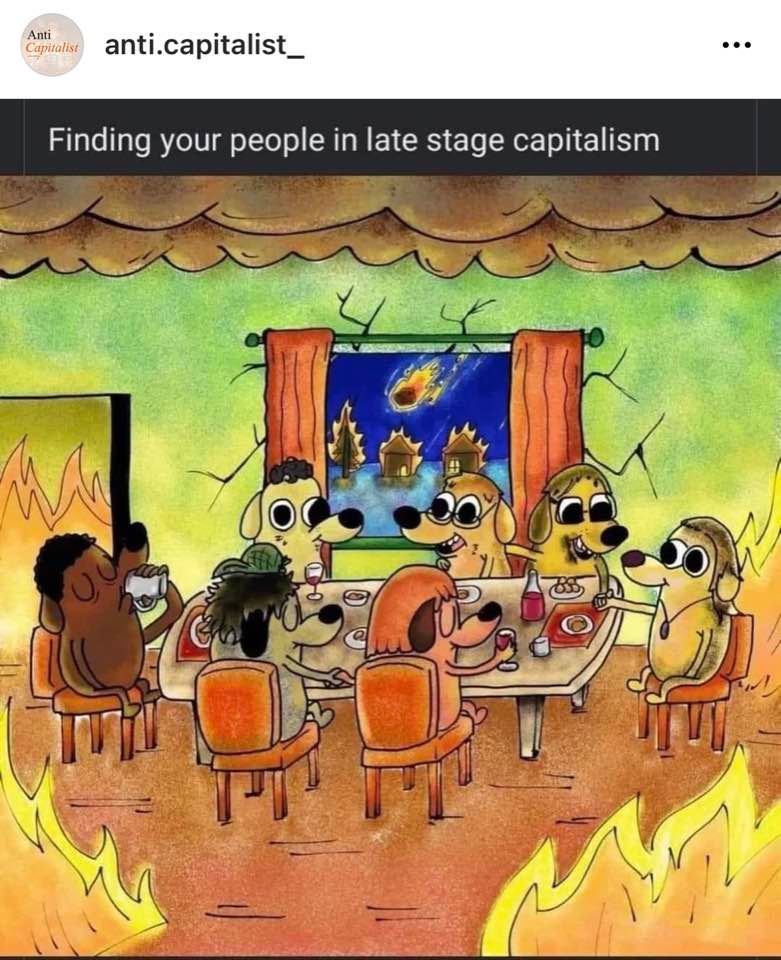
Okay, let's break down this meme, titled "Finding your people in late capitalism", through the lenses you've provided. It's a darkly humorous image with a lot to unpack, so I'll aim for a comprehensive but not overly dense analysis.
Visual Description
The image is a cartoon depiction of a dinner scene, dominated by anthropomorphic dogs. They are seated around a long, formally set table. Each dog has an exaggeratedly melancholy expression, depicted with large, wide eyes and downturned mouths. The overall color scheme is a somewhat muted and desaturated yellow-orange, contributing to a sense of bleakness.
The key unsettling element is that everything around them is on fire. Flames are visible under the table, licking at the furniture, and engulfing the space around the room. Behind the dogs hangs a painting depicting a city in flames, furthering the theme of destruction. Despite the obvious catastrophe occurring, the dogs continue to eat and converse, seemingly oblivious or apathetic. One dog wears a beanie, adding a touch of specificity to the characters. The overall effect is a blend of surrealism and grim humor.
Critical Theory
This image operates powerfully as a commentary on the alienation and absurdity of modern life, resonating with key tenets of Critical Theory, specifically the Frankfurt School. The image draws upon Adorno and Horkheimer's concept of the "culture industry" which creates standardized and commodified experiences, in this case the "dinner party" which is a traditional symbol of social gathering and comfort.
Here, the traditional social function of a dinner party is rendered absurdly pointless as the world around them burns. The dogs, as stand-ins for humans, engage in the ritual despite the impending disaster. This suggests a critique of the ways in which society encourages us to continue with "normal" life, or the performance of normalcy, even in the face of systemic crises (ecological, social, political).
The image asks us to question the foundations of these rituals and whether they still hold any meaning when the systems that support them are failing. It's a visual expression of a kind of "learned helplessness," where individuals continue to participate in destructive patterns even when aware of their futility.
Marxist Conflict Theory
The meme explicitly frames the scene as existing within "late capitalism," immediately invoking Marxist analysis. The fire is symbolic of the inherent contradictions within the capitalist system – the ecological destruction, social inequality, and precarity it generates.
The dogs' nonchalant acceptance of the flames can be interpreted as a metaphor for the working class (or broader population) being pacified or distracted by consumerism and the "culture industry" (as mentioned above). They are essentially eating while Rome burns, a reference to the historical tale of indifference to crisis.
The image highlights the disconnect between those who benefit from the system (who might be oblivious to the fires) and those who are directly harmed by its consequences. The conflict isn’t direct, but internal – a quiet, melancholic acceptance of a destructive status quo. The fact that the dogs are dogs can be read as a distancing device, allowing viewers to confront the uncomfortable truth without immediately feeling personally implicated.
Postmodernism
The meme aligns with several facets of postmodern thought. The juxtaposition of the mundane (a dinner party) with the catastrophic (a world on fire) is a classic postmodern technique of undermining established hierarchies and expectations. It’s an example of pastiche and irony. The image doesn’t offer a solution or a clear message; it’s more interested in demonstrating the absurdity and fragmentation of contemporary experience.
The lack of a clear narrative further reinforces the postmodern sensibility. The meme resists easy interpretation and encourages multiple readings. The cartoon style itself is a nod to a hyper-mediated reality where authenticity is increasingly difficult to discern.
Queer Feminist Intersectional Analysis
While not explicitly focused on queer or feminist themes, this image can be approached through an intersectional lens. The "fires" can be seen as symbolic of multiple intersecting oppressions – ecological disaster disproportionately impacts marginalized communities, economic instability exacerbates gender and racial inequalities, etc. The fact that the dogs continue with the dinner party despite the fires suggests a level of privilege and detachment from the real consequences of these crises.
Furthermore, the melancholic expressions of the dogs can be seen as a representation of the emotional toll that systemic oppression takes on individuals. The image suggests a state of collective trauma and a sense of helplessness in the face of overwhelming forces. The image, by showing a group (the dogs) maintaining social norms even as the world collapses, suggests that it is difficult to disrupt harmful structures, even with knowledge of their destructiveness.
Foucauldian Genealogical Discourse Analysis
Applying a Foucauldian lens, we can view the dinner party as a discourse – a system of thought, language, and practice that shapes our understanding of social life. The dinner party is presented as a normalized practice, a ritual that reinforces certain power relations.
The image asks us to examine the genealogy of this practice – how it came to be associated with status, social connection, and "normalcy." By placing the dinner party within a context of destruction, the image disrupts the traditional meaning of this discourse. It reveals how seemingly benign practices can be complicit in broader systems of domination.
The nonchalant attitude of the dogs can be seen as a form of discipline – an internalization of power relations that prevents them from questioning or challenging the status quo. They are "disciplined" to continue with the ritual, even in the face of disaster. The fires themselves represent the raw, chaotic forces that the discourse of "normalcy" attempts to contain.
In summary, this meme is a complex and multi-layered work of social commentary. It draws upon a variety of theoretical frameworks to critique the absurdity and destructiveness of late capitalism, and the ways in which we become complicit in our own oppression.
simple-description (llama3.2-vision)
This meme is a cartoon image of a group of people, likely anthropomorphic animals, sitting at a table, but instead of a normal dinner, they are surrounded by flames and destruction. The text above the image reads "In 2-3 sentences, describe this meme for someone who cannot see it."
tesseract-ocr
avon anti.capitalist_ rs Finding your people in late stage capitalism Try, eS ] la a 1 ] y ee LL A | / ar r Fy <| WY \ ee Ay ae) . . ( |O¢G~e 2 [Sey | | aN . toms P> SF fy Sh) Ao Ma. Het Y, oe i a y\ ES al ef G ‘ <| aC oy j | & = oo 4 Sf / { Ther b q | i = M