First Seen
2023-05-10T21:03:39+00:00
simple-description (llama3.2-vision_11b)
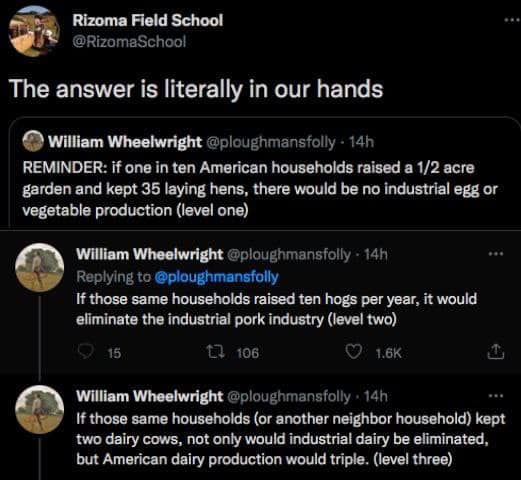
The meme is a humorous take on the concept of permaculture, a sustainable living approach that aims to create self-sufficient ecosystems. The image is a screenshot of a Twitter conversation where a user named "Rizoma" shares a quote from a permaculture book, followed by a response from a user named "Rizoma" again. The quote reads: "If one in ten households kept two cows, there would be no need for industrial farming. If one in ten households kept two cows, there would be no need for industrial farming." The response from "Rizoma" is a quote from a permaculture book, but the original quote is a response from "Rizoma" again.
detailed-analysis (gemma3-27b-vision)
Okay, let's break down this Twitter thread through the requested theoretical lenses. It's a surprisingly rich little cluster of statements, so there's quite a bit to unpack.
Visual Description
The image is a screenshot of a Twitter thread from "ploughmansfolly" (William Wheelwright) replying to a post from "RizomaSchool." It's comprised of three tweets (or levels), each building on the previous. The layout is typical of Twitter – user icons, handles, timestamps, engagement metrics (likes, retweets, replies). The tone conveyed is urgent and optimistic. The use of the phrasing "level one," "level two," and "level three" creates a sense of incremental and organized development of an argument.
Foucauldian Genealogical Discourse Analysis
This thread is ripe for a Foucauldian reading. The statements don't present a "truth" about food production, but rather construct a possibility, a counter-discourse to the dominant discourse of industrial agriculture.
- Power/Knowledge: Industrial agriculture operates within a power/knowledge system. It defines what "efficient" food production is, justifying its dominance. This thread challenges that definition. The statement isn't about objectively better production, but about reconfiguring the conditions of possibility by decentralizing production.
- Genealogy: Wheelwright’s assertions aren't advocating for a return to some idyllic pastoral past. They’re proposing a different arrangement of power relationships. The genealogy would look at how industrial agriculture came to dominate, and how decentralized small-scale production has been historically suppressed (through policy, infrastructure, etc.).
- Discipline & Biopower: Industrial agriculture exercises biopower by controlling food supply and, consequently, bodies. Decentralizing production, as proposed here, could be seen as a resistance to this control.
- Discourse Construction: The numbers ("one in ten households," "1/2 acre," "35 hens," "ten hogs," "two cows") are not objective facts but discursive markers. They establish a "thinkable" possibility. They create a framework for imagining a different agricultural system.
Critical Theory
From a Critical Theory perspective (drawing from thinkers like Horkheimer and Adorno), this thread resonates with themes of emancipation and the critique of instrumental reason.
- Critique of Instrumental Reason: Industrial agriculture exemplifies instrumental reason – valuing efficiency and profit above all else. This thread offers a challenge to this logic. It proposes a shift in values – towards self-sufficiency, localism, and a more holistic understanding of food production.
- Domination & Emancipation: Industrial agriculture can be seen as a form of domination – over the land, animals, and ultimately, people. This thread suggests a path towards emancipation – reclaiming control over food systems and resisting the alienating forces of industrialization.
- The Culture Industry: The dominance of industrial agriculture is perpetuated through the "culture industry" – advertising, media representations, and policy that reinforce its values. This thread represents a counter-cultural message, challenging the prevailing norms.
Marxist Conflict Theory
This thread can be interpreted through a Marxist lens as highlighting the contradictions inherent in capitalist agricultural production.
- Means of Production: Industrial agriculture concentrates the means of production (land, capital, technology) in the hands of a few large corporations. The thread implicitly suggests a redistribution of these means – empowering households to become producers themselves.
- Class Struggle: The current system creates a clear class division – between those who control the food supply and those who are dependent on it. This thread proposes a shift in power dynamics, potentially lessening the dependence of the working class on the capitalist class.
- Alienation: Industrial agriculture alienates people from the food they eat, the land it’s grown on, and the labor that goes into producing it. This thread suggests a path towards reconnecting people with the means of sustenance.
- Surplus Value: Industrial agriculture maximizes surplus value through economies of scale and the exploitation of labor. Decentralized production could potentially reduce this exploitation and promote a more equitable distribution of resources.
Postmodernism
A postmodern reading highlights the rejection of grand narratives and the embrace of localized knowledge.
- Rejection of Universal Truth: This thread doesn’t present a "solution" to the food crisis. It doesn't claim to have the answer. Instead, it proposes a possibility, a localized alternative.
- Deconstruction of the "Food System": The very idea of a monolithic "food system" is deconstructed. The thread suggests that food systems can be fragmented, decentralized, and more responsive to local needs.
- Focus on Difference: It emphasizes the potential for diverse forms of production – gardens, small farms, and household-level agriculture.
- Simulacra and Simulation: Industrial agriculture produces a "simulacrum" of food – highly processed, standardized, and disconnected from its origins. Decentralized production could offer a more authentic and meaningful experience of food.
Queer Feminist Intersectional Analysis
This is where the analysis gets more nuanced and potentially complex. At first glance, the thread doesn't explicitly address queer or feminist concerns. However, an intersectional analysis can reveal hidden dimensions.
- Challenging Patriarchal Structures: Industrial agriculture is often linked to patriarchal structures – the domination of land, the exploitation of labor, and the devaluation of traditionally "feminine" skills like gardening and food preservation. Decentralized production could empower women and challenge these structures.
- Food Sovereignty & BIPOC Communities: Food sovereignty, the right of peoples to healthy and culturally appropriate food produced through ecologically sound and sustainable methods, is a key feminist and anti-racist concern. This thread resonates with the idea of reclaiming control over food systems, particularly for marginalized communities.
- Care Work & Sustainability: Gardening, raising animals, and food preservation are all forms of care work. Feminist scholars argue that care work is often undervalued and devalued. This thread implicitly recognizes the importance of care work in creating a sustainable food system.
- Queer Ecology: A queer ecological reading might explore the ways in which decentralized production can disrupt conventional norms around land ownership, family structure, and community organization. It could also challenge the binary oppositions that underpin industrial agriculture (e.g., nature/culture, human/animal).
Important Note: The intersectional analysis is the most speculative here. It requires further elaboration and contextualization to fully demonstrate the connections between these theoretical frameworks and the content of the thread.
Let me know if you'd like me to elaborate on any of these points or explore additional theoretical lenses!
simple-description (llama3.2-vision)
The meme is a screenshot of a Twitter conversation between two users, @Rizoma and @PloughmansFolly. The top tweet is a reminder that if one in ten American households raised a small garden, there would be no need for industrial animal farming. The bottom tweet is a sarcastic response to this, implying that if households kept two cows, it would be enough to eliminate the industrial animal farming industry.
tesseract-ocr
Dr Bae cod a ber elut ladle Bite aia ale) Al mre) Ce an ee a Soe eae eet ee a ERCP ee ale Ee RIP es) garden and kept 36 laying hens, there would be no industrial egg or Be el Beene) DTT nee i a Seas ene os Replying to @ploughmansfolly Dee ee eRe eee mate RUM uu gi ew Ak) ry cee OTN a DTT nC eee a See et nea oa Re el AC aa) Cd SNe eee Meee Muar ge lace Pee Une eer ue Rul RL)