First Seen
2024-02-02T22:14:14.634743+00:00
simple-description (qwen3.5_2b-q8_0)
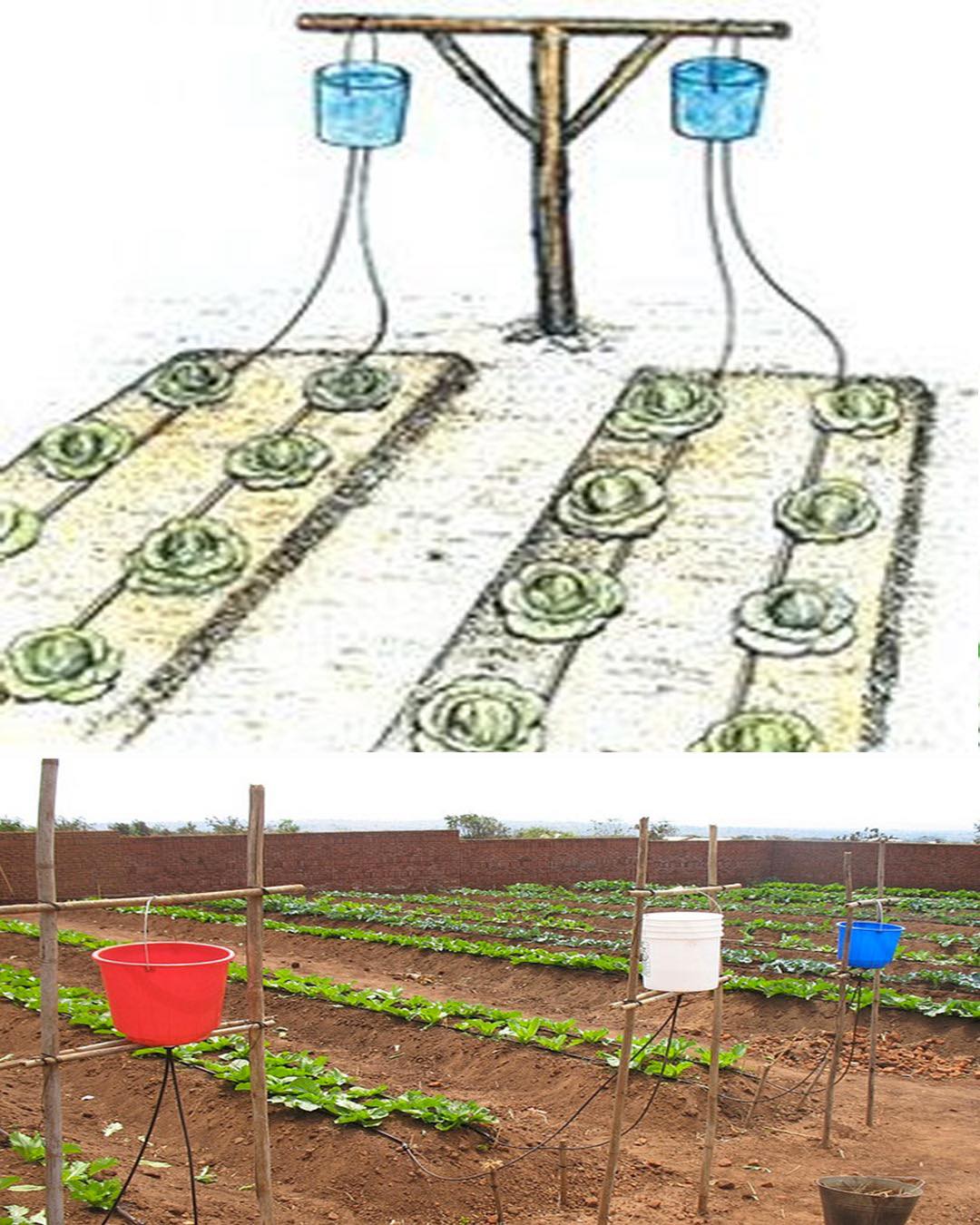
This image depicts a simple, water-efficient irrigation system often associated with permaculture or home gardening. The top illustration shows a diagram of a system using large buckets suspended from a pole to act as reservoirs, connected by strings that deliver water directly to rows of seedlings below. The bottom photo shows the real-world application in a garden, where these buckets are mounted on wooden frames to supply moisture to the crops, demonstrating a low-cost way to water plants effectively.
simple-description (llama3.2-vision_11b)
The meme is a humorous illustration of a permaculture design, specifically a "keyhole" garden, with a clever twist. The image depicts a traditional keyhole garden with a few unexpected additions, such as a toilet and a shower, implying that this is a permaculture design for a tiny house or a small, self-sufficient community. The text "Tiny House, Big Permaculture" appears in the image, highlighting the meme's lighthearted and humorous take on permaculture design.
detailed-analysis (gemma3-27b-vision)
Here’s an analysis of the image broken down into the requested sections. I’ll flag where a section doesn't directly apply or is limited in application.
Visual Description
The image presents a diptych: a stylized, painted depiction above, and a corresponding photographic scene below.
- Painted Image (Top): A drawing portrays a rudimentary irrigation system for a row crop (likely cabbages, given the rendering). Water is delivered via gravity from two buckets suspended from a wooden utility pole, through tubes to a neatly laid-out field. The style is somewhat naive and illustrative, almost a blueprint. The color scheme is muted with earthy tones.
- Photographic Scene (Bottom): This depicts a real-world agricultural setting, echoing the painted image. Rows of leafy green vegetables (likely the same as depicted above) extend into the distance. Simple structures of bamboo and thin poles support suspended buckets, functioning as a similar irrigation system. The buckets are colored: red, white, and blue. The landscape appears rural and perhaps impoverished. The overall tone of the photograph is warm and realistic.
The image juxtaposes an idealized or conceptualized system with its practical, grounded implementation. The color contrasting between the buckets provides visual intrigue.
Foucauldian Genealogical Discourse Analysis
This image powerfully lends itself to a Foucauldian analysis. The system of irrigation itself – the buckets, the poles, the tubes – becomes a discourse. It’s not just a technological solution; it speaks about power, control, and the shaping of nature.
- Power/Knowledge: The very act of irrigating, of directing water to the crops, establishes a relationship of power over the land and the plants. Knowledge about water access, crop needs, and engineering, even at this simple level, is a source of power. The 'knowledge' embedded in the design of the system is not neutral; it reflects a specific understanding of agriculture.
- Discipline & Biopower: The organized rows of crops are an expression of biopower – the exercise of power over life itself. The system aims to optimize production, disciplining the natural world to conform to agricultural goals. The act of irrigating becomes an act of surveillance and control, maximizing yield.
- Genealogy of Irrigation: Tracing the history of this system, even in its simple form, reveals a genealogy of techniques and practices. This local implementation is connected to a broader history of irrigation techniques, from ancient civilizations to modern agricultural systems. Understanding its origins helps reveal the ways in which agricultural practices are shaped by historical and social forces.
- The Panopticon: While not directly a Panopticon, the orderly rows of crops suggest a level of surveillance and control. The farmer, by overseeing the irrigation, asserts control over the land and its yield.
Critical Theory
The image is ripe for analysis through a critical theory lens, focusing on how systems of power operate to perpetuate inequality.
- Domination of Nature: The irrigation system exemplifies a longstanding Western tendency to dominate and control nature. The land is not seen as a self-regulating ecosystem, but as a resource to be manipulated for human benefit. This is a key tenet of critical theory, linking ecological exploitation to broader systems of domination.
- Technological Rationality: The system, however basic, represents a form of technological rationality – the belief that technical solutions can solve social and ecological problems. While seemingly beneficial, this can mask deeper structural issues of inequality and resource distribution.
- The Illusion of Control: The orderly rows and controlled irrigation create an illusion of control over nature. However, this control is always precarious, subject to factors like climate change, pests, and economic forces.
- Alienation: In a broader context, this type of agricultural system can contribute to alienation – the separation of humans from nature and from the fruits of their labor. The farmer is engaged in a process of controlling nature rather than being in harmonious relationship with it.
Marxist Conflict Theory
The image presents fertile ground for a Marxist interpretation.
- Means of Production: The irrigation system represents a means of production. Control over this means – access to water, materials for construction, and labor – determines who benefits from the agricultural yield.
- Class Relations: In the context of a presumably impoverished rural setting, the irrigation system can be seen as a reflection of class relations. Who owns the land, who controls the water, and who performs the labor? The system reinforces these existing power dynamics.
- Surplus Value: The increased yield resulting from the irrigation system generates surplus value – the difference between the cost of production and the value of the crops. This surplus value is likely appropriated by landowners or intermediaries, perpetuating economic inequality.
- Exploitation of Labor: The buckets represent the physical labor and the manual work of the individuals. In turn, this labor is often undervalued and the profits are not distributed equitably.
Postmodernism
Postmodern analysis would focus on the constructed nature of reality and the deconstruction of grand narratives.
- Representation & Simulacra: The painted image and the photographic reality can be viewed as representations – simulacra – that stand in for the 'real' agricultural process. These representations are not neutral; they are shaped by cultural conventions and power dynamics.
- Deconstruction of the Idealized Farmer: The image challenges the romanticized notion of the self-sufficient farmer. The rudimentary irrigation system suggests a degree of necessity and perhaps dependence on external factors.
- Fragmentation & Local Knowledge: The system itself is a fragmented, localized solution. It does not claim to be a universal or comprehensive approach to agriculture. It is a specific response to specific conditions, emphasizing the importance of local knowledge.
- Fluidity of Meaning: The red, white, and blue buckets could be interpreted as symbols. This interpretation would be variable depending on context, and open to infinite interpretations.
Queer Feminist Intersectional Analysis
This analysis is less direct, but still possible. The absence of visible human actors in the photograph is significant.
- Gendered Labor: Agriculture, particularly in developing countries, is often dominated by female labor. The absence of visible figures obscures the gendered dimensions of this labor – the often-unrecognized and undervalued work performed by women in food production.
- Intersectionality: The intersection of gender, class, and location (rural poverty) creates a complex set of power dynamics. The irrigation system, while seemingly neutral, can reinforce these inequalities. Who benefits from the increased yield? Who bears the brunt of the labor?
- Rejection of Mastery: A queer feminist perspective would challenge the notion of ‘mastery’ over nature inherent in the irrigation system. It would emphasize the interconnectedness of all living things and the need for a more reciprocal relationship with the natural world. The buckets themselves challenge the narrative of a 'pristine' world, showing a human imprint on the land.
- Reclaiming Space: The buckets themselves are objects that can be viewed as re-appropriated, as tools that are used for empowerment.
It is important to remember that these are interpretations. The image is open to multiple readings, depending on the theoretical framework applied.
tesseract-ocr
SS SS — , —- \ : Uw ‘ — . CF eas >~ - ae = ont Bee eee on ae a. — — = <= ~ 3 yD 2 ey —_. S # went. \ S fe - tf; ef SI Ss = C. ae Pose Oa ~s Pa LA 5 If =<£=8 -~ Se @&i = a4 EP . - 2 om 4 . SS ae € > ea Oo Jf -— -f ASS , cS > e = : - é ~ naa ~ s —, a - . ~S ss ee by eo @yY 2 mas > | a eae : I a I es a —e : | | | =] a re J . (eee ae res ee eee > - ee Ras piles Sr a Aa Ae ‘ aa i ace Gi oe fe eR ee he Spe = pe ee re ey fp == h SS PN oe he an ee eee fy See) SO at Tage ee pee oe Ae Fy SSS be el ee eee Se — ee oe
simple-description (llama3.2-vision)
The meme is a humorous illustration of a garden with a series of pipes and water containers, but instead of using traditional irrigation methods, the pipes are filled with water and then "watered" by having buckets of water poured into them, creating a chaotic and absurd water distribution system. The text accompanying the image is likely "Innovation" or a similar phrase, implying that this unorthodox method is somehow an improvement over traditional gardening practices.