First Seen
2024-01-24T01:53:51.426285+00:00
simple-description (qwen3.5_2b-q8_0)
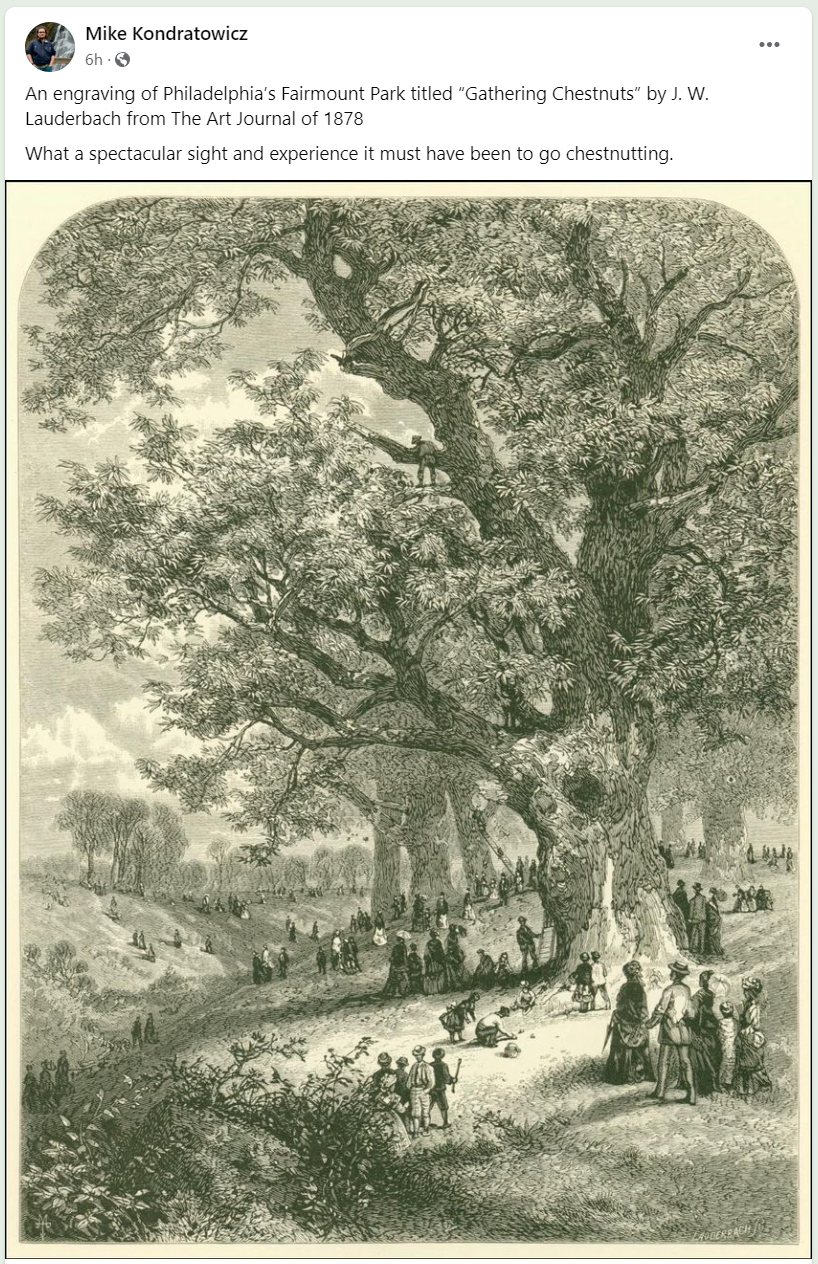
This image illustrates a historical permaculture tradition called "cobblering," where Philadelphia residents gathered chestnuts from massive trees to harvest sustainable free food. It reflects the permaculture ideal of living in harmony with nature by harvesting natural resources without disturbing the ecosystem. The image includes text from 1878 describing Philadelphia's Fairmount Park titled "Gathering Chestnuts" by J. W. Lauderbach.
simple-description (llama3.2-vision_11b)
The meme is a humorous take on the concept of permaculture, which is an approach to sustainable living that focuses on creating self-sufficient ecosystems. The image shows a cartoonish illustration of a tree with a face, surrounded by people, with the caption "Permaculture: where the trees are the bosses" referencing the idea that in permaculture, the trees are the central focus and the people are the ones who are supposed to be taking care of them.
detailed-analysis (gemma3-27b-vision)
Okay, let's analyze the 1878 engraving "Gathering Chestnuts" by J.W. Lauderbach through the lenses requested, keeping in mind that not every framework will seamlessly fit. I'll provide sections where they are relevant.
Visual Description
The engraving depicts a bustling scene in Fairmount Park, likely in the late 19th century. The central focus is a massive chestnut tree, its branches laden with leaves and presumably chestnuts. A large crowd of people is engaged in the activity of gathering the fallen chestnuts. The figures, rendered in a detailed, somewhat formal style typical of engraving, represent a range of social classes and ages, although a clear distinction is somewhat obscured by the style of the image. Men in top hats and suits mingle with women in long dresses and bonnets. Children are actively collecting chestnuts, some using sticks to knock them down. The background reveals a gentle slope, trees, and what might be a pathway or road. The overall impression is one of leisure, community gathering, and a connection to nature. The style suggests an attempt to capture a "pleasant" moment, typical of idealized landscape scenes in the period.
Foucauldian Genealogical Discourse Analysis
This image provides a fascinating entry point for Foucauldian analysis. The seemingly innocuous act of "chestnutting" is deeply embedded within a network of power/knowledge relations.
- Discipline and Leisure: The image represents a carefully managed leisure activity. While it appears natural, the very act of being in a designated park (Fairmount) speaks to a developing system of urban planning and control over space. The “orderly” gathering, while ostensibly free, is happening within parameters set by the city and its administrators.
- Normalization of Class Relations: The gathering, with figures appearing in distinct styles of dress, suggests a reinforcement of class boundaries even in a supposedly egalitarian recreational setting. Observing how people interact, or don't, is significant. The expectation of "proper" behavior within this managed space normalizes existing social hierarchies.
- The "Natural" vs. The Constructed: The chestnut tree, representing "nature," is simultaneously a product of urban landscaping and management. This highlights the Foucauldian idea that “nature” itself is a constructed category shaped by human interventions and discourses.
- Genealogy of Recreation: Tracing the history of "recreation" – how it evolved as a concept, what needs it was meant to fulfill (social control, productivity enhancement, etc.) – reveals the shifting power dynamics involved. Chestnutting, as depicted, isn't simply "fun;" it’s a historically contingent practice tied to specific social and political formations.
Critical Theory (specifically, Adorno/Horkheimer and the Culture Industry)
Looking at this engraving through the lens of the Frankfurt School, particularly Adorno and Horkheimer, suggests that it participates in the creation of a "false consciousness."
- Standardization of Leisure: The image presents a standardized, idealized form of leisure. Chestnutting is depicted as a harmonious, universally enjoyable activity, obscuring any potential alienation, social inequalities, or environmental impacts.
- Reification of Nature: The chestnut tree is presented as a beautiful, passive object, divorced from the larger ecological context. This reification contributes to the commodification of nature and a loss of genuine connection with the environment.
- Repression of Dissent: The scene lacks any hint of social unrest or critique. It promotes a passive acceptance of the status quo. By presenting a harmonious vision of society, it implicitly silences alternative perspectives.
- The Illusion of Freedom: The "freedom" experienced in the park is illusory. It is framed within a system of control and regulation. The individuals appear free, but they are ultimately conforming to the norms and expectations of the dominant culture.
Marxist Conflict Theory
This image can be read as an illustration of the ways in which leisure time is structured to reinforce class relations.
- The Leisure of the Bourgeoisie: The presence of figures in elaborate clothing suggests that the park is primarily a space for the upper and middle classes. Their ability to enjoy leisure time is built upon the labor of the working class.
- Ideological Function: The image serves an ideological function by presenting a harmonious vision of society, masking the underlying class conflicts and inequalities. It naturalizes the existing social order.
- Control of Resources: Access to the park and the ability to engage in leisure activities are tied to the control of resources. The upper classes have the economic and social capital to enjoy these privileges.
- Distraction from Exploitation: The act of chestnutting, while seemingly harmless, serves as a distraction from the harsh realities of industrial capitalism. It provides a temporary escape from the alienation and exploitation of labor.
Postmodernism
A postmodern reading would question the very notion of a “truthful” depiction of reality and the authority of representation.
- Deconstruction of the “Natural”: Postmodern thought would challenge the idea of a pristine, untouched “nature.” The park is a constructed space, and the image itself is a constructed representation.
- Simulacra and Simulation: The image could be seen as a simulacrum of experience – a copy without an original. The image is not a direct reflection of reality but a mediated representation that shapes our perceptions.
- Loss of Grand Narratives: A postmodern perspective would reject the idea of a single, unifying narrative of progress or social harmony. The image, with its idealized vision of society, is seen as a form of ideological control.
- The Subjective Gaze: The image is shaped by the subjective gaze of the artist, who selects and frames the scene in a particular way. There is no objective truth to be found.
Queer Feminist Intersectional Analysis
While the image doesn’t explicitly depict queer or feminist issues, an intersectional reading can reveal underlying power dynamics related to gender, class, and social control.
- Gender Roles: Observe the ways in which men and women are depicted. Are they engaging in different activities? Are there any subtle cues about traditional gender roles? The image likely reinforces patriarchal norms.
- Social Exclusion: Who is not present in the image? Are there any marginalized groups who are excluded from this leisure activity?
- Spatial Control: The park is a controlled space, and access to it may be limited for certain groups. This can be seen as a form of spatial control that reinforces social inequalities.
- The Idealized Family: If the image depicts families, how are they portrayed? Does it reinforce heteronormative ideals?
I hope this detailed breakdown gives you a good starting point for analyzing the engraving through these various theoretical lenses. Let me know if you'd like me to elaborate on any of these points or explore additional angles!
tesseract-ocr
By Mike Kondratowicz eee / ch-@ An engraving of Philadelphia’s Fairmount Park titled “Gathering Chestnuts” by J. W. Lauderbach from The Art Journal of 1878 What a spectacular sight and experience it must have been to go chestnutting. BTS BR OBESE EES RS So Se hs, BES Ba he ES SERN LEE SSE Du ee ae FA) ee ER Seat OSs hi RR I oC ARS TSS tog yy SS ee Peri gor IRD a fo GSS, RE EI Se 3 FEIN. ee RL RS ae Noe Ae WR eee - Bees ORBAN GES sacri a ge Regge fe gk Ye by pees ROSNER cS RR mee eg NS ne Wee SORES ge sy Shs =e Ss Re Cer, Cee Sa ee SS eg as TN ec RO ee ee) a a a 2 OSS SEN ~ Weta Weak Rees =< Ss SER SE BR Cea ONO ge a CN SS oh aN ee te ae » Ses ERG, Ni a eR Cae Re NS Ries ge ers A ares OND, Se RY 5 rap ee Pe ee, | ae eco wy SNE AN sae 88 es | See Te RN Wee | 5 RISES S TN Se OS MANES BES TE 0g a a er OR ee ga Ze 7 es Kt wae FS ENG eee ete OS a Wes ee S age at ae 5. oa ea votes, Es a Se WN x By SR SR WA Den) Saeeany)e aern See Be ERS SS RINE Nae NE cea PAR) ies bes Wy, RN I ee Wiel oi) os if r “BRN SUA a oes Nae STN a. ul wan | s WEP es ae coe dal ES UeESias m fA am ee % nieces Se paygetacn’ ste I og i sol eae a US jo Se a HNN SAR SE ee a. pase a pe ws ~ Sais ‘hy e ie a Tea ge i ae ER OF ee a | aie it: BP ges oe pele ee ee ee fe BS eat oe as rR Pe al ii i ovr Rak oe OER ee - Are Pe ate Partie . F<. Se aw a SO) a Wee ip ss “ rie CHM e : fe a eee aE gst “Sc See IE Peg pain 7 |e RAE fe) eee ee eR eS BSP Bes Gwe os
simple-description (llama3.2-vision)
The meme is a humorous image of a 19th-century painting of a group of people gathered around a large tree, with a caption referencing the tree's name, "The Gathering of the Chestnuts". The text in the image is the title of the painting, "The Gathering of the Chestnuts".