First Seen
2023-05-10T20:59:59+00:00
simple-description (llama3.2-vision_11b)
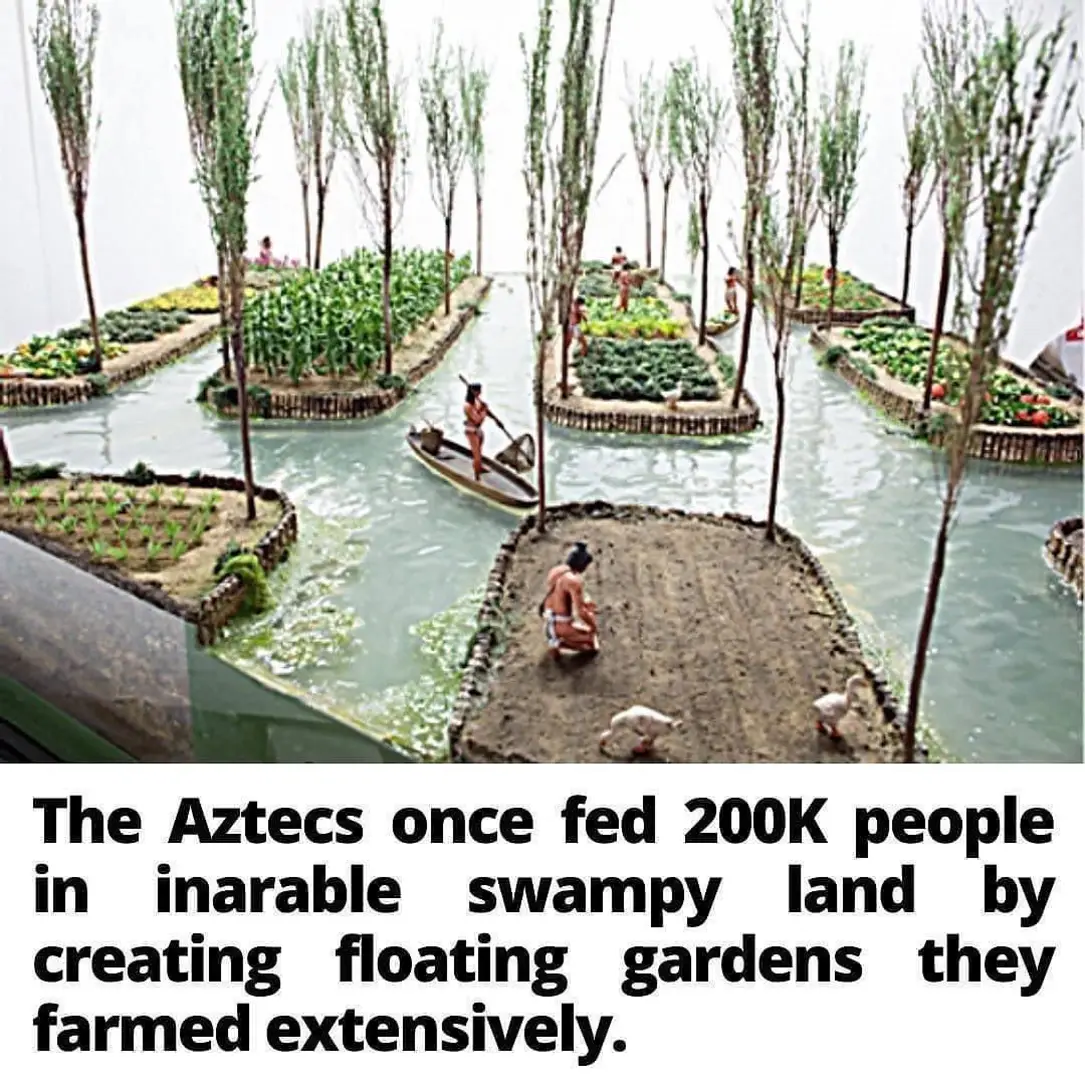
The meme is a humorous take on the Aztecs' ability to create extensive gardens on floating islands in the middle of a lake. The text "The Aztecs once fed 200K people in inarable swampy land by creating floating gardens" is meant to be ironic, implying that the Aztecs were able to achieve impressive agricultural feats despite the challenging environment.
detailed-analysis (gemma3-27b-vision)
Okay, let's break down the image and its associated text through the requested theoretical lenses.
Visual Description
The image depicts a reconstructed or artistic rendering of the Aztec chinampas—floating gardens. These are rectangular areas of fertile land created in shallow lake beds, surrounded by canals. The image is dominated by a network of these gardens, connected by navigable waterways. Several small canoes carrying people are visible, suggesting transport and maintenance of the gardens. The gardens themselves are lush and green, indicating active cultivation. In the background, there are trees around the edges of the waterways. The overall impression is one of a highly organized and intensive agricultural system adapted to a unique and challenging environment. The scene evokes a sense of ingenuity and a deep relationship between people and their natural surroundings.
Foucauldian Genealogical Discourse Analysis
This image and its caption lend themselves well to a Foucauldian analysis focusing on discourse and power/knowledge.
- The Discourse of 'Civilization' and 'Progress': Historically, Western discourse often positioned indigenous agricultural systems (like the chinampas) as "primitive" or "less developed" compared to European methods. This is a power dynamic – it defines what constitutes 'successful' agriculture (often tied to land ownership, monoculture, and control) and casts other systems as inferior. The image, while depicting a thriving system, could be interpreted as part of a discourse seeking to rescue indigenous knowledge – and that rescue, in itself, is a power move.
- The Production of ‘Arable’/’Inarable’: The text highlights the “inarable” nature of the land before the Aztecs created the chinampas. This categorization of land – arable vs. inarable – isn’t a natural fact but a construction created through discourse. The Aztecs, through their practices, re-defined what constituted "usable" land, challenging the dominant categorization.
- Power and Control of Resources: The image speaks to a particular form of power derived from the ability to engineer an environment to meet human needs. The chinampas are not simply gardens; they represent a sophisticated knowledge system for resource management and ecological adaptation – a key form of power.
Critical Theory
From a critical theory perspective (drawing on the Frankfurt School, Horkheimer, Adorno, etc.), this image can be viewed as representing a form of “instrumental reason” – a focus on efficiency and control over nature.
- Domination of Nature: While seemingly harmonious, the chinampas represent a significant alteration of the natural landscape. The Aztecs did not simply live with the swamp; they transformed it to suit their needs. This reflects a tendency toward dominating nature – a core theme in Western critical thought.
- The Myth of Technological Progress: The image could be seen as upholding a myth of technological progress. The Aztecs 'solved' the problem of unusable land through innovation. However, critical theorists would ask: At what cost? What were the unforeseen consequences of this environmental manipulation? (We'd need further historical analysis to fully answer that, but the question is important.)
- Critique of Rationality: While the chinampas are a brilliant example of adaptive agricultural technology, a critical theorist might point out that the pursuit of efficiency can lead to unintended consequences and ecological damage. It’s a cautionary tale about prioritizing rational control over natural processes.
Marxist Conflict Theory
From a Marxist perspective, the image highlights the relationship between the mode of production, social organization, and control of resources.
- Means of Production: The chinampas themselves represent a sophisticated means of production, enabling the Aztecs to overcome environmental limitations and produce a surplus of food. This surplus allowed for social stratification, the emergence of a ruling class, and the development of a complex society.
- Control of Land and Labor: The construction and maintenance of the chinampas required significant collective labor. The question arises: How was this labor organized? Was it voluntary, or was it enforced through systems of tribute or social control? The control of this labor and the resulting agricultural surplus would have been a key source of power.
- Class Structure & Surplus: The ability to feed 200,000 people indicates a surplus of production. This surplus wasn’t simply distributed equally; it likely supported a ruling class of priests, warriors, and administrators. The chinampas system, while innovative, was likely embedded within a hierarchical social structure where the benefits weren’t shared equally.
- Base and Superstructure: The chinampas (the material base) shaped the "superstructure" – the social, political, and ideological structures of Aztec society. The ability to reliably feed a large population allowed for the development of a complex state and a sophisticated culture.
Postmodernism
A postmodern reading would challenge grand narratives and focus on the constructed nature of knowledge and the multiplicity of perspectives.
- Deconstruction of ‘Progress’: Postmodernism would reject the idea that the chinampas represent linear “progress” in agricultural development. It would argue that this is simply one way of organizing agriculture, among many, with its own specific cultural context and limitations.
- Multiple Interpretations: The image is open to multiple interpretations. A postmodernist would emphasize that there is no single “correct” way to understand the chinampas. Its significance depends on the viewer’s perspective and the historical context.
- Rejection of Universal Truths: The claim that the Aztecs “solved” the problem of unusable land would be questioned. Postmodernism would argue that the very concept of “usability” is socially constructed and culturally specific.
- Emphasis on Local Knowledge: The chinampas represent a form of local, ecological knowledge that is often marginalized by Western science and technology. Postmodernism would emphasize the value of this knowledge and the importance of preserving cultural diversity.
Let me know if you'd like me to delve deeper into any of these perspectives or explore other theoretical frameworks!
simple-description (llama3.2-vision)
The meme is a humorous illustration of the Aztecs' alleged practice of creating extensive gardens on floating islands in Lake Texcoco, which is now known as Mexico City. The image depicts a serene lake scene with lush gardens and floating islands, accompanied by the text: "The Aztecs...".
tesseract-ocr
fa } ig by hi ? | ¥ ;, \ \y ve righ yeas bret Cath bi) sg ae j Wi’ & Wey ii Ay Ad " / ae BN OR Be ae be SUN NON ag + ‘ . , \j 1a ) Re ie V/fg ‘ fb || ie Ya! EB = Basen) We 4 Hee ) ) to” MET see SMe e ale a wi wen 2 * Hieie nn te unayers , € abi‘ — D iremsep esta, A oa | Sine a, ; a i & TEBE Ie i roe es Gea> > SS — sy Bey “30 Ss ra era, f » hn, oy ee : Ca ak Ree fe : : é atest § 5 Ko ee yy The Aztecs once fed 200K people in inarable swampy land by creating floating gardens they farmed extensively.