First Seen
2023-05-10T20:59:59+00:00
simple-description (llama3.2-vision_11b)
The meme is a humorous commentary on the challenges of permaculture, a sustainable farming practice. The image juxtaposes a young adult's optimism with a dystopian future, implying that their enthusiasm for permaculture will be crushed by the harsh realities of the world. The text reads: "I'm gonna grow all my food, have a sustainable home, and make friends with the bees. We're gonna make the world a better place, one garden at a time!"
detailed-analysis (gemma3-27b-vision)
Okay, let's break down this meme using the requested theoretical frameworks. It's a fairly dense piece of internet humor, laden with cultural references and generational anxieties, so each section will be fairly detailed.
Visual Description
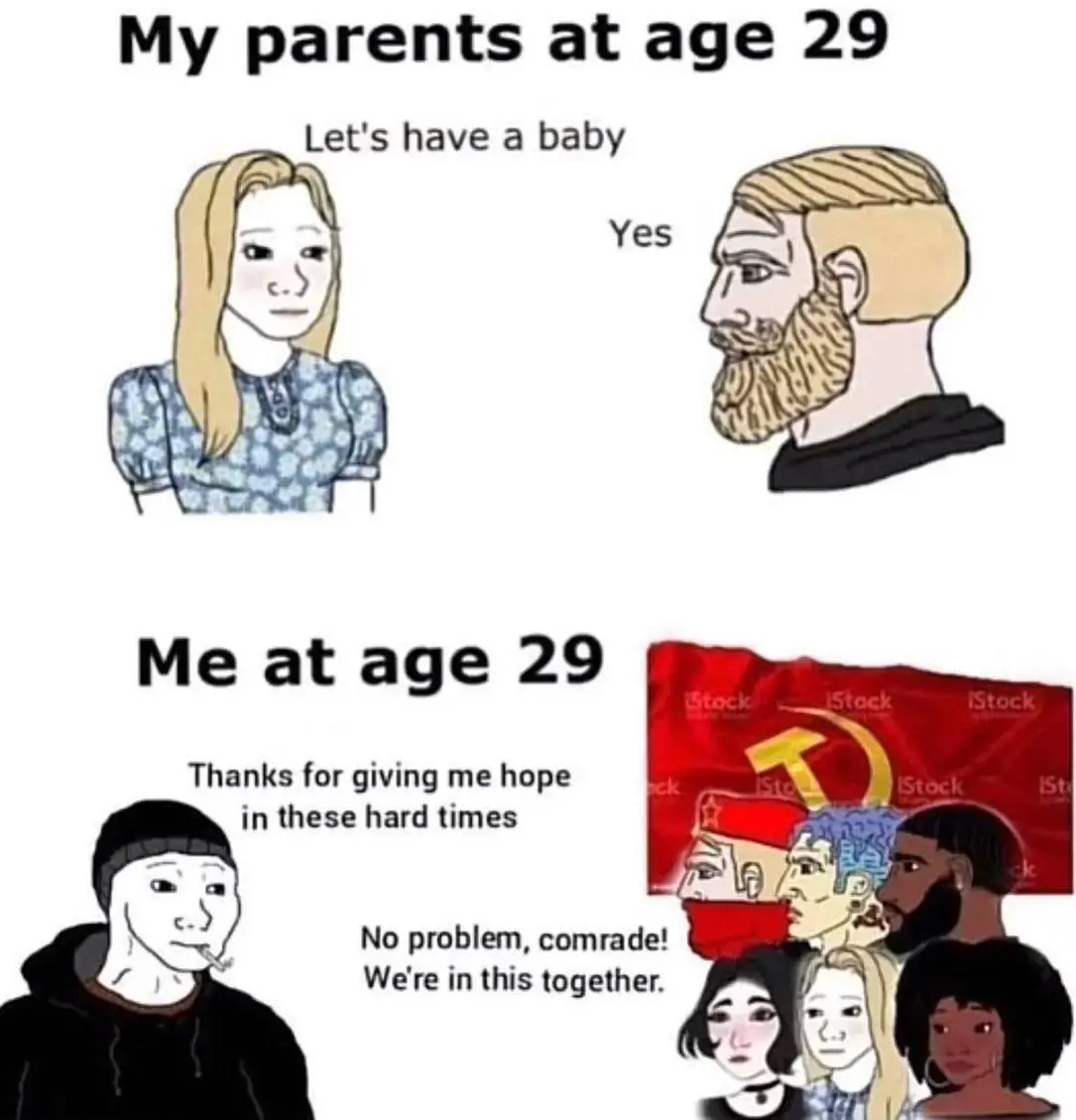
The meme is a diptych, comparing "My parents at age 29" with "Me at age 29." The top panel features a simple illustration of a traditionally attractive, smiling woman in a 1950s-style dress saying "Let's have a baby," and a man with a beard responding with a smiling "Yes." The image evokes a very specific ideal of mid-20th-century domesticity and traditional gender roles.
The bottom panel is quite different. It features a highly stylized illustration of a young, visibly distressed person with a dark, goth-adjacent aesthetic, saying "Thanks for giving me hope in these hard times." This figure is positioned in front of a chaotic backdrop featuring numerous diverse characters depicted in a flat, cartoon style. Overlaid on this scene are multiple "Stock" watermarks, and conspicuously displayed are numerous Soviet-era communist symbols and imagery (red stars, hammer and sickle, and figures reminiscent of Soviet propaganda posters). The response is "No problem, comrade! We're in this together." The juxtaposition creates a stark contrast in aesthetic, political alignment, and perceived life stage.
Foucauldian Genealogical Discourse Analysis
Foucault's genealogical method looks at how concepts and categories are formed through power relations and historical contingencies. Here, the meme's contrast relies heavily on the historically constructed notions of "adulthood," "family," and "hope."
- Discipline & Normalization: The parental image represents a historically normalized ideal of adulthood: early marriage, procreation, and the pursuit of domestic stability. This ideal was powerfully constructed through institutional forces (media, religion, legal systems) that disciplined bodies and desires to conform to this pattern. The distressed figure in the bottom panel rejects this normalization.
- Discourse & Power: The contrast between the parental "Let's have a baby" and the younger person's plea for "hope" highlights a shift in dominant discourses. The older generation’s discourse centers on perpetuating lineage and building a family, while the younger generation’s reflects anxieties about economic instability, climate change, political polarization, and a perceived lack of future prospects. The language of “comrade” in the response signifies a shift in values towards collective action and solidarity.
- Genealogy of Hope: The meme implicitly questions the genealogy of "hope" itself. Is hope found in traditional institutions and individual achievement (the parental side), or in collective struggle and radical political change (the younger generation’s side)? The meme suggests that hope, in this era, is less about personal fulfillment and more about collective survival.
Critical Theory
Using a broadly Critical Theoretical lens (drawing on Frankfurt School thinkers like Adorno and Horkheimer), we can see how the meme critiques the alienation and anomie of late-stage capitalism.
- Culture Industry: The "Stock" watermarks on the lower panel are a key component here. They symbolize the commodification of identity and the overwhelming saturation of imagery in the digital age. It suggests that even rebellion and counter-cultural movements are increasingly being absorbed and repackaged as commodities.
- False Consciousness: The parental image can be seen as representing a form of “false consciousness,” where individuals are unaware of the systemic forces that shape their lives. They are pursuing a conventional path to happiness without questioning the underlying structures of inequality.
- Alienation: The distressed figure embodies a sense of alienation from both traditional institutions and the promises of consumer culture. They are searching for meaning and solidarity in a world that feels increasingly fragmented and meaningless.
- Critique of Progress: The stark contrast between the two generations can be seen as a critique of the notion of linear progress. The meme suggests that the current generation is facing challenges that are qualitatively different from those faced by their parents, and that the old solutions are no longer viable.
Marxist Conflict Theory
From a Marxist perspective, the meme embodies class struggle and the changing nature of the proletariat.
- Class Consciousness: The young person’s embrace of communist iconography and solidarity ("comrade") signals a developing class consciousness. They are recognizing their shared interests with others who are marginalized and oppressed by the capitalist system.
- Proletarianization & Precarity: The anxieties expressed by the young person ("hard times") reflect the growing precarity of labor and the increasing difficulty of achieving economic security in late capitalism. This is compounded by environmental degradation and political instability.
- Revolutionary Potential: The image of a diverse group rallying around communist symbols suggests a potential for collective action and revolutionary change. The meme implies that the current generation is more willing to challenge the status quo than their parents.
- Ideological Struggle: The meme can be seen as a site of ideological struggle between different worldviews. The traditional values represented by the parents are contrasted with the radical politics of the younger generation.
Postmodernism
The meme fits into a postmodern framework through its self-referentiality, irony, and rejection of grand narratives.
- Pastiche & Irony: The juxtaposition of disparate images (1950s domesticity vs. Soviet propaganda) is a form of pastiche, creating a fragmented and ironic effect. The meme doesn't offer a coherent message, but rather a playful deconstruction of meaning.
- Rejection of Metanarratives: The meme implicitly rejects the idea of a single, overarching narrative about progress or the good life. It suggests that there are multiple, equally valid ways of experiencing the world.
- Simulacra and Simulation: The "Stock" watermarks embody Baudrillard's concept of simulacra – copies of copies that have lost their connection to reality. This suggests that the digital age is characterized by a proliferation of superficial images and a loss of authenticity.
- Fragmentation of Identity: The diversity of characters in the lower panel suggests a fragmented and fluid sense of identity. Individuals are no longer defined by traditional categories (class, gender, race), but by a complex web of affiliations and experiences.
Queer Feminist Intersectional Analysis
This is the most complex lens to apply, but potentially the most insightful.
- Deconstructing Traditional Family Structures: The meme implicitly critiques the heteronormative and patriarchal assumptions embedded in the traditional family structure represented by the parents. The focus is shifted from reproduction to solidarity and collective struggle, opening up possibilities for alternative forms of kinship.
- Intersectionality of Oppression: The diverse group in the bottom panel suggests a recognition of the intersectionality of oppression – the ways in which different forms of discrimination (based on race, gender, class, sexuality, etc.) intersect and reinforce one another.
- Rejecting the Burden of Reproduction: The refusal to focus on having a baby can be seen as a rejection of the patriarchal expectation that women are primarily defined by their reproductive capacity.
- Solidarity as Resistance: The embrace of communist iconography and the language of “comrade” represents a form of resistance to oppressive power structures. The meme suggests that solidarity is essential for creating a more just and equitable world. It’s a form of creating chosen family and mutual support.
It’s important to note that these frameworks are not mutually exclusive. The meme is rich enough to accommodate multiple interpretations, and different readers may emphasize different aspects of its meaning. It’s a powerful example of how internet humor can be used to express complex political and social anxieties.
simple-description (llama3.2-vision)
The meme is a humorous comparison of one's life at age 29 versus what their parents would have wanted for them at birth. The text reads: "My parents at 29: Let's have a baby. Me at 29: Thanks for the optimism, I'll be living in my mom's basement forever."
tesseract-ocr
My parents at age 29 Let's have a baby P\ SSN Yes i a A) PE f ph) AS ws We ra Me at age 29 Thanks for giving me hope in these hard times / b $5 } “2 No problem, comrade! a 7 ;X Were in this together. y A= a yd,