First Seen
2023-05-10T21:03:39+00:00
simple-description (llama3.2-vision_11b)
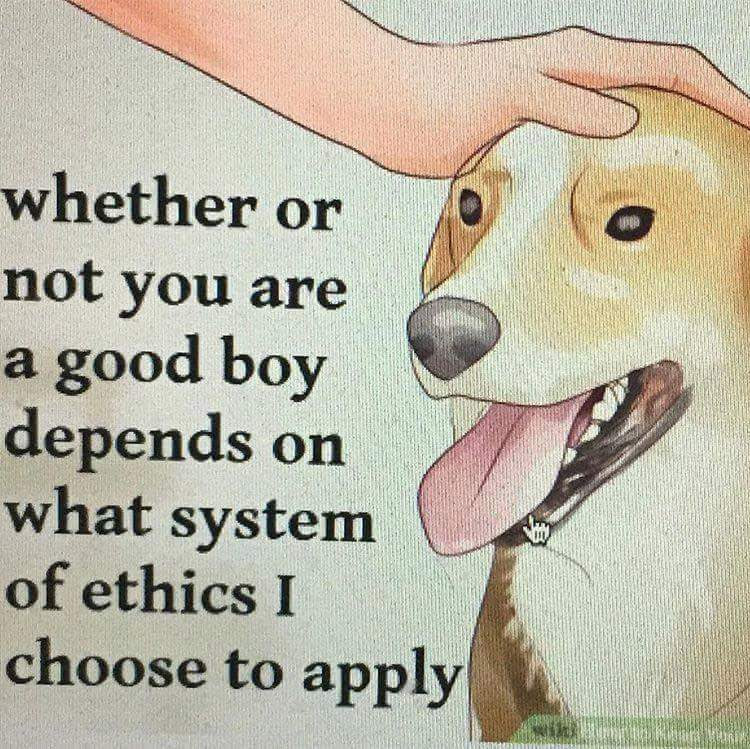
The meme is a play on the concept of moral relativism, which is a philosophical idea that moral judgments are relative to the cultural, historical, and personal context of an individual. The meme pokes fun at this idea by suggesting that moral judgments are not absolute, but rather dependent on the "category context" of the individual. The text "I only do what I think is right... in the context of my current moral framework" implies that moral judgments are subjective and can change depending on the individual's perspective.
detailed-analysis (gemma3-27b-vision)
Okay, let's break down this image with the requested theoretical lenses. It’s a surprisingly rich image for such a simple composition, precisely because of the text overlay.
Visual Description
The image features a portion of a golden retriever’s face and a human hand gently touching its head. The dog's mouth is open, tongue lolling out, with a playful or happy expression. The color palette is soft and warm, leaning towards pastel yellows and pinks, suggesting a cute or endearing aesthetic. The style appears to be illustrative, potentially from a children's book or a similar context. The dog has a large black nose, and the text is in a black font.
Foucauldian Genealogical Discourse Analysis
This image and its accompanying text are a perfect example for Foucauldian analysis. The phrase "good boy" is not an inherent truth, but a discourse – a system of thought, language, and practice that constructs meaning. The text explicitly states that “goodness” is contingent on the ethical system applied. This means the concept of a "good boy" isn't natural or universal, but a product of power relations.
- Genealogy: A genealogical approach would ask how the concept of a "good boy" (and its application to dogs) emerged historically. What practices, institutions (like dog training, pet ownership, veterinary science) and knowledge systems shaped this concept? How did this historically evolve? The idea of "goodness" in a dog likely ties into notions of domestication, obedience, and human control.
- Power/Knowledge: The statement implies the person doing the ethical assessment holds power. They are the one defining what constitutes "goodness". The power lies in the ability to classify and judge. It's not that the dog is inherently good or bad, but that it's made to be seen as such through the application of an ethical framework.
- Discipline: Dog training itself is a form of discipline. Rewards and punishments construct the dog’s behavior to fit within a socially defined "goodness." This aligns with Foucault's ideas of disciplinary power—how power operates not through repression but through the shaping of behavior.
Critical Theory
From a Critical Theory perspective, the image challenges the notion of objective truth. The text directly states that 'goodness' isn’t inherent but socially constructed. This aligns with the core tenets of Critical Theory which emphasize how knowledge is inextricably linked to power structures and ideologies.
- Ideology: The phrase "good boy" can be seen as part of a broader ideology surrounding pet ownership – one that reinforces human dominance over animals and prescribes acceptable behaviors. The image subtly critiques this by highlighting the arbitrary nature of that prescription.
- Domination: The very act of evaluating a dog as "good" or "bad" can be seen as an exercise of power. The human asserts their authority by judging the dog's worth. The image makes the arbitrary nature of this authority evident.
Postmodernism
The image perfectly encapsulates postmodern themes. The explicit statement that “goodness” is dependent on the chosen ethical system is a direct rejection of grand narratives or universal truths.
- Deconstruction: The image deconstructs the seemingly simple and innocent phrase "good boy". It unveils the hidden assumptions and power dynamics embedded within it.
- Relativism: The image embraces a form of relativism. There is no objective standard for "goodness". It depends entirely on the perspective and the chosen framework.
- Playfulness/Irony: There’s a certain playfulness to the image, a wink at the absurdity of applying complex ethical systems to a dog. This self-awareness is a hallmark of postmodern art.
I don’t believe Queer Feminist Intersectional Analysis or Marxist Conflict Theory are readily applicable here, as the image doesn’t inherently present a strong enough basis for either viewpoint. However, if one were to attempt to apply them, it would need to stretch the analysis quite a bit.
I hope this breakdown is helpful! Let me know if you’d like me to elaborate on any of these points or explore a different theoretical lens.
simple-description (llama3.2-vision)
The meme features a cartoon image of a dog with a sarcastic expression, accompanied by a quote that pokes fun at the idea that a person's behavior is justified by their good intentions. The text reads: "I'm not arguing, I'm just explaining why I'm right. And if you disagree, you're wrong."
tesseract-ocr
i, : . ai 0 whether or 2 te re not you are Fn | yg a agoodboy W | fy dependson // gy what system \_ ' of ethics I 7 ie i), ee choose to apply| i re RN iH AM