First Seen
2023-05-10T21:03:39+00:00
gemma3-27b-vision
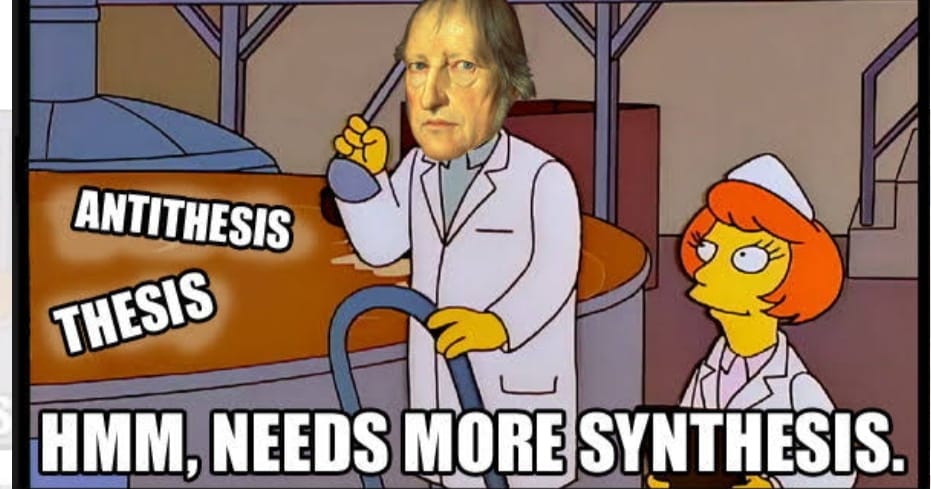
Okay, let's break down this meme using the requested theoretical frameworks. It's a rich image ripe for analysis! **Visual Description** The image is a screen capture from *The Simpsons*. The scene depicts the character Dr. Julius Hibbert, looking intensely and critically, while pointing his cane towards a board with the words "THESIS" and "ANTITHESIS" written on it. Beside him is a nurse, who is looking at the board and Dr. Hibbert. At the bottom of the image is a text caption: "Hmm, needs more synthesis." The visual composition leans heavily on the established character of Dr. Hibbert as a somewhat detached, intellectual observer, combined with the humorous context of *The Simpsons*. The setting appears to be a hospital or lab environment. The color palette is the standard, bright cartoon colors of the show. --- **Critical Theory** This meme is a direct parody of the dialectical method, central to Hegelian and Marxian thought, and thus is prime territory for Critical Theory analysis. The setup of "thesis" and "antithesis" immediately signals a process of argumentation or thought. Dr. Hibbert's dismissive “Hmm, needs more synthesis” is a critical commentary on incomplete thought or analysis. It suggests that simply identifying opposing viewpoints (thesis/antithesis) is insufficient; a true understanding requires a *synthesis* – a resolution that transcends the initial conflict. This is especially pertinent within Critical Theory as it implies a dissatisfaction with superficial binary oppositions (which are common in much discourse). The meme suggests that merely *pointing out* problems or conflicts isn't enough; a transformative, synthetic solution is required to move beyond the limitations of those oppositions. The meme subtly critiques the tendency to get stuck in polarized debates without seeking common ground or innovative solutions. --- **Foucauldian Genealogical Discourse Analysis** From a Foucauldian perspective, the meme highlights the construction of "knowledge" and "truth" through discourse. The concepts of "thesis" and "antithesis" aren’t neutral; they are historically situated terms within a Western academic tradition. They represent a *particular* way of framing argumentation. Dr. Hibbert’s critique implicitly questions the validity of *this* discursive framework itself. The “need for synthesis” could be seen as an assertion of power/knowledge. Who gets to define what constitutes a “sufficient” synthesis? What are the power dynamics involved in declaring an argument incomplete? The meme can be read as questioning the naturalization of this particular method of analysis—suggesting that it's not an objective truth, but a construction. We can also see how the image itself participates in a specific discourse (humorous critique of intellectualism) which is itself subject to analysis. --- **Marxist Conflict Theory** In terms of Marxist conflict theory, the “thesis” and “antithesis” can be interpreted as representing opposing class interests or ideologies. The demand for “synthesis” implies a desire to overcome these conflicts—perhaps through a revolutionary transformation. However, the meme’s comedic tone also subtly suggests the difficulty or impossibility of achieving a true resolution. We can read the meme as a critique of the tendency within some forms of Marxist thought to oversimplify complex social realities into binary oppositions (e.g., proletariat vs. bourgeoisie). Dr. Hibbert’s dismissive attitude implies that simply identifying these conflicts isn’t enough; a more nuanced and sophisticated understanding is required to move towards real change. The need for synthesis could be seen as a call for a more comprehensive and transformative solution that transcends the limitations of existing class structures. --- **Postmodernism** The meme aligns with postmodern concerns by deconstructing the idea of a stable “truth” or “resolution.” The demand for "synthesis" is not necessarily a call for *finding* a unifying truth but rather acknowledging the impossibility of such a thing. It mocks the idea that all conflicts can be neatly resolved through logical argumentation. The very act of parodying the dialectical method undermines its authority. It suggests that any attempt to create a “synthesis” is itself a constructed and provisional act—subject to endless deconstruction. The comedic tone reinforces this sense of relativism. In essence, it is a playful acknowledgement that "truth" is always contingent and provisional. --- **Queer Feminist Intersectional Analysis** While not immediately obvious, this meme can also be analyzed through an intersectional lens. The binary structure of "thesis" and "antithesis" can be seen as mirroring other binary oppositions that often marginalize and exclude—such as male/female, heterosexual/homosexual, etc. The demand for "synthesis" can be interpreted as a call for a more inclusive and nuanced understanding that transcends these limiting binaries. It suggests that true progress requires moving beyond simplistic categories and embracing the complexities of lived experience. The meme’s critique of incomplete thought implicitly challenges the tendency to essentialize identities and ignore the intersections of power and privilege. **In Conclusion:** This seemingly simple meme is surprisingly rich in potential meaning. Its effectiveness stems from its ability to tap into established theoretical frameworks and offer a humorous commentary on intellectualism, conflict, and the pursuit of truth. Each theoretical lens illuminates different aspects of the meme's meaning, and together they offer a multifaceted understanding of its message.
tesseract-ocr
(TTS ‘a = EIS = uy ea PN TON SUC LS
llama3.2-vision
The meme is a humorous take on the academic term "antithesis" and its relationship to "thesis". The image depicts a professor explaining the concept, but the student is confused and asks for a more detailed explanation, implying that the professor's explanation is not clear. The text "antithesis thesis" is written on a chalkboard, and the student's response is "hmm, needs more synthesis".