First Seen
2023-05-10T21:03:39+00:00
simple-description (llama3.2-vision_11b)
The "Distracted Boyfriend" meme, also known as "Distracted Boyfriend Meme," is a humorous image that illustrates the human tendency to be distracted by something or someone else, even when they are in a committed relationship. The image shows a man looking at another woman while his girlfriend or wife looks on in shock or disappointment. The text that appears in the image is often a caption that pokes fun at the situation, such as "When you're trying to focus on your work but your brain keeps wandering to your ex."
detailed-analysis (gemma3-27b-vision)
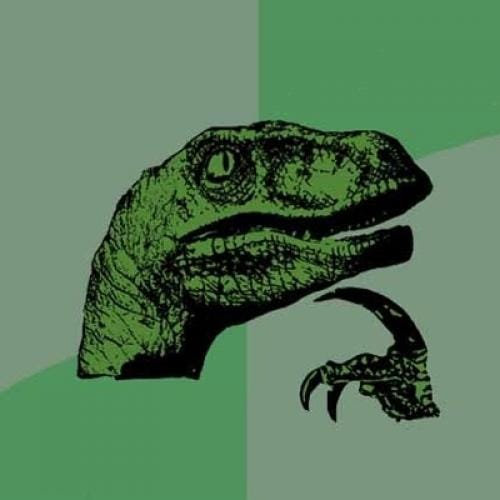
Okay, let's break down this image—a green, stylized velociraptor head with a prominent claw—through the lenses of the theoretical frameworks you've requested. I'll include sections only where the theory demonstrably applies.
Visual Description
The image depicts the head of a velociraptor rendered in a highly stylized, almost engraving-like, green monochrome. It is likely a vector graphic. The velociraptor is a dinosaur known for its sharp claws and predatory nature. The perspective is a close-up, focusing on the head and one particularly visible and prominent claw. The background is a flat, light green, divided into angled sections resembling a meme format. The overall aesthetic is somewhat cartoonish but still maintains a sense of the dinosaur's inherent power and threat. The monochrome coloring and graphic style give it a dated, internet-culture feel, strongly reminiscent of early internet memes.
Foucauldian Genealogical Discourse Analysis
This image lends itself well to Foucault's approach. The velociraptor, as a discourse, isn’t just a prehistoric animal. It’s a cultural construct, powerfully shaped by its representation in popular culture—most notably Jurassic Park.
- Power/Knowledge: The depiction of the velociraptor isn’t a neutral scientific rendering. It's a culturally informed representation of power. The claw, prominently displayed, is a clear symbol of predatory strength. This image perpetuates a discourse around danger and the "primitive" – constructing the dinosaur as an “other” that embodies raw, unrestrained force.
- Genealogy: A genealogical analysis would trace the history of the velociraptor's image. From scientific reconstruction to cinematic adaptation, we see how its perceived characteristics shifted and were then naturalized as “truth” through repeated representation. Jurassic Park popularized a velociraptor that deviated considerably from the paleontological record, creating a new “truth” that continues to dominate popular imagination.
- Disciplinary Power: The image, in its meme format, participates in a network of discourse that playfully normalizes concepts of predation and dominance. The use of the image as a reaction image, for example, often signifies surprise or an aggressive stance—reinforcing these power dynamics.
Postmodernism
The image embodies several hallmarks of postmodern thought.
- Simulacra and Simulation: The velociraptor isn’t the real animal, but a simulacrum— a copy without an original. Its image exists primarily through representations (films, memes, art) and has become divorced from its actual paleontological reality. We relate more to the idea of the velociraptor than the creature itself.
- Irony & Playfulness: Meme culture thrives on irony and decontextualization. The image is likely used in humorous or sarcastic ways, undermining the ‘serious’ portrayal of the dinosaur and instead emphasizing its comedic potential.
- Fragmentation & Loss of Grand Narratives: The image, as a single fragment of popular culture, embodies a shift away from overarching, totalizing narratives. It's a small piece in the ever-growing mosaic of internet culture, lacking any inherent “meaning” beyond what is projected onto it by the user.
Critical Theory
Looking at this image through the lens of Critical Theory, particularly Frankfurt School thought, we see an interesting dynamic.
- Culture Industry: The velociraptor, having been popularized by blockbuster films, has become a commodity within the "culture industry." Its image is endlessly reproduced, consumed, and commodified. This image participates in that cycle.
- Ideology: The image can be read as reinforcing an ideology of “natural dominance.” The velociraptor, as a predator, embodies a worldview that privileges strength and aggression. The image, through its visual power, subtly normalizes this worldview.
Let me know if you'd like me to elaborate on any of these interpretations or consider other theoretical lenses!
simple-description (llama3.2-vision)
This meme features a picture of a T-Rex with a confused or disappointed expression. The text "I can explain" appears above the T-Rex's head, implying that someone is trying to explain something complex or technical, but the T-Rex is not buying it. The meme is often used to express skepticism or frustration when someone is trying to explain something that seems obvious or unnecessary.
tesseract-ocr
aE RS ee aC: mee D'S a ee Ss Ap NESS, Raed Sta BS. Aa SP Ray o fio LE Seamed A er ee PUB E Ceonte ie AN tore Sent BN SOR Sh BONS Sa aad SS SS Ra! PKS NG n Rag ae ay Bate C7 eas ah