First Seen
2024-03-02T02:46:20.181125+00:00
simple-description (qwen3.5_2b-q8_0)
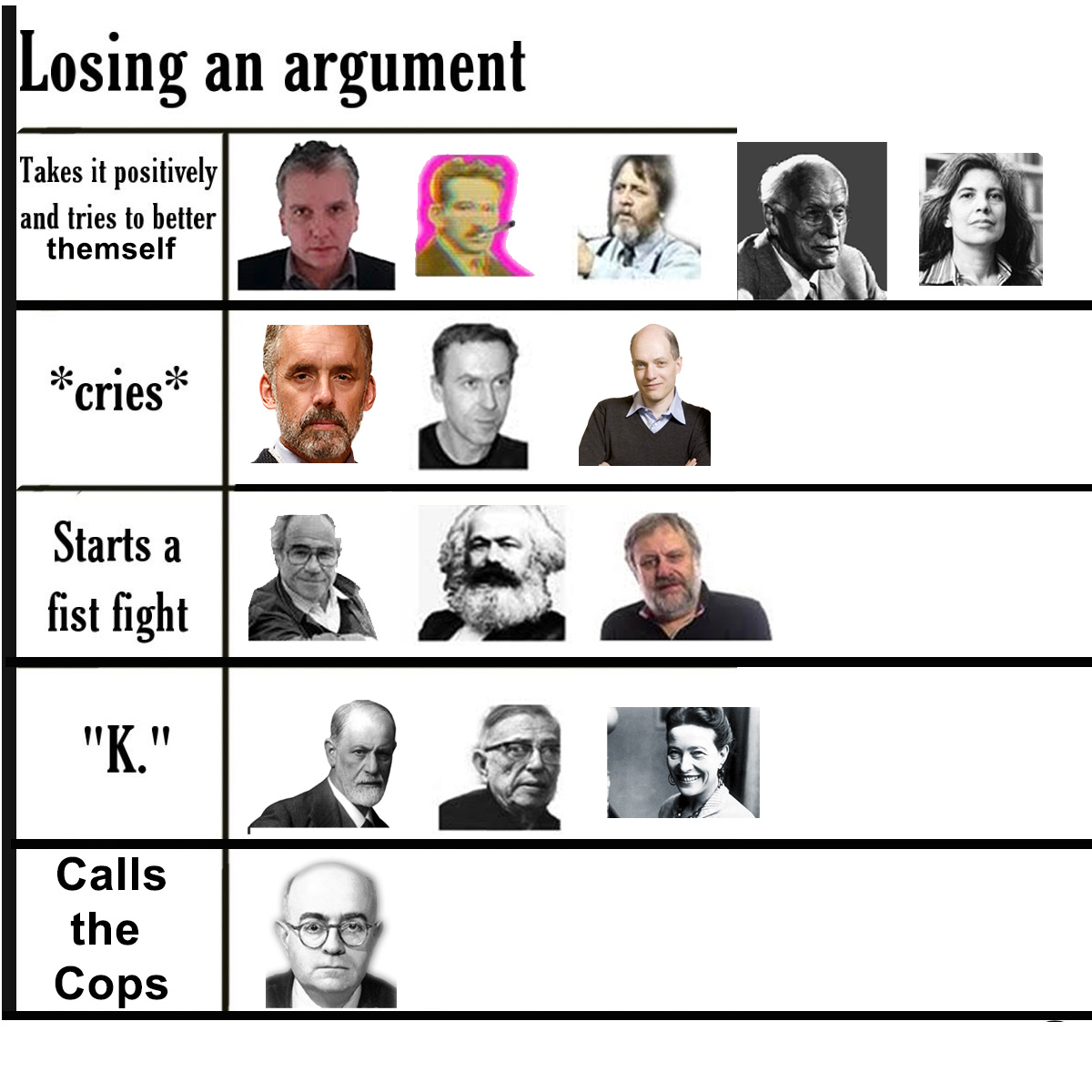
This meme humorously illustrates the escalating stages of losing a philosophical debate, referencing the absurdity of existence and the breakdown of reason. The first row, "Takes it positively and tries to better themselves," represents the ideal of existentialism, suggesting the philosopher accepts the situation's irrationality with wit or stoicism. The subsequent rows depict a psychological descent, moving from emotional distress ("cries") and physical violence ("Starts a fist fight") to the insanity of the final row, labeled ""K." which alludes to Kafkaesque irrationality and the ultimate absurdity of reality.
simple-description (llama3.2-vision_11b)
This meme is a humorous representation of a philosophical debate between 12 famous philosophers, each representing a different philosophical school of thought. The image shows a series of cartoons, each featuring a philosopher who is "losing an argument" in a humorous way, with text bubbles and speech bubbles adding to the humor. The meme is captioned "When you're arguing with a philosopher" and pokes fun at the idea that philosophers are often too focused on abstract ideas to engage in everyday conversations.
detailed-analysis (gemma3-27b-vision)
Okay, here's a breakdown of the image "Losing an Argument" through several theoretical lenses, as you requested. It's a bit of a meme-like grid correlating famous intellectuals/figures with responses to losing an argument. I'll include headings only where the lens applies, and offer nuance where possible given the inherently satirical nature of the image.
Visual Description
The image is a grid, structured like a flowchart or a "reaction meme." It has five rows, each labeled with a different response to losing an argument: "Takes it and tries to better themselves," "cries," "Starts a fist fight," "K." and "Calls the Cops." Each row contains three headshots of famous philosophers, intellectuals, or political figures. The image relies on the reader's pre-existing knowledge of these figures and their general reputation/personality. It's visually simple and relies heavily on the associative power of the selected images. The format plays on internet culture and meme formats.
Foucauldian Genealogical Discourse Analysis
This meme can be examined through a Foucauldian lens to trace the discursive formations around intellectual responses to disagreement. The pairing of figures with specific reactions isn't arbitrary; it taps into pre-existing discourses about these individuals. For example:
- "Takes it and tries to better themselves" (Habermas, Gandhi, Angela Davis): This row suggests a discourse surrounding 'rationality', 'non-violence', and 'self-correction'. These figures are associated with attempts to build consensus through dialogue, self-reflection, and social justice work. The genealogy might trace how 'intellectual humility' and 'constructive criticism' became valorized traits, while simultaneously revealing how these ideals can be used to reinforce power structures (e.g., demanding self-correction from marginalized groups).
- "cries" (Nietzsche, Noam Chomsky, Slavoj Žižek): This row highlights the discourse of 'intellectual suffering', and the pressure associated with being a public intellectual. It can be argued that Nietzsche's philosophical framework, focused on 'will to power' and overcoming adversity, has been co-opted by a culture that glorifies struggle. Chomsky's seemingly detached critique of power and Žižek's dramatic performativity might be interpreted as masking an underlying emotional vulnerability.
- "Starts a fist fight" (Kant, Karl Marx, Jordan Peterson): This highlights the discourse of 'intellectual aggression', the history of conflict in theoretical debates, and the ways in which ideas can become linked to real-world violence. The figures associated with this section reveal a historical trend that has seen philosophers engage in passionate disagreements, often with the intent to establish their own worldview as the dominant paradigm.
- "K." (Hegel, Frantz Fanon, Judith Butler): Here "K." suggests a terse dismissal. Fanon's anti-colonial work, while not necessarily terse, embodies a clear, uncompromising stance. Hegel, with his complex dialectical approach, might be seen as 'overthinking' or offering an overly-complicated response. Judith Butler’s work could be interpreted as being ‘too difficult’ for a ‘layman’ to understand.
The meme functions by constructing these figures as representatives of certain modes of responding to intellectual challenge. It's not about who these people are, but about what they represent in the discourse.
Marxist Conflict Theory
From a Marxist perspective, the meme can be understood as a reflection of the underlying class conflict and power dynamics inherent in intellectual discourse. The meme highlights how individuals respond to being “defeated” in an argument, and how different responses reinforce existing power structures:
- "Takes it and tries to better themselves": This can be seen as a form of false consciousness, whereby individuals accept the dominant ideology and attempt to assimilate within the existing system, rather than challenging it.
- "cries": This response is indicative of the alienation and emotional toll of living in a capitalist society, where individuals are constantly subject to competition and critique.
- "Starts a fist fight": This is an obvious manifestation of the violent conflicts that underlie the capitalist system, where power is constantly contested.
- "K.": This can be interpreted as a form of resistance against the dominant ideology, a refusal to engage with the logic of the ruling class.
- "Calls the Cops": This highlights the role of the state in maintaining the existing power structure and suppressing dissent.
The meme suggests that even intellectual discourse is not neutral, but is always shaped by the underlying forces of class struggle. The choice of figures—many of whom dealt directly with issues of power and social justice—reinforces this point.
Postmodernism
A postmodern reading would deconstruct the meme's claims to 'truth' or 'essential meaning'. It would challenge the idea that these figures actually represent these responses. Instead, it would emphasize the constructedness of these associations and the play of signifiers.
- The meme relies on simulacra—copies of copies—of these figures' personalities and ideas. We're not engaging with the 'real' Habermas, but with a representation of him as someone who seeks consensus.
- It embraces fragmentation and relativism. There is no 'right' way to respond to losing an argument, only different performances.
- It challenges the idea of a unified 'self'. Each figure is reduced to a single reaction, ignoring the complexity and contradictions of their thought.
- It highlights the performative nature of intellectual debate. The point is not to arrive at 'truth,' but to enact a certain persona or stake a claim in a field of discourse.
The meme is, in a postmodern sense, a self-referential game, commenting on the nature of intellectual representation itself.
Queer Feminist Intersectional Analysis
This lens might consider how the chosen figures and their assigned responses reflect/reinforce patriarchal, heteronormative, and colonial power structures.
- Representation: The meme predominantly features (white) male philosophers. This absence of diverse voices speaks to the historical exclusion of women, people of color, and queer theorists from mainstream philosophical discourse.
- Response as Performance: The categorization of responses can be seen as a way to police or regulate intellectual expression. For example, a strong or assertive response might be labeled as “aggressive” or “unfeminine,” while a more conciliatory response is seen as “rational” or “appropriate.”
- Power Dynamics: The "Calls the Cops" response explicitly highlights the role of state power in maintaining social hierarchies and suppressing dissent, particularly for marginalized communities.
- Intersectional Considerations: The meme fails to acknowledge the ways in which individuals' responses to conflict are shaped by their multiple social identities (race, gender, class, sexuality, etc.). A Black woman responding to a debate might face different expectations and consequences than a white man.
A queer feminist analysis would expose the underlying power dynamics and biases embedded in the meme's construction and interpretation. It would challenge the assumption that these figures represent universal or neutral ways of responding to disagreement.
Hopefully, this breakdown provides a thorough analysis of the meme through the lenses you requested. Let me know if you'd like me to elaborate on any particular point or explore additional theoretical frameworks.
tesseract-ocr
Losing an argument Takes it positively am’ ef Naw - pies to pate oo a) | ‘ ‘i emse (a> r we ; 2 ‘cries | & - aa Startsa | GS fe, cage | Se Bm oS a wa e 54 ce ad a EN Calls / Cops a»
simple-description (llama3.2-vision)
This meme is a humorous ranking of the "worst ways to lose an argument" in a humorous, exaggerated way. The text "Losing an argument" is at the top, and the list below it includes: "Taking it personally and becoming defensive", "Crying", "Starting a fist fight", "Calling the cops", and "Giving up and saying 'I'm wrong'".