First Seen
2024-03-18T03:31:31.870602+00:00
simple-description (qwen3.5_2b-q8_0)
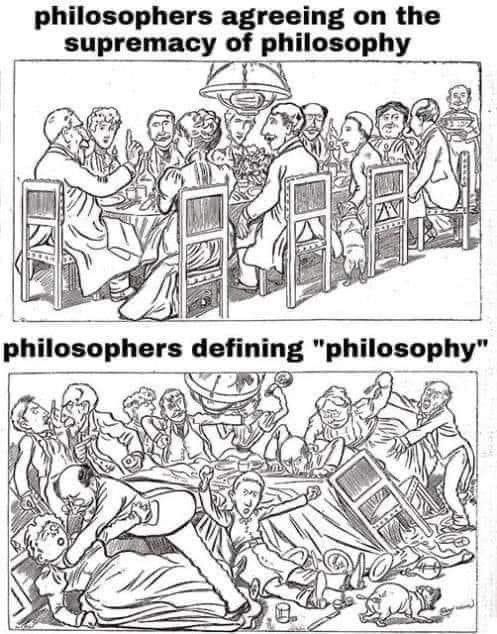
This meme contrasts the serene atmosphere of a philosophical gathering with its inherent chaos. In the first panel, philosophers are shown sitting calmly around a table, sharing an agreement that philosophy holds supreme importance. In the second panel, the scene shifts to a wild, screaming chaos where philosophers are frantically trying to define the subject, illustrating that philosophy is actually a messy, unmanageable collection of conflicting ideas rather than a simple, agreed-upon truth.
simple-description (llama3.2-vision_11b)
The meme depicts a cartoon of philosophers arguing, with the caption "Philosophers arguing about the meaning of life" above it, and "Philosophers agreeing on the meaning of life" below it. The image shows a group of philosophers in a room, with some of them shouting and gesturing, while others are calmly discussing. The text highlights the contrast between the two scenarios, implying that philosophers can't even agree on the basics of their own field.
detailed-analysis (gemma3-27b-vision)
Okay, let's break down this fascinating, and rather chaotic, image through several theoretical lenses.
Visual Description
The image is a diptych—two panels presented side-by-side. Both are rendered in a style reminiscent of historical woodcuts or etchings.
- Panel 1 ("Philosophers agreeing on the supremacy of philosophy"): Depicts a group of men (the figures appear almost exclusively male) seated around a long table. They are in varying poses of amicable discussion and agreement. There's a sense of formal order and a bright, clear space. They seem to be engaged in a civil (if intense) discourse.
- Panel 2 ("Philosophers defining 'philosophy'"): This panel shows absolute chaos. The same figures are now tumbling over each other in a brawl, a free-for-all. Books are strewn around, furniture is overturned, and it's a scene of complete disarray. There’s a sense of desperation and struggle. A small pig or boar appears near the bottom, seemingly oblivious to the violence.
The contrast between the two panels is dramatic and is key to understanding the message.
Foucauldian Genealogical Discourse Analysis
This image is ripe for a Foucauldian reading. Foucault's method of genealogy traces the historical development of concepts and practices, revealing the power/knowledge relationships embedded within them.
- Power/Knowledge: Panel 1 represents the illusion of a unified, rational discourse – a "truth" about philosophy established through agreement. This agreement, however, implicitly exercises power by defining what counts as legitimate philosophical inquiry and excluding other forms of knowledge. The very act of ‘agreeing on supremacy’ presupposes authority.
- Discursive Formation: Panel 2 explodes this illusion. It reveals the hidden struggle behind the seemingly rational consensus. The brawl signifies that “philosophy” isn’t a stable, self-evident entity. It’s constructed through conflict, negotiation, and the suppression of dissenting voices. Defining “philosophy” is not a rational process, but one where power is asserted through force.
- Archeology/Genealogy: The image suggests a genealogy of “philosophy” that exposes its origins not in pure reason, but in a battle for dominance. The initial “agreement” is a surface effect concealing a history of contestation.
- Discipline: The order in the first panel implies a disciplinary formation – a way of regulating thought and behavior – that is undermined by the chaos of the second. The violence suggests the inherent instability of any such regulation.
Critical Theory
This image strongly resonates with critical theory, particularly the Frankfurt School's critique of Enlightenment rationality.
- Dialectic of Enlightenment: The two panels can be interpreted as a visual representation of the dialectic—the tension between reason and barbarism. Panel 1 embodies the claim of Enlightenment reason – the idea that rational discourse can lead to consensus and truth. Panel 2 reveals the reality of Enlightenment reason—its tendency toward domination, violence, and the suppression of difference.
- Ideology: The first panel represents the ideological facade of philosophy – the presentation of itself as a neutral, objective pursuit of truth. The second panel exposes the underlying power dynamics that shape this facade. The brawl suggests that philosophical inquiry is not simply about "truth," but about securing and maintaining power.
- Critique of Domination: The image criticizes the ways in which philosophical discourse has historically reinforced systems of domination. The near-absence of women and people of color in the images (although subtle) might imply the exclusion of marginalized voices from the philosophical canon, reinforcing existing power structures.
Marxist Conflict Theory
The image lends itself well to a Marxist interpretation of class struggle and the pursuit of ideology.
- Class Struggle: The brawl can be read as a metaphor for class struggle, with different philosophers vying for dominance and control over the definition of "philosophy." The conflict represents a struggle for intellectual and cultural capital.
- Ideology and False Consciousness: Panel 1 represents the dominant ideology—the prevailing set of beliefs and values that legitimize the existing power structure. Panel 2 reveals the material basis of this ideology—the struggle between competing interests that underlies the seemingly rational consensus.
- Base and Superstructure: “Philosophy” itself (as represented in the panels) is a part of the superstructure, influenced by underlying material conditions (the conflict, the struggle for dominance). The brawl signifies that the superstructure is not a unified, coherent entity, but a site of constant contestation.
- Alienation: The violence and chaos can also be seen as a metaphor for the alienation inherent in capitalist society. The philosophers are caught in a relentless struggle for power, disconnected from any meaningful purpose or values.
Postmodernism
Postmodernism challenges grand narratives and embraces the instability of meaning. The image is a textbook example of postmodern themes.
- Deconstruction: The image deconstructs the very notion of a unified, coherent "philosophy." It reveals the inherent contradictions and instabilities within the discipline. The contrast between the two panels undermines the idea of a stable, objective truth.
- Relativism: The brawl suggests that there are multiple, competing interpretations of "philosophy," and that none of them is inherently superior to the others. Meaning is not fixed or absolute, but contingent and subject to interpretation.
- Rejection of Metanarratives: The image rejects the idea that "philosophy" can offer a grand, unifying explanation of the world. It embraces the fragmentation and complexity of reality.
- Simulacra and Simulation: The first panel might be seen as a simulacrum—a copy without an original—representing the empty rhetoric and superficiality of much philosophical discourse.
Queer Feminist Intersectional Analysis
This is the trickiest lens, given the limited visual cues, but a reading is possible.
- Exclusion and Marginalization: The overwhelming maleness of the figures suggests the historical exclusion of women and other marginalized groups from the philosophical canon. The brawl can be seen as a metaphor for the struggle for inclusion and recognition.
- Power Dynamics and Oppression: The violence suggests that philosophical discourse has often been used to justify and perpetuate systems of oppression. The brawl represents the struggle against these systems.
- Intersectional Struggle: While not explicitly visible, the image invites us to consider how different forms of oppression (e.g., sexism, racism, homophobia) intersect and reinforce each other within the realm of philosophical inquiry. The chaos could be seen as a manifestation of these intersecting struggles.
- Subversion and Resistance: The breakdown of order in the second panel can be interpreted as an act of resistance against the dominant power structure. The brawl represents a challenge to the established norms and hierarchies of philosophical discourse.
In conclusion, this image is remarkably rich in symbolic meaning. Through the juxtaposition of order and chaos, it offers a scathing critique of the philosophical tradition, revealing the hidden power dynamics, conflicts, and exclusions that lie beneath the surface of rational discourse. The image’s resonance is amplified by its ability to be read through a variety of critical lenses.
tesseract-ocr
philosophers agreeing on the supremacy of philosophy EIN Ae A acy ai (eh ee Pie. Di abs a | philosophers defining "philosophy" > ay, a A i | HR. EONS GAR Seen egy eee et SD SU CRUESNES \ Nee FEOF EAS.
simple-description (llama3.2-vision)
The meme is a humorous comparison between philosophers discussing the meaning of life and philosophers actually defining the concept of "philosophy". The image shows a group of philosophers engaged in a lively discussion, with one philosopher at the center of the table, passionately arguing with his colleagues. The text at the top of the image reads "Philosophers discussing the meaning of life" and at the bottom, "Philosophers defining 'philosophy'".