First Seen
2023-05-10T21:03:39+00:00
gemma3-27b-vision
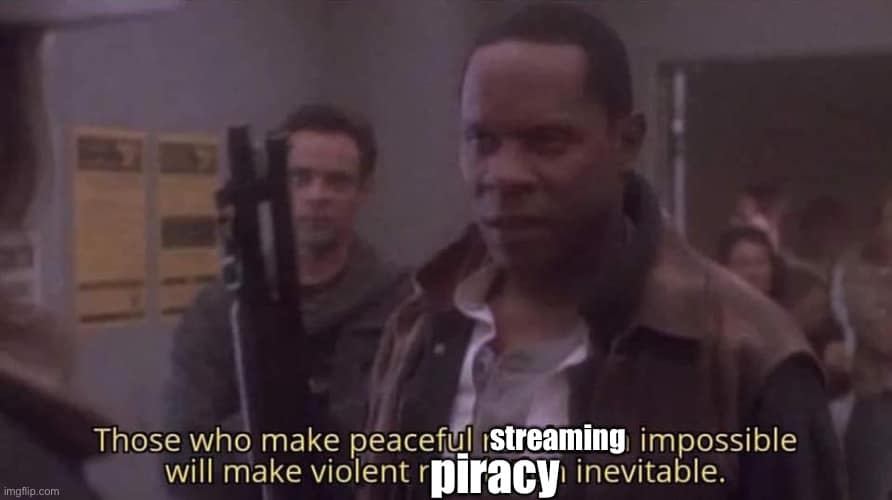
Okay, let's break down this image and its accompanying text through several theoretical lenses. **Visual Description** The image appears to be a still from a film, likely action or thriller, given the setting and the weapons visible. Two men, seemingly armed and clad in dark clothing, are positioned in a dimly lit interior, possibly a hallway or corridor. The foreground figure is close-up, his face partially shadowed, and appears to be speaking with an intense expression. Behind him is another man, also armed and with a stern look. The composition suggests tension and possibly imminent conflict. The overall aesthetic is gritty and realistic, suggesting a serious subject matter. **Foucauldian Genealogical Discourse Analysis** The text, "Those who make peaceful streaming impossible will make violent piracy inevitable," is a prime example of a *discourse* that constructs a specific power/knowledge relationship. A Foucauldian analysis would explore *how* this statement operates as a form of disciplinary power. * **Power/Knowledge:** The statement posits a direct link between the actions of those restricting "peaceful streaming" (think content providers, DRM, legal restrictions) and the emergence of "violent piracy." It doesn't simply state a fact, but *constructs* a causal relationship that frames piracy not as inherently criminal, but as a *response* to certain practices. The statement positions "streaming" as a neutral/desirable activity, and restriction of that activity as the *true* instigator of violence. * **Discipline & Biopower:** The phrase implies a form of biopower. The control of information (streaming) is an attempt to regulate access and shape behavior. Limiting streaming isn’t merely about controlling intellectual property but about controlling the flow of information and, ultimately, the actions and desires of individuals. The threat of "violent piracy" functions as a disciplinary measure, subtly warning against restricting access to content. * **Genealogy:** A genealogical analysis would trace the historical shifts in how “piracy” has been defined and understood. From early forms of copying to modern digital practices, the meaning of piracy has constantly evolved, shaped by technological developments and the changing needs of power structures. This text participates in that ongoing historical narrative. **Marxist Conflict Theory** This image and statement are ripe for a Marxist reading focusing on class struggle and the control of means of production/distribution. * **Control of Distribution:** "Streaming" represents a modern form of cultural distribution. Those controlling streaming platforms (large corporations) hold power over access to information and entertainment. The restriction of "peaceful streaming" can be seen as an attempt to maximize profit by limiting access to content, potentially creating a gap between those who can afford it and those who cannot. * **Class Conflict:** The statement frames "piracy" as a result of this control. It implies that those excluded from legitimate access (the "proletariat" of content consumers) will be forced to seek alternatives (piracy), potentially leading to a struggle against those controlling the means of distribution. The “violence” may not be literal but could represent a disruption of the existing economic order. * **Commodity Fetishism:** The focus on “streaming” and “piracy” obscures the underlying labor and economic systems that create and distribute content. It reinforces the commodification of culture, where content is valued not for its artistic or intellectual merit but for its profit potential. **Postmodernism** A postmodern reading would focus on the dismantling of grand narratives, the blurring of boundaries, and the instability of meaning. * **Deconstruction of "Piracy":** The statement challenges the traditional framing of "piracy" as purely illegal or immoral. It suggests that "piracy" is not an inherent act of wrongdoing but a response to systemic issues. This undermines the simple binary opposition of "legal" vs. "illegal" and forces a re-evaluation of the concept. * **Simulation and Hyperreality:** "Streaming" itself can be seen as a form of simulation – a mediated experience that replaces direct engagement with culture. The statement suggests that restricting this simulation can lead to even more “violent” forms of engagement (even if metaphorical). * **Loss of Authenticity:** The debate around streaming vs. piracy highlights the loss of authenticity in a digital age. What constitutes "original" content? What is the value of ownership in an era of digital reproduction? The statement implies that the search for authentic access to culture can be fraught with conflict. **Critical Theory** Critical theory, with its emphasis on social structures and power dynamics, can illuminate the statement's deeper implications. * **Ideology & Hegemony:** The statement can be read as an ideological challenge to the dominant narrative surrounding copyright and intellectual property. It questions the notion that restricting access to information is inherently just or beneficial, suggesting that it perpetuates a system of control and inequality. * **The Culture Industry:** The issue of streaming and piracy aligns with critical theory's concerns about the "culture industry" - the mass production and distribution of cultural products aimed at pacifying and controlling the population. Restrictions on streaming can be seen as a mechanism for maintaining control over this industry. * **Domination and Resistance:** The statement frames “piracy” as a form of resistance against this domination. While not necessarily endorsing illegal activity, it recognizes that restrictions on access can lead to counter-movements and challenges to the existing power structure. Let me know if you'd like me to elaborate on any of these interpretations or apply other theoretical frameworks.
tesseract-ocr
j P Those who make rexseYersyi LUCE ian) ekesssst] oc eo will make violent Metal inevitable.
llama3.2-vision
This meme is a screenshot from the TV show "The Office" where a character named Andy Bernard is being threatened by a group of men. The text overlay reads: "This is how piracy ends." However, the image has been altered to replace the word "piracy" with "streaming", implying that the threat of violence is being applied to the online streaming of movies and TV shows.