First Seen
2023-05-10T21:03:39+00:00
simple-description (llama3.2-vision_11b)
The meme is a screenshot from the TV show "Stranger Things" where a character, Steve, is talking to his friend, Robin. In the conversation, Steve says "I... uh... you... I made a new friend... Robin, I made a new friend. Her name's Robin. She likes... plants. Yeah, plants." The meme is a humorous take on the awkwardness of Steve's attempt to introduce Robin, and the absurdity of saying "I made a new friend" in such a straightforward way.
detailed-analysis (gemma3-27b-vision)
Okay, here’s an analysis of the meme, broken down by the requested theoretical lenses. I'll skip any section if it doesn't meaningfully apply.
Visual Description
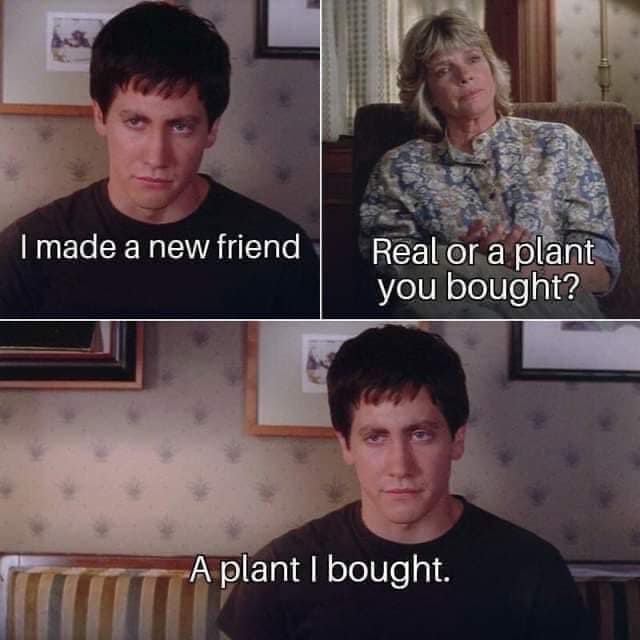
The meme is a three-panel image featuring stills from an old TV show. The first panel shows a man with dark hair, speaking directly to the camera with a somewhat earnest expression. Text overlay reads, “I made a new friend.” The second panel shows a woman with blonde hair, also looking directly at the camera with a questioning and suspicious expression. The text reads, “Real or a plant you bought?” The third panel returns to the man, who looks even more stoic and defeated. The text reads, “A plant I bought.” The setting appears to be a fairly traditional, possibly middle-class interior, with floral wallpaper and framed artwork. The color palette is warm, but somewhat muted. The visual emphasis is on facial expressions and the dialogue.
Foucauldian Genealogical Discourse Analysis
This meme can be analyzed through a Foucauldian lens by examining the discourse surrounding relationships, authenticity, and control. The woman’s question (“Real or a plant you bought?”) isn't simply about botany; it's about the exercise of power through knowledge. She's demanding proof of authenticity in a relationship. This points to a historical development in how we understand "friendship" and "authenticity" as being subject to verification and potential suspicion.
- Power/Knowledge: The woman’s question is an attempt to establish power by demanding justification for the man’s claim. It highlights the idea that relationships aren't simply experienced; they are scrutinized, categorized, and assessed.
- Discipline: The meme's humor comes from the expectation that relationships should be spontaneous and organic. The woman's question is a disciplinary measure, forcing the man to account for his social connections.
- Genealogy: One could trace the genealogy of this suspicion. The increasing commodification of relationships in modern life (dating apps, social media “connections”) might contribute to a sense that human connections are easily fabricated or bought. We've moved from relationships built on shared lived experience to relationships that are often mediated by markets and technology.
- Truth Regime: The meme implicitly questions the very idea of "genuine" friendship. The man’s defeated reply shows the absurdity of having to prove a friendship’s authenticity. It speaks to a truth regime where connections are inherently suspect and require justification.
Critical Theory
From a Critical Theory perspective, the meme exposes the alienation and cynicism inherent in modern social relationships.
- Commodification of Relationships: The question "Real or a plant you bought?" speaks to the broader trend of commodifying social interaction. Relationships are treated as a possession or something that can be purchased or curated. The joke hinges on the idea that relationships can be simulated, mirroring the superficiality of consumer culture.
- Loss of Authenticity: The man's admission ("A plant I bought") is a cynical acknowledgement of the loss of authenticity in relationships. It suggests that genuine connection is becoming increasingly rare and that people are becoming accustomed to superficial interactions.
- Domination & Control: The woman’s question exerts a form of social control over the man. She's positioning herself as the judge of his relationships and demanding that he meet her standards of authenticity. This reflects the broader power dynamics that exist in social life.
- Ideology: The meme implicitly critiques the ideology that equates social success with the accumulation of "friends." The humor arises from the absurdity of having to "prove" a friendship, revealing the underlying assumptions about how relationships should be formed and maintained.
Postmodernism
The meme fits well with a Postmodern reading because it playfully deconstructs the notion of authenticity and genuine connection.
- Simulacra and Simulation: The “plant” metaphor points towards the idea of simulacra – copies without originals. The friendship isn't "real" in a traditional sense; it's a manufactured imitation. This is central to Baudrillard's theories of postmodernity, where simulations have replaced reality.
- Deconstruction of Meaning: The meme destabilizes the conventional meaning of "friendship." It challenges the idea that relationships must be based on genuine emotional connection. The humor arises from the unexpected twist – the man admitting his friendship is a deliberate purchase.
- Irony and Meta-Commentary: The meme is inherently ironic and self-aware. It acknowledges the superficiality of modern relationships and playfully mocks the expectation of authenticity. It’s a meta-commentary on the way we construct and perform relationships in a consumerist culture.
- Loss of Grand Narratives: There's a sense of skepticism and lack of faith in grand narratives about human connection. The meme doesn't offer any hope for genuine connection; it simply acknowledges the prevalence of superficiality.
Please Note: The other lenses (Marxist Conflict Theory and Queer Feminist Intersectional Analysis) don’t quite fit as strongly with this meme, as it's primarily focused on the dynamics of interpersonal relationships and the construction of authenticity, rather than explicitly addressing issues of class or gender/sexual identity. While those analyses could be stretched to fit, they would feel forced and less insightful.
Let me know if you would like me to elaborate on any of these analyses or explore other theoretical perspectives!
simple-description (llama3.2-vision)
This meme is a screenshot from the 2008 comedy film "Forgetting Sarah Marshall". The image shows a character, played by Jason Segel, having a conversation with a woman who is a spiritual healer. In the conversation, the woman asks if the man is a spiritual person, and he responds with a humorous and awkward answer.
tesseract-ocr
aa oN =| oy > ea a = > ae eee most Meet 3 |madeanewfriend | Realora plant you bought? = | | “= “ vs . on (i -A ea | bought. oe i