First Seen
2023-05-10T21:03:39+00:00
simple-description (llama3.2-vision_11b)
The meme shows a person looking at plants and thinking they are similar to humans, with the caption "I see what my plants are doing". The image is humorous because it's a play on the idea that humans are often self-aware and have thoughts about their own actions, but plants are not capable of self-awareness.
detailed-analysis (gemma3-27b-vision)
Okay, here's an analysis of the meme, broken down into sections based on the theoretical frameworks you requested. Not all will apply, as some are more relevant than others for this particular image and its implied context.
Visual Description
The meme is a two-panel comparison.
-
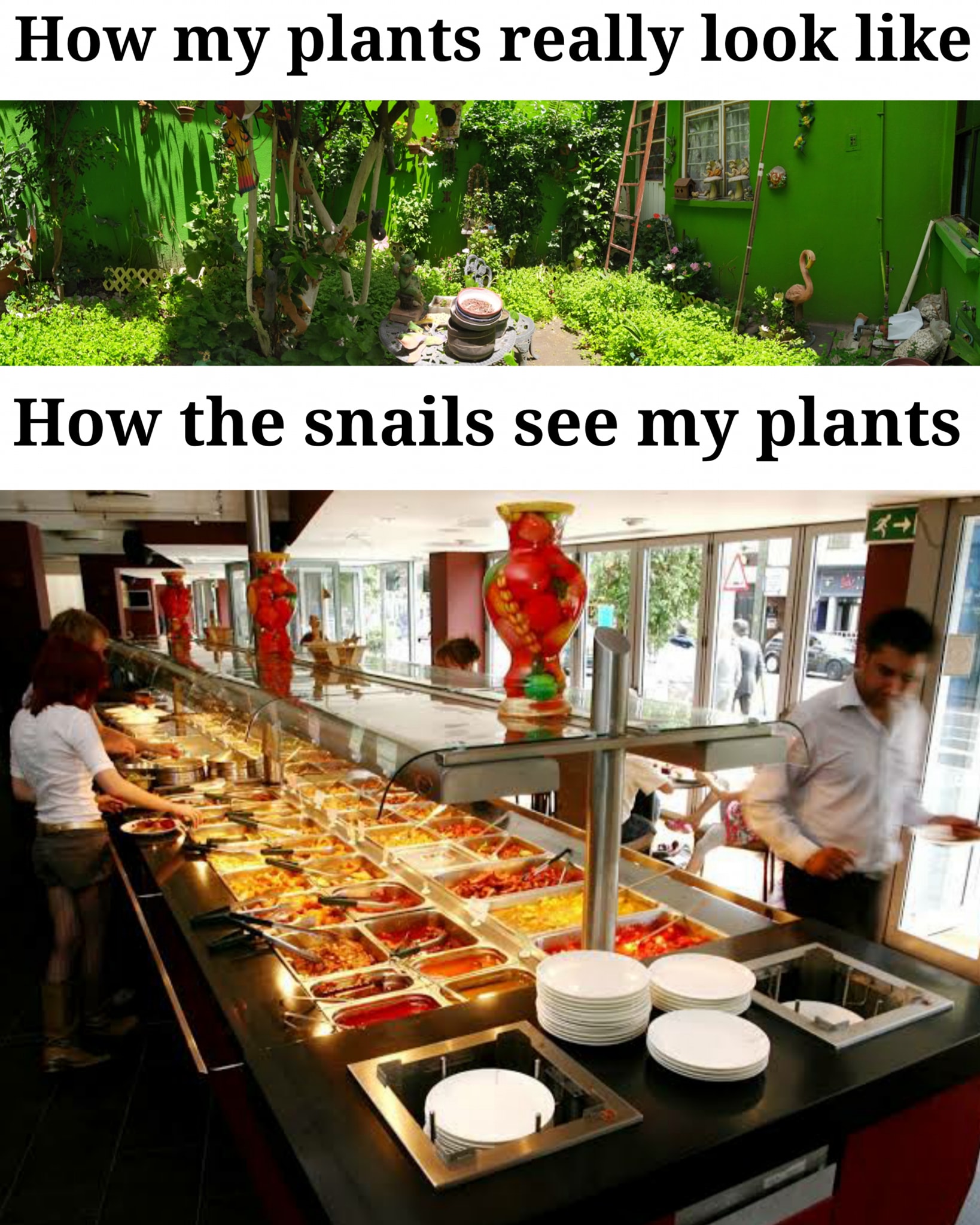
Top Panel: Shows a lush, overgrown garden. There’s a variety of green foliage, including plants with large leaves, some climbing up a structure. There's a decorative, possibly terracotta, pot in the center, and a ladder leaning against a wall. It represents the gardener's subjective view of their garden as abundant and natural.
-
Bottom Panel: Displays a Chinese buffet. There are long rows of food containers filled with various dishes. People are seen taking food and the scene is bright, artificially lit, and appears very crowded and organized for consumption. The image suggests an endless abundance, but one that is organized and presented for direct consumption.
The meme's humor stems from the ironic juxtaposition of these two images. The gardener views their garden as a natural, somewhat wild, and potentially abundant space. The snails, however, perceive it as an all-you-can-eat buffet.
Marxist Conflict Theory
This is perhaps the most directly applicable framework to interpret the meme.
- Class Relations & Exploitation: The meme subtly exposes a conflict between species, or "classes" in a metaphorical sense. The gardener invests labor (time, resources, care) in producing the “wealth” (the plants). The snails, representing the consuming "class," exploit this labor by simply taking the produced wealth (eating the plants) without contributing to its creation. The gardener’s view of a beautiful garden contrasts sharply with the snails' perception of it as a readily available resource for their own survival.
- Means of Production: The garden represents the “means of production” - the resources and labor used to create a “product” (the flourishing plants). The snails operate as a parasitic force, appropriating the products without participating in the production process.
- Alienation: The gardener might experience alienation when they see their careful work being decimated by snails. Their relationship to their garden shifts from one of nurturing care to one of constant struggle against consumption.
Critical Theory
This theory can add another layer to the analysis:
- Domination and Resistance: The gardener attempts to exert control over the natural world (the garden), but the snails represent a resistance to this control. They subvert the gardener's intentions and pursue their own needs.
- Deconstruction of “Nature”: The meme challenges the romanticized notion of “nature” as pristine and untouched. It exposes the garden as a site of conflict and consumption, blurring the boundaries between “natural” and “artificial”. The gardener’s effort to create a natural setting is undermined by the snails' purely utilitarian view of it.
Postmodernism
This theory can be applied more subtly:
- Rejection of Grand Narratives: The meme playfully rejects the grand narrative of “nature” as a harmonious, self-regulating system. It highlights the fragmented, conflicting, and subjective nature of reality. What constitutes a “garden” is dependent on the observer’s point of view.
- Simulacra and Simulation: The garden, as perceived by the snails, can be seen as a simulation of abundance. It appears as a boundless source of food, but this is a constructed perception based on their limited perspective.
- Irony and Parody: The core of the meme’s humor is based on irony – the contrast between the gardener's idealized vision and the snails' pragmatic one. This playful use of irony aligns with postmodern sensibilities.
Foucauldian Genealogical Discourse Analysis
This theory is more tangential but can offer some insight.
- Power/Knowledge: The gardener’s knowledge of horticulture grants them a certain power over the garden, allowing them to shape and control it. The snails, however, possess a different kind of knowledge – an instinctive understanding of how to find and consume resources. This creates a power struggle based on differing modes of knowledge.
- Discipline and Control: The gardener attempts to “discipline” the garden through pruning, weeding, and pest control. The snails, in their constant consumption, resist this discipline and assert their own agency.
- Genealogy of “Gardening”: A genealogical analysis could trace the historical development of gardening practices and reveal how these practices have been shaped by power relations and social norms. The meme hints at the inherent conflict between human attempts to control nature and the natural world’s tendency to resist this control.
Queer Feminist Intersectional Analysis
This theory is arguably the least applicable here, as the meme doesn’t inherently address issues of gender, sexuality, or intersectionality. However, a stretch could be made:
- Challenging Traditional Narratives of “Care”: The gardener’s act of cultivating a garden can be seen as a traditionally feminized form of care. The snails, in their consumption, disrupt this “careful” order and assert their own needs without regard for the gardener’s intentions. This could be read as a subversion of traditional caregiving roles.
- Agency of Non-Human Entities: By giving the snails a specific viewpoint and agency (they "see" the garden as a buffet), the meme challenges anthropocentric perspectives and acknowledges the autonomy of non-human entities.
Let me know if you'd like me to elaborate on any of these points or explore other theoretical frameworks!
simple-description (llama3.2-vision)
The meme is a humorous comparison between how plants are perceived by humans and how they are perceived by small insects, specifically snails. The top image shows a beautifully manicured garden with a caption "How my plants look". The bottom image shows a messy, overgrown garden with a caption "How my plants look to snails".
tesseract-ocr
How my plants really look like a | WR OR YEE es ie ah a am te a Dy a a ™ | | ; How the snails see my plants mee: Tees: oll eee mae) y/o in | es a] aaa See ee — aa —— SE SS a fe 0) Pr A | <<} a a = 4 = . _ : , ee > ae, | eS | S a = = ea \e - —