First Seen
2023-05-10T21:03:39+00:00
simple-description (llama3.2-vision_11b)
The meme is an image of a child's drawing of a powerful aura, which is a concept from the popular manga and anime series "Naruto". The drawing depicts a swirling, colorful aura surrounding the child's head, with a caption "I can feel the aura" written in childish handwriting.
detailed-analysis (gemma3-27b-vision)
Okay, here's a breakdown of the image, using the requested analytical frameworks where relevant. It's important to note that applying complex theoretical lenses to a single image can be speculative. I'll aim to be thorough and reasoned, pointing out how a framework could be brought to bear.
Please be aware this image depicts a potentially disturbing scene involving a child and a mannequin. The analysis will remain objective and academic, but the subject matter is sensitive.
1. Visual Description
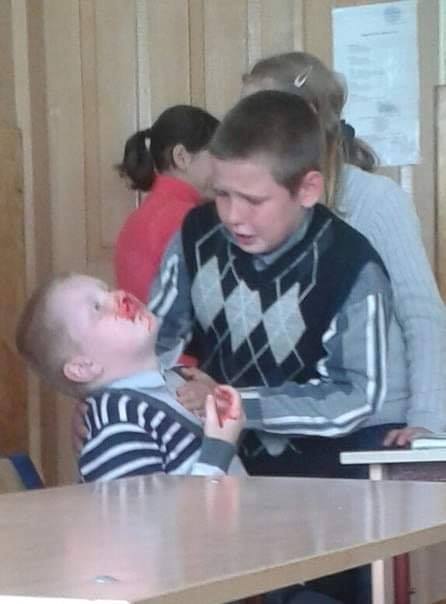
The image shows a young boy (likely pre-teen) holding a realistic-looking baby doll/mannequin head in his hands. The mannequin head is disproportionately large compared to the boy’s body. It appears he is attempting to feed the head. His expression is one of intense concentration or perhaps distress. There's some visible staining around the mannequin's mouth which could be interpreted as “blood,” though its source is uncertain.
Behind the boy, there are two other girls. One is partially visible in the background, and the other is standing immediately behind him, appearing to observe. The background is a wall with what appears to be paneling. There is a table (likely a classroom desk) in front of the boy, partially visible. The lighting is somewhat dim and the image quality is low, giving it a slightly grainy, unpolished feel. The boy is wearing a sweater vest over a striped shirt.
2. Foucauldian Genealogical Discourse Analysis
Applying a Foucauldian lens, we can analyze the discourses shaping the boy's actions and the context.
- Discourse of Childhood & Play: Historically, "play" has been defined and regulated. The idea of childhood and appropriate play has evolved. This image could be seen as a disruption of that idealized "play," revealing underlying power dynamics. What constitutes "acceptable" play is constantly constructed and reinforced through social norms, and the boy’s actions deviate from that expectation.
- Discourse of the Body/Anatomy: The mannequin, being a realistic representation of a baby’s head, taps into discourses of the body, reproduction, and care. The staining around the mouth is particularly relevant. Is it simply paint? Does it evoke discourses of injury, violence, or trauma?
- Power/Knowledge: Foucault emphasized how power and knowledge are intertwined. The boy's act, even if simply play, draws on knowledge about babies, caregiving, and physical bodies. The other girls observing potentially represent a form of social control – assessing the "appropriateness" of his behavior.
- Genealogy of Care: A genealogical approach might trace the history of "care" practices. How have societal expectations around nurturing and the representation of infants evolved? Does the image challenge or reinforce those historical norms?
3. Critical Theory
Critical Theory, generally concerned with challenging dominant ideologies and power structures, could interpret this image as follows:
- Deconstruction of the "Ideal" Child: The image disrupts the idealized image of the innocent, carefree child. It forces us to question what we expect children to do and how we categorize their behaviors.
- Alienation: If we read the mannequin as representing a symbolic object, the boy’s interaction with it could be interpreted as a form of alienation – a disconnect from authentic experience. The object (mannequin) stands in for a real relationship.
- The Spectacle: The presence of the other girls observing could be seen as creating a "spectacle" – a performance for an audience. This highlights how behaviors can be shaped by the gaze of others and the desire for recognition.
- Critique of Representation: The mannequin head is a representation. Critical theory would question how that representation shapes perceptions of babies and caregiving.
4. Marxist Conflict Theory
While less directly applicable, a Marxist lens could be used to analyze the social and economic context of the image:
- Material Conditions & Play: The availability of the mannequin head, its quality, and the setting (likely a school or community center) reflect material conditions. The fact that the boy is using a mannequin rather than, for example, a real doll, might say something about access to resources.
- Socialization & Ideology: The boy’s behavior could be viewed as a form of socialization, where he is learning and internalizing societal norms about gender roles, caregiving, and acceptable behavior. This socialization serves to perpetuate the dominant ideology.
- Reproduction of Labor: Caregiving, traditionally associated with women, is a form of “reproductive labor” that is essential for the continuation of society. The boy's play with the mannequin could be seen as an early exposure to this role.
5. Queer Feminist Intersectional Analysis
This framework is potentially insightful, given the themes of care, bodies, and gender:
- Disruption of Gender Norms: While the act of "feeding" a baby is typically associated with femininity, the boy performing this act disrupts traditional gender roles.
- The Body as a Site of Power: The mannequin head becomes a site of power, representing both vulnerability and control. The boy’s interaction with it is infused with this dynamic.
- Intersectional Lens: Consider the intersection of gender, age, and class. The boy's socioeconomic background might influence his access to toys and the types of play he engages in.
- Care and Labor: Feminist theory often highlights the undervalued nature of care work. The boy's "care" for the mannequin, even in this unusual context, can be viewed as a symbolic representation of this labor.
Important Considerations:
- Context is Crucial: Without knowing the full context of the image (where it was taken, what was happening before/after, the boy’s background), interpretations are speculative.
- Multiple Interpretations: These analytical frameworks are tools for exploring possibilities, not for arriving at a single “correct” answer.
- Ethical Considerations: As mentioned earlier, it’s important to approach this image with sensitivity, recognizing that it depicts a child.
I hope this detailed analysis is helpful. Let me know if you'd like me to elaborate on any of these points.
simple-description (llama3.2-vision)
The meme is a picture of a toddler screaming and flailing on the floor, with a caption that reads "When you finally understand the economy". The image is a humorous representation of the frustration and overwhelm that can come with understanding complex financial concepts.
tesseract-ocr
ey ee —