First Seen
2023-05-10T21:03:39+00:00
simple-description (llama3.2-vision_11b)
The meme features a picture of a large, fluffy pig with a confident and powerful aura, surrounded by a crowd of people who are seemingly intimidated by its presence. The text "I can smell the desperation" appears above the pig, implying that the pig's aura is so strong that it's making the people around it feel anxious and uncertain. The meme is likely being used to describe a situation where someone is feeling confident and powerful, but others are feeling intimidated or threatened by their presence.
detailed-analysis (gemma3-27b-vision)
Okay, let's break down this historical photograph with several analytical lenses.
Visual Description
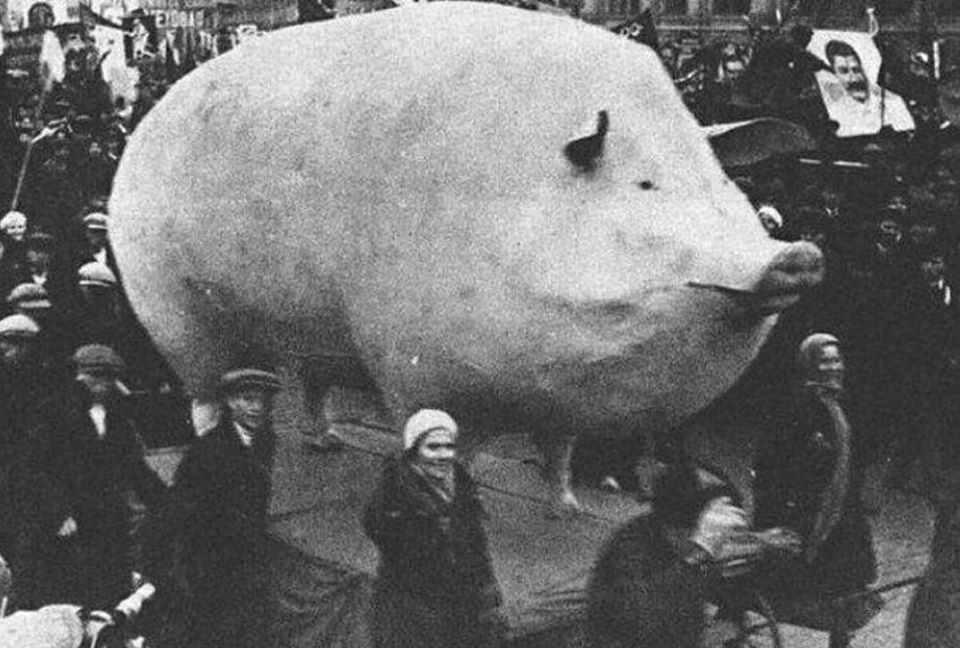
The photograph is a black and white image capturing a street scene from a likely protest or parade. The dominant feature is a massive, papier-mâché pig head being carried through a crowd of people. The pig’s head is oversized and cartoonishly rendered, possessing exaggerated features like a large snout and small, beady eyes. It’s carried by a group of people whose heads and shoulders are visible beneath the structure.
The crowd itself appears to be composed of a variety of individuals, most wearing hats and coats, suggesting a colder climate or period setting. Their faces are largely obscured or blurred, contributing to a sense of collective anonymity. A banner or portrait of a person can be seen in the background, indicating the presence of a specific cause or figure being referenced. The overall impression is one of collective action, possibly satirical or critical in nature. The image has a historical feel, potentially dating from the early to mid-20th century.
Foucauldian Genealogical Discourse Analysis
Michel Foucault’s genealogical approach examines how concepts and power structures arise from specific historical contexts. In this photograph, the pig image is not simply an animal representation, but a discursive element steeped in historical meaning.
- The Pig as Discourse: Historically, pigs have been associated with gluttony, greed, and often, with derogatory labels applied to specific groups or individuals. Examining the historical context of the image's creation is crucial – who was being demonized or satirized at that time? What discourses (ways of talking about a subject) did the pig head evoke?
- Power Relations: The act of carrying this oversized pig head performs power. It's a visual assertion of collective critique. Who holds the power to define "the pig," and what is being challenged by turning this symbol on its head?
- Archaeology of Knowledge: The image suggests a rupture or disruption of established norms. By making the symbol of "the pig" visible and public, the protesters are challenging existing power structures and revealing the discourses that maintain them. The genealogy would trace the historical evolution of this symbolism and how it shifted over time.
Marxist Conflict Theory
This image powerfully lends itself to a Marxist interpretation.
- Class Struggle: The pig, as a symbol of gluttony and excess, can be seen as representing the ruling class or those who exploit others. The act of carrying this symbol through the streets becomes a visible demonstration of class antagonism.
- Ideology & False Consciousness: The image can be read as a rejection of the dominant ideology. The pig head challenges the narrative of societal values, and reveals the exploitative nature of the elite.
- Proletarian Resistance: The crowd, anonymous yet united in carrying the pig head, symbolizes the collective power of the working class. It is a visual representation of resistance against oppressive forces.
- Critique of Capitalism: The exaggerated features of the pig head could be a satirical critique of capitalist greed and the accumulation of wealth by a select few at the expense of others.
Critical Theory
Drawing from the Frankfurt School’s Critical Theory, the image can be understood as a form of counter-culture resisting the “culture industry” and its attempts to create conformity.
- Critique of Domination: The image challenges the status quo and exposes the underlying power dynamics that maintain social control.
- Enlightenment & Rationality: The image can be seen as a rejection of the Enlightenment's emphasis on reason, highlighting the irrationality and injustices of existing systems. The satire and exaggeration of the pig’s head suggest a critique of abstract ideologies.
- Mass Culture: The act of public display, the oversized nature of the pig, and the collective participation all signal a desire to disrupt the passive consumption of mass culture and actively create a counter-narrative.
- De-reification: By making the "pig" visible and symbolic, the protesters are challenging its reification – treating it as a natural or inevitable feature of society.
Postmodernism
The image can be approached through a postmodern lens by emphasizing the deconstruction of meaning and the rejection of grand narratives.
- Intertextuality & Simulacra: The pig head is not simply a representation of an animal, but a signifier loaded with cultural meaning. It draws on multiple texts and associations, creating a play of simulacra (copies without originals).
- Deconstruction of Symbolism: Postmodernism emphasizes the instability of meaning. The image invites a questioning of what “the pig” actually represents, challenging any fixed or universal interpretation.
- Rejection of Metanarratives: The image rejects grand narratives or overarching explanations of history and society. It is a localized act of resistance that refuses to be incorporated into a larger ideological framework.
- Playfulness and Irony: The exaggeration of the pig’s features suggests a playful and ironic tone, rejecting the seriousness and authority of traditional forms of protest.
It's important to remember that these interpretations are not mutually exclusive. The photograph is rich in meaning, and can be analyzed from multiple perspectives. The specific context in which the image was created is critical for a deeper understanding.
simple-description (llama3.2-vision)
The meme is a picture of a pig in a tutu, dancing on its hind legs. The image is captioned "When you have to go outside for a walk but you really don't want to".
tesseract-ocr
wee ae _ RGR Renting " aay > vat oe po ie nN @¢ : te j fs e >. Saar eS i = a3 i x a ; ‘ ef , ii Re eee a F ee Sian aoa? < <a 4 a a CMe a i “2 i a -— i “ae a Pie ‘fae EN 8 “Sa: gs TENN y “ has . oe a . od / x ; “ .. ard 4 4 : SP et PS by are al wh i a os it ae