First Seen
2023-05-10T21:03:39+00:00
simple-description (llama3.2-vision_11b)
The meme depicts a character from the anime "Attack on Titan" ( Levi ) reacting to a massive explosion of a powerful aura, which is a supernatural energy that can be used for combat or other purposes. The image shows Levi looking shocked and overwhelmed, with a caption that reads "when you're trying to have a quiet morning but the aura is just TOO MUCH". The meme is a humorous take on the idea of being overwhelmed by a powerful aura, and the image is likely to resonate with fans of the anime.
detailed-analysis (gemma3-27b-vision)
Okay, here's an analysis of the image, broken down into the requested theoretical sections, with caveats about appropriateness where concepts don't fully apply. I will indicate where a section feels forced or doesn’t have a strong basis within the image's content.
Visual Description
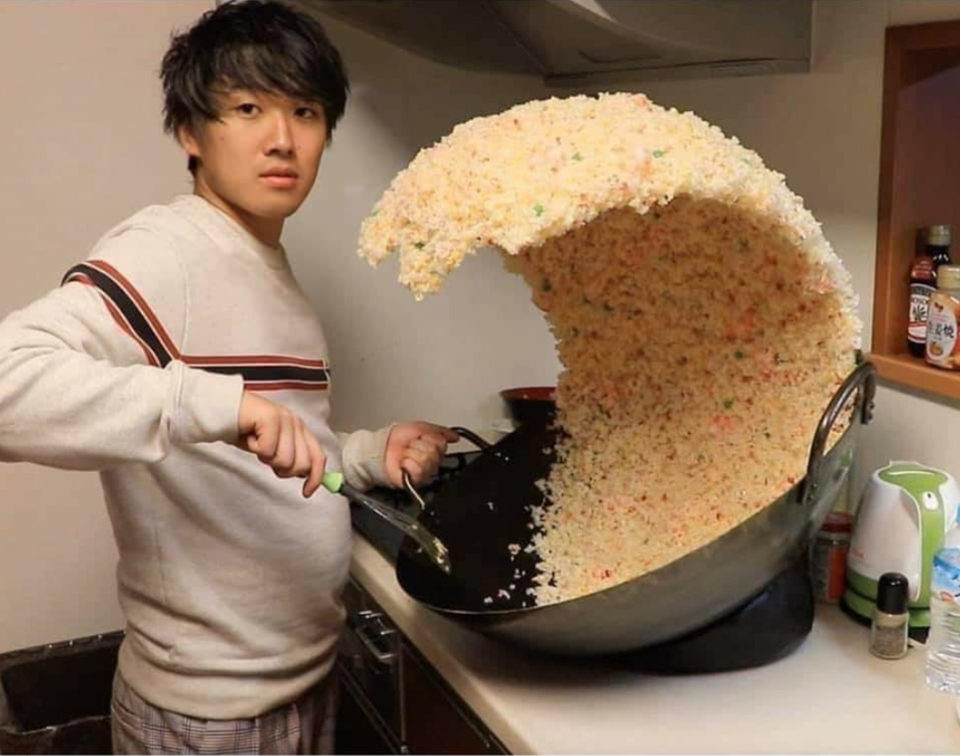
The image depicts a man standing in a kitchen, apparently in the act of cooking. He’s wearing a casual outfit – a white and red striped sweater with patterned pajama pants. He's positioned over a very large wok on a stovetop. The wok contains food that is aggressively erupting upwards like a wave, almost filling the entire frame. The food appears to be a fried rice dish. The expression on the man's face is relatively neutral, almost stoic, despite the overwhelming volume of food. The background shows a typical kitchen environment with shelving and various items. The lighting appears to be artificial and slightly harsh, and the image seems to be digitally manipulated to accentuate the height and size of the "food wave."
Foucauldian Genealogical Discourse Analysis
This image lends itself to a Foucauldian analysis by looking at the discourse surrounding "home cooking" and masculinity. The act of cooking, historically, has been coded as 'feminine' work. The man’s engagement in cooking appears simple, however, the sheer scale of this act is where the power dynamics emerge. The overflowing wok isn’t just cooking; it’s a performance of competence.
- Genealogy: We can trace the history of food preparation from necessity to a signifier of care, domesticity, and social status. In contemporary Western society, the "domestic male" is increasingly seen as a progressive figure. However, this is built upon (and potentially reinforces) a historical framework where cooking was considered outside the realm of “proper” masculinity.
- Power/Knowledge: The image suggests a playful subversion of this power dynamic. The man is not simply cooking; he is dominating the culinary process. The overflowing food becomes a display of skill and control. The scale exaggerates this display.
- Disciplinary Practices: While not directly shown, one could argue the image subtly participates in the discourse of "male culinary prowess," potentially establishing standards or expectations around male cooking skills (or, in this case, exceeding them).
Critical Theory
This image presents an opportunity to explore themes of control, excess, and the human relationship with production and consumption, aligning well with Critical Theory.
- Domination and Control: The sheer volume of food can be viewed as a metaphor for the pressures of modern production and consumption. The man, ostensibly in control of the cooking process, is seemingly overwhelmed by the result. The image subtly portrays the paradox of seeking control through labor, only to be consumed by it.
- Alienation: Despite the act of creation, the excessiveness of the food could be interpreted as a symbol of alienation. Is this meal meant for nourishment, or simply for display? The disconnect between the effort and the potential utility of the food highlights the potential for labor to become detached from its purpose.
- Commodification: The fried rice, as a commodity, represents the process of turning sustenance into an object of exchange. The image can prompt questions about the role of food in capitalist systems and the ways in which our relationship to food is mediated by economic forces.
Marxist Conflict Theory
While a stretch, we can apply Marxist lenses to the image. The production of the fried rice, even at this absurd level, represents labor.
- Means of Production: The wok, stovetop, ingredients, and the man’s skills constitute the means of production.
- Labor: The man’s effort in cooking is the labor.
- Surplus Value: The massive amount of fried rice produced beyond any reasonable consumption level can be interpreted as “surplus value.” This surplus isn’t consumed, but simply exists, potentially symbolizing the inherent wastefulness of capitalist production.
- Class Conflict: In a broader sense, the image could be seen as a playful critique of excess in a society marked by inequality, where some have an abundance of food while others struggle to meet their basic needs.
Postmodernism
The image is strongly postmodern in its self-aware absurdity and embrace of hyperreality.
- Pastiche & Hyperreality: The image is a clear example of exaggeration for effect. The scale of the fried rice is beyond anything realistic, creating a hyperreal spectacle. It's not about cooking; it's about the idea of cooking, amplified to an absurd degree.
- Deconstruction of Norms: The image disrupts our expectations of a typical cooking scene. It deconstructs the idea that cooking should be a contained, manageable activity.
- Playfulness & Irony: There’s a sense of irony and playfulness in the image. It doesn't take itself seriously, and it seems to revel in its own absurdity.
- Simulation: The image is a simulation of cooking that surpasses the real, creating a spectacle that is divorced from the practical purpose of food preparation.
Queer Feminist Intersectional Analysis
This analysis is the most challenging to apply, given the image doesn't explicitly address issues of gender, sexuality, or intersectionality. However, we can make some nuanced connections.
- Subversion of Gender Roles: While subtle, the image challenges traditional gender roles by presenting a man engaged in a traditionally “feminine” activity. However, it does so in a way that emphasizes power and domination, which may reinforce patriarchal norms. The extreme scale could be a performance of masculine "ability" to master even traditionally feminine tasks.
- Challenging Domesticity: The image subverts the idealized notion of domesticity by presenting a chaotic and overwhelming kitchen scene. This can be interpreted as a rejection of the pressure on women to maintain a perfect home.
- Critique of Performative Masculinity: The exaggerated display of cooking skill could be seen as a critique of performative masculinity - a need to prove competence and mastery, even in non-traditional spheres.
Important Note: These interpretations are, of course, subjective and open to debate. The image’s meaning depends on the viewer’s own background and perspective. Some analyses stretch the applicability of these theories; they are included to demonstrate how various frameworks could be applied, even in a somewhat forced manner.
simple-description (llama3.2-vision)
The meme is an image of a person who is clearly overwhelmed by a massive pile of rice. The text "I can smell the desperation" appears on the image, implying that the person is struggling to cope with the sheer amount of food in front of them. The image is humorous because it's an exaggerated and absurd situation, and the text adds to the comedic effect.
tesseract-ocr
~*~ a3 aw Sa. —— \\ Rar se ey \__} ae : — ae! CO ; a