First Seen
2023-05-10T21:03:39+00:00
simple-description (llama3.2-vision_11b)
The meme is an image of a person in a Winnie the Pooh costume, holding a sign that says "I am not a doctor" in a bold, cartoonish font. The image is captioned with a humorous quote from a popular internet meme, "I can smell the desperation" from the perspective of a powerful aura, implying that the person is trying to cover up their lack of medical expertise with a silly costume.
detailed-analysis (gemma3-27b-vision)
Okay, here's an analysis of the image, broken down into sections as requested. I'll focus on the sections that most clearly apply given the image's content and the theoretical frameworks, and explain why some might not be as relevant.
Image Description
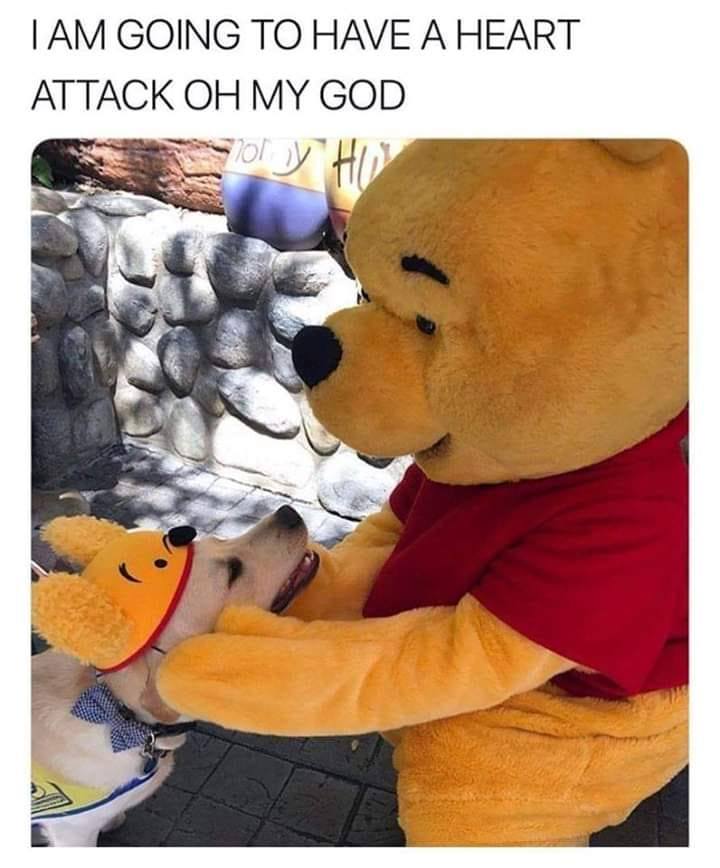
The image is a digitally manipulated combination of two very different visual sources. On the left, a young boy, dressed in athletic wear and a baseball cap, is embracing several stuffed animals. The scene appears to be indoors, with a patterned floor. On the right, layered over the boy, is a large, extremely distressed and muscular Winnie-the-Pooh bear in a similar embrace. The Pooh bear’s muscles are very pronounced, seemingly Photoshopped onto the original bear form, and his expression is far from the traditionally gentle and sweet demeanor associated with the character. He appears anguished or angry. The image is black and white, except for the stuffed animals which appear in a faded color. A caption above the image reads: “I AM GOING TO HAVE A HEART ATTACK OH MY GOD.” The image is clearly meant to be unsettling and humorous through its contrast.
Foucauldian Genealogical Discourse Analysis
This image is ripe for a Foucauldian analysis. It's not simply about the image itself, but the discourse around childhood, nostalgia, and the very idea of "innocence" that it disrupts.
- Disrupting the Norm: The traditional Winnie-the-Pooh is a symbol of childhood comfort, innocence, and gentleness. This image radically disrupts that norm. The hyper-masculinized, distressed Pooh represents a break from this established expectation. Foucault would be interested in how this disruption challenges the historical construction of "childhood" as a time of pure innocence.
- Power/Knowledge: The image can be seen as a commentary on the ways in which our perceptions of childhood are shaped by power dynamics. The "gentle" Pooh is a cultural construction, serving the purpose of reinforcing certain societal expectations. This hyper-masculine version reveals the artificiality of that construction and the power structures underpinning it. What is the purpose of the innocent, cuddly Winnie-the-Pooh? Who benefits from this image?
- Genealogy of Masculinity: The image's juxtaposition of the child and hyper-masculinized bear could be read as a genealogy of masculinity. The child is in the process of becoming, and the image poses the question of what he is becoming. Is he becoming a representation of the hyper-masculine figure of the bear, imposed upon him?
Critical Theory
This image powerfully utilizes juxtaposition and imagery to engage with aspects of Critical Theory.
- Commodification and Disney: Winnie-the-Pooh is a heavily commodified character, owned by Disney. Critical theory, specifically around the Frankfurt School, questions the impact of culture industries on society. This image can be seen as a form of counter-culture, subverting the "harmless" Disney image and highlighting the manufactured nature of nostalgia and "comfort." The image mocks the commercial appeal of a childhood symbol.
- Alienation: The distressed Pooh can be interpreted as a metaphor for the alienation experienced in modern society. The character, stripped of its traditionally comforting qualities, represents a loss of innocence and a sense of disconnection.
- Social Conditioning: The image suggests a commentary on the pressures and expectations placed on young boys in particular. The juxtaposed muscular bear can be seen as a representation of the restrictive and often damaging ideals of masculinity that are imposed on them from an early age.
Marxist Conflict Theory
While not the primary focus, some Marxist interpretation is possible.
- Commodification of Childhood: As mentioned in Critical Theory, the image's use of a Disney-owned character speaks to the commodification of childhood and the role of capitalist culture in shaping our experiences.
- Power Dynamics: The imposition of the muscular bear onto the child's embrace could be read as a metaphor for the ways in which dominant ideologies (in this case, ideals of masculinity) are "imposed" on individuals. The child's agency is obscured by this figure.
- Class and Nostalgia: Nostalgia itself can be seen as a tool used to perpetuate existing power structures. By associating childhood with a "simpler" time, the image can subtly reinforce the status quo. However, this image disrupts that nostalgic narrative.
Postmodernism
This image strongly aligns with postmodern sensibilities.
- Pastiche & Juxtaposition: The core of the image is the jarring juxtaposition of two very different visual styles and contexts. This is a key feature of postmodern art.
- Deconstruction: The image "deconstructs" the traditionally comforting image of Winnie-the-Pooh, stripping away its innocent facade and revealing the artificiality of its construction.
- Irony & Parody: The image is clearly ironic and parodic. It's taking a familiar icon and subverting its meaning, creating a sense of unease and disorientation.
- Loss of Grand Narratives: The image rejects the idea of a single, cohesive narrative of childhood or innocence. Instead, it presents a fragmented, contradictory, and unsettling vision.
Queer Feminist Intersectional Analysis
This analysis is less directly applicable but still worth considering.
- Challenging Gender Roles: The hyper-masculinization of Pooh can be read as a critique of rigid gender roles. It disrupts the expectation that childhood characters should be "soft" and "feminine."
- Intersection of Childhood and Masculinity: The image plays with the intersection of childhood and masculinity, suggesting that the process of becoming a man is often fraught with pressure and expectation.
- Power Dynamics in Embrace: The embrace itself is interesting from a feminist perspective. Who has the power in the embrace? Is the child being "dominated" by the hyper-masculine bear? (Although, it's worth noting that applying this dynamic could be a stretch).
- Subversion of Sentimental Imagery: The image subverts sentimental imagery that is traditionally associated with motherhood, nurturing, and gentle affection.
In Conclusion:
This image is rich in potential for analysis. It works best through the lenses of Postmodernism, Foucauldian Discourse, and Critical Theory, as it directly engages with issues of representation, power, and the construction of meaning. While other frameworks can be applied, they are less central to the image's core message. The image is, at its heart, a disruptive and unsettling commentary on childhood, nostalgia, and the forces that shape our perceptions of the world.
simple-description (llama3.2-vision)
This meme is an image of Winnie the Pooh from the Disney franchise, but with a more aggressive and angry expression. The image is captioned with a phrase that is often used to express frustration or annoyance, "I am going to destroy you". The image is likely humorous because it takes a character known for being friendly and gentle and gives him a darker, more aggressive tone.
tesseract-ocr
| AM GOING TO HAVE A HEART ATTACK OH MY GOD Sh 5 ie, | oe >» one a me | Wa -) » » ~ ) A™ 2 ff E