First Seen
2023-05-10T21:03:39+00:00
simple-description (llama3.2-vision_11b)
The meme depicts a powerful and intimidating police officer, with the phrase "Powerful Auras" written above them, implying that their presence is so commanding that it can even affect the surrounding environment. The image is likely a humorous exaggeration of the idea that some people, especially those in authority, can have a profound impact on their surroundings. The meme is likely meant to poke fun at the idea of "powerful auras" being taken seriously.
detailed-analysis (gemma3-27b-vision)
Okay, here's an analysis of the image, broken down into sections based on the requested theoretical frameworks, focusing on those that apply to the image and its possible interpretations. Some sections will be brief, others more extended.
Image Description:
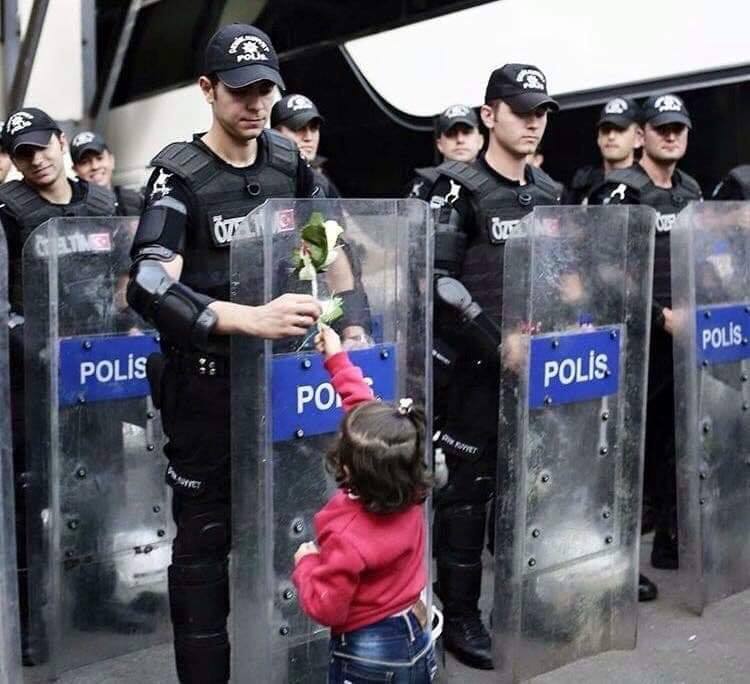
The photograph depicts a line of Turkish police officers in full riot gear, shields displaying "POLİS" (police in Turkish). They appear to be forming a barrier, facing outward. In front of them, a young child (appearing to be a girl) is reaching up towards one of the officers, offering a single, small bouquet of flowers. The child is facing upwards at the officer. The officer is not responding. The background is somewhat blurred, hinting at a possibly urban setting, and a large metal structure is partially visible above the officers. The overall impression is stark, contrasting the hard, imposing physicality of the police with the smallness and vulnerability of the child, and the symbolism of the flowers. The image has a strong emotional charge due to this juxtaposition.
Foucauldian Genealogical Discourse Analysis
This image is ripe for a Foucauldian reading. The 'POLİS' emblazoned on the shields isn't merely an identifier; it's a manifestation of discourse and power/knowledge. Foucault argues that power isn't simply repressive, but productive – it shapes our understanding of the world and defines norms. The "POLİS" on the shields constructs the police as a legitimate authority, defining the boundaries of acceptable behavior and asserting control over the population.
The riot gear itself is discourse. It's a visual language communicating authority, threat, and the expectation of potential conflict. It normalizes the presence of force as a standard element of public order.
The child's offering of flowers disrupts this discourse. Flowers, conventionally associated with peace, love, and innocence, are fundamentally outside the discourse of riot control and state force. The officer's lack of acknowledgement is crucial. The act of not responding reinforces the power dynamic. The child's gesture isn't incorporated into the established discourse, but rather contained by it, rendered irrelevant. This containment is an act of power. The image reveals how discourses are not monolithic; they are constantly being challenged and reinforced, often in subtle ways. Foucault's idea of 'governmentality' – how populations are governed through techniques that shape conduct – is clearly at play here.
Critical Theory (Frankfurt School)
From a Critical Theory perspective, particularly informed by the Frankfurt School, this image can be understood as a commentary on the "instrumental rationality" of modern power. The police, as representatives of the state, are operating according to a logic of control and order, prioritising system maintenance over individual humanity. The officers are instruments of a larger, perhaps dehumanising, system.
The child's offering of flowers represents a different kind of rationality – a morality based on empathy, care, and the desire for connection. This is suppressed and ignored. The image highlights the alienation inherent in modern society. The police, disconnected from the emotional world of the child, embody the dehumanising effects of bureaucracy and rationalisation.
The image hints at a broader critique of consumer culture. Flowers, as commodities, are symbolic of a system where even gestures of affection and goodwill are commodified. Yet the child's sincere offering cuts through the commodification, making the indifference of the police all the more stark.
Marxist Conflict Theory
From a Marxist viewpoint, the image can be interpreted as a representation of class conflict and state repression. The police, as agents of the ruling class, are maintaining the status quo and suppressing any potential challenge to it. The officers are there to protect the interests of the powerful, even if it means ignoring or silencing the voices of the marginalized.
While the child's social class isn’t immediately evident, the image represents the vulnerability of the powerless in the face of state power. The flowers can be seen as a symbolic attempt to bridge the gap between the oppressors and the oppressed, but the officer's lack of response reinforces the inherent inequality of the power dynamic. The image exposes the violence embedded in social structures, where those in power are willing to use force to maintain their dominance. The suppression of a simple gesture of peace can be seen as a microcosm of the broader oppression faced by the working class and other marginalized groups.
Postmodernism
A postmodern reading of this image focuses on the breakdown of grand narratives and the instability of meaning. The traditional narrative of the police as protectors of the public is challenged by the image's stark contrast. The officer's response isn’t consistent with this narrative. There is a disjunction between what the police should do (accept the gesture) and what they actually do (ignore it).
The meaning of the flowers is also destabilized. While conventionally symbols of peace, they are rendered powerless in the face of state force. The image highlights the constructed nature of meaning and the fluidity of identity. The police officer isn't simply an officer; they are a performative role, enacting a script of authority and control. The image exposes the simulacrum– a copy without an original– in this particular interaction. The gesture of peace becomes merely a signifier, devoid of genuine connection.
Queer Feminist Intersectional Analysis
This is the least directly applicable theory here, but still offers insight. The child's vulnerability and the officer's unresponsiveness can be seen as a reflection of patriarchal power dynamics. The child, often seen as embodying innocence and vulnerability, is subjected to the authority of a male-dominated institution. The image can be interpreted as a metaphor for the silencing of marginalized voices, particularly those of women and children, who are often denied agency and recognition.
An intersectional approach acknowledges that the child's experience may be shaped by multiple forms of oppression, including gender, class, and possibly ethnicity or nationality (depending on the context of the image). The officer's refusal to acknowledge the gesture can be seen as a manifestation of systemic inequalities and the ways in which power is used to maintain those inequalities. The image challenges the traditional notion of "protection" and reveals how those in power can perpetuate harm even while claiming to maintain order.
Let me know if you'd like me to elaborate on any of these points or explore additional theoretical frameworks.
simple-description (llama3.2-vision)
The meme is a photo of a child holding up a flower to a police officer, who is standing behind a riot shield. The text "I can smell the desperation" appears in the image. The image is a humorous commentary on the contrast between the child's innocent gesture and the police officer's intimidating presence.
tesseract-ocr
ian 4 j oN . oh er ee <5 poe Se ns we * al Sia a) Ow aah oe a2. ae ate Co \ Se ee : in 4 = hcl Aes oo U ie =| OT , E - =